 VIPSolutions
Give step-by-step solution with explanation and final answer:In the figure, take R1 = 3.00 kQ, R= 2.00 kQ, R3=8.00 kQ and € 1=77.0V,e2=57.0V,€3=77.0V. Using Kirchhoff's rules, find the current in resistor R 3 in Figure. (Your result must be in mAs. Include 2 digit after the decimal point and maximum of 5% of error is accepted in your answer.) » I Rs d £ & & Ry | LE Yi e
Question:
Give step-by-step solution with explanation and final answer: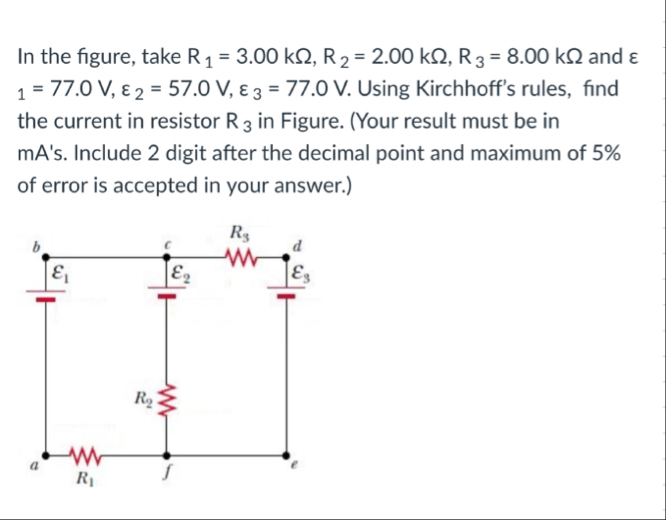 In the figure, take R1 = 3.00 kQ, R= 2.00 kQ, R3=8.00 kQ and €
1=77.0V,e2=57.0V,€3=77.0V. Using Kirchhoff's rules, find
the current in resistor R 3 in Figure. (Your result must be in
mAs. Include 2 digit after the decimal point and maximum of 5%
of error is accepted in your answer.)
» I Rs d
£ & &
Ry |
LE Yi e
This is AI generated Response.
Asked by: gvr
Created at: 2025-06-19 19:13:15
Asked by: gvr
Created at: 2025-06-19 19:13:15
Final Answer:
Rendered
Raw Text
Did you like this answer?
Given:
- \( R_1 = 3.00~k\Omega \)
- \( R_2 = 2.00~k\Omega \)
- \( R_3 = 8.00~k\Omega \)
- \( \epsilon_1 = 77.0~V \)
- \( \epsilon_2 = 57.0~V \)
- \( \epsilon_3 = 77.0~V \)
Let's use Kirchhoff's rules:
Let the currents in each branch be:
- \( I_1 \) through \( R_1 \) (from a to b)
- \( I_2 \) through \( R_2 \) (from f to c)
- \( I_3 \) through \( R_3 \) (from c to d)
**Junction Rule at point c:**
\[
I_1 = I_2 + I_3
\]
### 1. Loop 1: \( a \to f \to c \to b \to a \)
\[
-\epsilon_1 + I_1 R_1 + I_2 R_2 + \epsilon_2 = 0
\]
\[
I_1 R_1 + I_2 R_2 = \epsilon_1 - \epsilon_2
\]
\[
3I_1 + 2I_2 = 77 - 57 = 20 \quad \text{(in kΩ and V)}
\]
\[
3I_1 + 2I_2 = 20 \tag{1}
\]
### 2. Loop 2: \( c \to d \to e \to f \to c \)
\[
-\epsilon_2 + I_3 R_3 - \epsilon_3 - I_2 R_2 = 0
\]
\[
I_3 R_3 - I_2 R_2 = \epsilon_2 + \epsilon_3
\]
\[
8I_3 - 2I_2 = 57 + 77 = 134
\]
\[
8I_3 - 2I_2 = 134 \tag{2}
\]
### 3. Loop 3: \( a \to b \to c \to d \to e \to f \to a \)
Alternatively, use the two equations above and the junction equation:
\[
I_1 = I_2 + I_3 \implies I_2 = I_1 - I_3
\]
### Substitute \( I_2 = I_1 - I_3 \) into (1) and (2):
From (1):
\[
3I_1 + 2(I_1 - I_3) = 20
\]
\[
3I_1 + 2I_1 - 2I_3 = 20
\]
\[
5I_1 - 2I_3 = 20 \tag{3}
\]
From (2):
\[
8I_3 - 2(I_1 - I_3) = 134
\]
\[
8I_3 - 2I_1 + 2I_3 = 134
\]
\[
10I_3 - 2I_1 = 134 \tag{4}
\]
### Now solve equations (3) and (4):
From (3): \( 5I_1 - 2I_3 = 20 \)
From (4): \( -2I_1 + 10I_3 = 134 \)
Multiply (3) by 5:
\[
25I_1 - 10I_3 = 100
\]
Add (4):
\[
(25I_1 - 10I_3) + (-2I_1 + 10I_3) = 100 + 134 \\
23I_1 = 234 \\
I_1 = \frac{234}{23} = 10.174~\text{mA}
\]
Plug \( I_1 \) into (3):
\[
5(10.174) - 2I_3 = 20 \\
50.87 - 2I_3 = 20 \\
-2I_3 = 20 - 50.87 = -30.87 \\
I_3 = \frac{30.87}{2} = 15.44~\text{mA}
\]
### **Final Answer:**
**The current in resistor \( R_3 \) is:**
\[
\boxed{15.44~\text{mA}}
\]
**(to two decimal places, as required)**
---
If you need the direction:
- The result is positive, so the current flows from \( c \) to \( d \) through \( R_3 \) as per our assumed direction.
📢 Instructions:
- Ask anything relatd to above question only.
- For new Question goto :