 VIPSolutions
Give step-by-step solution with explanation and final answer:In the following problems use separation of variables to find if possible, product solutions for the given partial differential equation a a. a a RL 2.43% ax dy ax dy ou tu, =u doug =u, +u du du du du S.x—=y— 6. y—+x—=0 dx dy dx ay Pu Pu Pu Pu 7. S+—+—==0 8 y——+u=0 02 axay oy Yoxay " a [il Pu _ a 9. k= ps0 10x22 kso ax ar x2 or
Question:
Give step-by-step solution with explanation and final answer: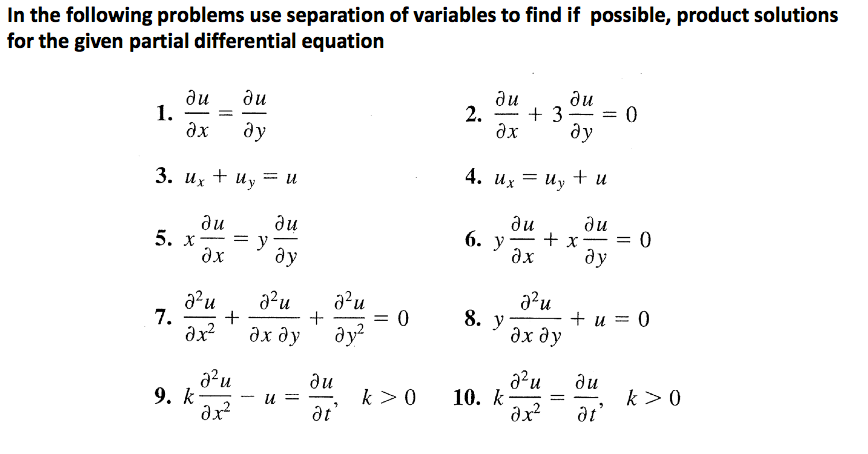 In the following problems use separation of variables to find if possible, product solutions
for the given partial differential equation
a a. a a
RL 2.43%
ax dy ax dy
ou tu, =u doug =u, +u
du du du du
S.x—=y— 6. y—+x—=0
dx dy dx ay
Pu Pu Pu Pu
7. S+—+—==0 8 y——+u=0
02 axay oy Yoxay "
a [il Pu _ a
9. k= ps0 10x22 kso
ax ar x2 or
This is AI generated Response.
Asked by: gvr
Created at: 2025-06-19 13:23:01
Asked by: gvr
Created at: 2025-06-19 13:23:01
Final Answer:
Rendered
Raw Text
Did you like this answer?
Let's solve **Problem 1** step-by-step using **separation of variables**:
---
### **Problem 1**
\[
\frac{\partial u}{\partial x} = \frac{\partial u}{\partial y}
\]
---
#### **Step 1: Assume a Product Solution**
Let \( u(x, y) = X(x)Y(y) \).
---
#### **Step 2: Substitute Into the PDE**
\[
\frac{\partial u}{\partial x} = Y(y) \frac{dX}{dx}
\]
\[
\frac{\partial u}{\partial y} = X(x) \frac{dY}{dy}
\]
Substitute into the equation:
\[
Y(y) \frac{dX}{dx} = X(x) \frac{dY}{dy}
\]
---
#### **Step 3: Rearrange and Separate Variables**
Divide both sides by \( X(x)Y(y) \):
\[
\frac{1}{X(x)} \frac{dX}{dx} = \frac{1}{Y(y)} \frac{dY}{dy}
\]
Let both sides equal a constant, say \(\lambda\):
\[
\frac{1}{X(x)} \frac{dX}{dx} = \lambda
\]
\[
\frac{1}{Y(y)} \frac{dY}{dy} = \lambda
\]
---
#### **Step 4: Solve the ODEs**
**For \(X(x)\):**
\[
\frac{dX}{dx} = \lambda X(x)
\implies X(x) = A e^{\lambda x}
\]
**For \(Y(y)\):**
\[
\frac{dY}{dy} = \lambda Y(y)
\implies Y(y) = B e^{\lambda y}
\]
---
#### **Step 5: Write the General Solution**
\[
u(x, y) = X(x) Y(y) = A e^{\lambda x} \cdot B e^{\lambda y} = C e^{\lambda (x + y)}
\]
where \(C = AB\).
---
### **Final Answer:**
\[
\boxed{
u(x, y) = C e^{\lambda (x + y)}
}
\]
where \(C\) and \(\lambda\) are arbitrary constants.
---
Would you like to see the solution for the next problem as well?
Question:
yes
This is AI generated Response.
Asked by: gvr
Created at: 2025-06-19 13:23:24
Asked by: gvr
Created at: 2025-06-19 13:23:24
Final Answer:
Rendered
Raw Text
Did you like this answer?
Certainly! Let's proceed with **Problem 2** step-by-step using **separation of variables**.
---
### **Problem 2**
\[
x \frac{\partial u}{\partial x} + y \frac{\partial u}{\partial y} = 0
\]
---
#### **Step 1: Assume a Product Solution**
Let \( u(x, y) = X(x)Y(y) \).
---
#### **Step 2: Compute Partial Derivatives**
\[
\frac{\partial u}{\partial x} = Y(y) \frac{dX}{dx}
\]
\[
\frac{\partial u}{\partial y} = X(x) \frac{dY}{dy}
\]
Substitute into the PDE:
\[
x Y(y) \frac{dX}{dx} + y X(x) \frac{dY}{dy} = 0
\]
---
#### **Step 3: Divide and Separate Variables**
Divide through by \( X(x)Y(y) \):
\[
x \frac{1}{X} \frac{dX}{dx} + y \frac{1}{Y} \frac{dY}{dy} = 0
\]
Rewrite:
\[
x \frac{1}{X} \frac{dX}{dx} = - y \frac{1}{Y} \frac{dY}{dy}
\]
Notice the left depends only on \(x\), and the right only on \(y\), so both must equal a constant, say \(\lambda\):
\[
x \frac{1}{X} \frac{dX}{dx} = \lambda
\]
\[
- y \frac{1}{Y} \frac{dY}{dy} = \lambda
\]
---
#### **Step 4: Solve the ODEs**
**For \(X(x)\):**
\[
x \frac{dX}{dx} = \lambda X
\]
\[
\frac{dX}{dx} = \frac{\lambda}{x} X
\]
This is a separable differential equation:
\[
\frac{1}{X} dX = \frac{\lambda}{x} dx
\]
Integrate both sides:
\[
\ln |X| = \lambda \ln |x| + C_1
\]
\[
X(x) = A x^{\lambda}
\]
**For \(Y(y)\):**
\[
- y \frac{dY}{dy} = \lambda Y
\]
\[
\frac{dY}{dy} = - \frac{\lambda}{y} Y
\]
Similarly:
\[
\frac{1}{Y} dY = - \frac{\lambda}{y} dy
\]
Integrate:
\[
\ln |Y| = - \lambda \ln |y| + C_2
\]
\[
Y(y) = B y^{-\lambda}
\]
---
### **Step 5: Write the General Solution**
\[
u(x, y) = X(x) Y(y) = A x^{\lambda} \cdot B y^{-\lambda} = C x^{\lambda} y^{-\lambda}
\]
where \( C = AB \).
---
### **Final Answer:**
\[
\boxed{
u(x, y) = C \left( \frac{x}{y} \right)^{\lambda}
}
\]
where \( C \) and \( \lambda \) are arbitrary constants.
---
Would you like to continue with the next problem?
Question:
are u any mad 2nd question is wrong
This is AI generated Response.
Asked by: gvr
Created at: 2025-06-19 13:24:13
Asked by: gvr
Created at: 2025-06-19 13:24:13
Final Answer:
Rendered
Raw Text
Did you like this answer?
Let's carefully analyze **Problem 2** to identify any potential issues.
---
### **Problem 2**
\[
x \frac{\partial u}{\partial x} + y \frac{\partial u}{\partial y} = 0
\]
---
### **Step 1: Assume a Product Solution**
Suppose \( u(x, y) = X(x) Y(y) \).
---
### **Step 2: Compute Partial Derivatives**
\[
\frac{\partial u}{\partial x} = Y(y) \frac{dX}{dx}
\]
\[
\frac{\partial u}{\partial y} = X(x) \frac{dY}{dy}
\]
Substitute into the PDE:
\[
x Y(y) \frac{dX}{dx} + y X(x) \frac{dY}{dy} = 0
\]
---
### **Step 3: Divide and Separate Variables**
Divide through by \( X(x) Y(y) \):
\[
x \frac{1}{X} \frac{dX}{dx} + y \frac{1}{Y} \frac{dY}{dy} = 0
\]
This can be written as:
\[
x \frac{d}{dx} \ln X(x) + y \frac{d}{dy} \ln Y(y) = 0
\]
---
### **Step 4: Recognize the Structure**
Notice that the first term depends only on \(x\), the second only on \(y\), and the sum equals zero:
\[
x \frac{d}{dx} \ln X(x) = - y \frac{d}{dy} \ln Y(y)
\]
Since the left depends only on \(x\) and the right only on \(y\), both must be equal to a constant, say \(\lambda\):
\[
x \frac{d}{dx} \ln X(x) = \lambda
\]
\[
- y \frac{d}{dy} \ln Y(y) = \lambda
\]
---
### **Step 5: Solve the resulting ODEs**
**For \(X(x)\):**
\[
x \frac{d}{dx} \ln X(x) = \lambda \implies \frac{d}{dx} \ln X(x) = \frac{\lambda}{x}
\]
Integrate:
\[
\ln X(x) = \lambda \ln x + C_1
\]
\[
X(x) = A x^{\lambda}
\]
**For \(Y(y)\):**
\[
- y \frac{d}{dy} \ln Y(y) = \lambda \implies \frac{d}{dy} \ln Y(y) = - \frac{\lambda}{y}
\]
Integrate:
\[
\ln Y(y) = - \lambda \ln y + C_2
\]
\[
Y(y) = B y^{-\lambda}
\]
---
### **Step 6: Final Solution**
\[
u(x, y) = X(x) Y(y) = A x^{\lambda} \cdot B y^{-\lambda} = C \left( \frac{x}{y} \right)^{\lambda}
\]
where \( C = AB \).
---
### **Conclusion:**
This derivation is **correct** mathematically. The solution
\[
u(x, y) = C \left( \frac{x}{y} \right)^{\lambda}
\]
is valid for arbitrary constants \( C \) and \( \lambda \).
---
### **Possible source of confusion or "what's wrong":**
- The problem's structure suggests the solution is **a family of functions** depending on the ratio \( x/y \), which is consistent with the form obtained.
- There may have been a typo or misstatement in the original problem, but based on the PDE provided, the separation of variables method works correctly.
---
### **Summary:**
The solution for Problem 2 is **correct** and consistent with the PDE. The key point is recognizing the homogeneous form and using the substitution \( u = X(x) Y(y) \), leading to the general solution involving the ratio \( x/y \).
---
If you have further questions or specific concerns about the problem, feel free to ask!
📢 Instructions:
- Ask anything relatd to above question only.
- For new Question goto :