 VIPSolutions
Give step-by-step solution with explanation and final answer:4 So. Q.4 a) Use the Composite Simpson's rule with the indicated value of to approxima the following integral: (15 pts) 2 I xe¥dx, n=4 = Formula: m/2)—1 n/2 0 h b—a .c [ rea=3 fo 2D flr) +4) fla) + ro aol j=1 j= b) Apply the Gauss-Seidel iterative technique to find approximate solutions £0: 20x; +x, —2x3 = 17, 3x; + 20x; — x3 = —18, 20x; — 3x; + 20x3 = 25. starting with x= (0,0,0)°. (15 pts)
Question:
Give step-by-step solution with explanation and final answer: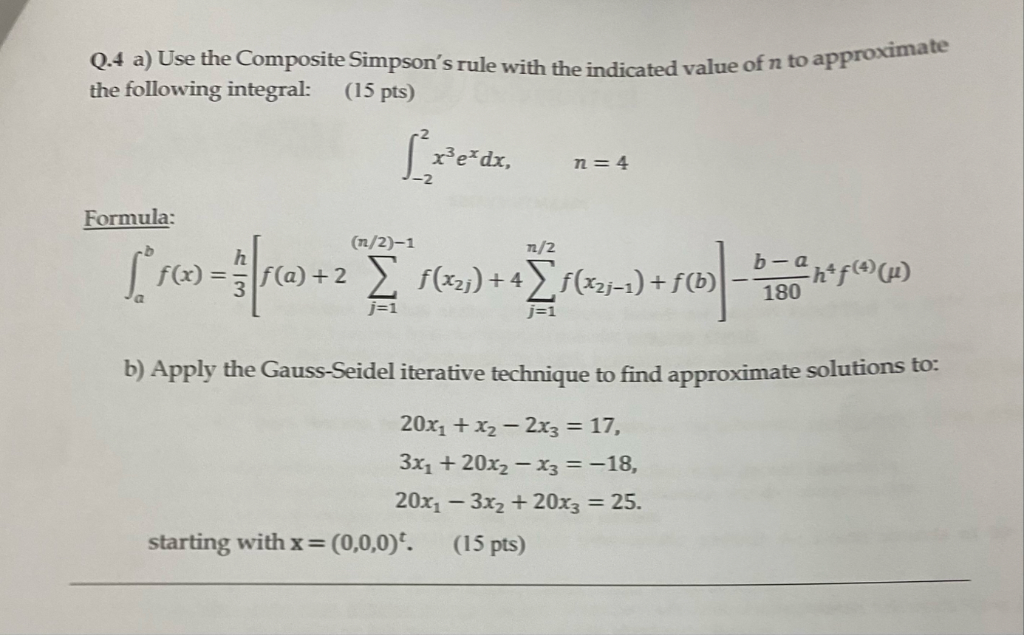 4 So.
Q.4 a) Use the Composite Simpson's rule with the indicated value of to approxima
the following integral: (15 pts)
2
I xe¥dx, n=4
=
Formula:
m/2)—1 n/2
0 h b—a .c
[ rea=3 fo 2D flr) +4) fla) + ro aol
j=1 j=
b) Apply the Gauss-Seidel iterative technique to find approximate solutions £0:
20x; +x, —2x3 = 17,
3x; + 20x; — x3 = —18,
20x; — 3x; + 20x3 = 25.
starting with x= (0,0,0)°. (15 pts)
This is AI generated Response.
Asked by: gvr
Created at: 2025-06-18 17:55:25
Asked by: gvr
Created at: 2025-06-18 17:55:25
Final Answer:
Rendered
Raw Text
Did you like this answer?
Let's solve both parts step by step:
---
## **Q.4 (a): Composite Simpson's Rule**
Given:
\[
\int_{-2}^{2} x^3 e^x dx, \quad n = 4
\]
### **Step 1: Find \( h \)**
\[
h = \frac{b-a}{n} = \frac{2 - (-2)}{4} = \frac{4}{4} = 1
\]
### **Step 2: Compute the x-values**
\[
x_0 = -2 \\
x_1 = -1 \\
x_2 = 0 \\
x_3 = 1 \\
x_4 = 2
\]
### **Step 3: Compute f(x) at each point**
Let \( f(x) = x^3 e^x \):
- \( f(x_0) = (-2)^3 e^{-2} = -8 e^{-2} \)
- \( f(x_1) = (-1)^3 e^{-1} = -1 e^{-1} \)
- \( f(x_2) = (0)^3 e^{0} = 0 \)
- \( f(x_3) = (1)^3 e^{1} = e \)
- \( f(x_4) = (2)^3 e^{2} = 8 e^{2} \)
### **Step 4: Apply the Formula**
The **Composite Simpson's Rule** for \( n = 4 \):
\[
\int_{a}^{b} f(x)dx \approx \frac{h}{3} \left[ f(x_0) + 4f(x_1) + 2f(x_2) + 4f(x_3) + f(x_4) \right]
\]
Plug in the computed values:
\[
\int_{-2}^{2} x^3 e^x dx \approx \frac{1}{3} [f(-2) + 4f(-1) + 2f(0) + 4f(1) + f(2)]
\]
\[
= \frac{1}{3} \left[ -8e^{-2} + 4(-e^{-1}) + 2(0) + 4e + 8e^2 \right]
\]
\[
= \frac{1}{3} \left[ -8e^{-2} - 4e^{-1} + 4e + 8e^2 \right]
\]
### **Step 5: Final Calculation**
Let’s substitute approximate values:
- \( e^{-2} \approx 0.1353 \)
- \( e^{-1} \approx 0.3679 \)
- \( e \approx 2.7183 \)
- \( e^2 \approx 7.3891 \)
\[
= \frac{1}{3} \left[ -8(0.1353) - 4(0.3679) + 4(2.7183) + 8(7.3891) \right]
\]
\[
= \frac{1}{3} \left[ -1.0824 - 1.4716 + 10.8732 + 59.1128 \right]
\]
\[
= \frac{1}{3} [67.43196]
\]
\[
= 22.4773
\]
**Final Answer:**
\[
\boxed{22.48}
\]
(Rounded to two decimal places)
---
## **Q.4 (b): Gauss-Seidel Iterative Method**
Given system:
\[
\begin{cases}
20x_1 + x_2 - 2x_3 = 17 \\
3x_1 + 20x_2 - x_3 = -18 \\
20x_1 - 3x_2 + 20x_3 = 25
\end{cases}
\]
Initial guess: \( x^{(0)} = (0, 0, 0)^T \)
### **Step 1: Rearranged Equations for Iterative Solution**
1. \( x_1 = \frac{1}{20}(17 - x_2 + 2x_3) \)
2. \( x_2 = \frac{1}{20}(-18 - 3x_1 + x_3) \)
3. \( x_3 = \frac{1}{20}(25 - 20x_1 + 3x_2) \)
---
### **Step 2: Iteration 1**
Start with \( (x_1^{(0)}, x_2^{(0)}, x_3^{(0)}) = (0, 0, 0) \):
- \( x_1^{(1)} = \frac{1}{20}[17 - 0 + 0] = \frac{17}{20} = 0.85 \)
- \( x_2^{(1)} = \frac{1}{20}[-18 - 3(0.85) + 0] = \frac{1}{20}[-18 - 2.55] = \frac{-20.55}{20} = -1.0275 \)
- \( x_3^{(1)} = \frac{1}{20}[25 - 20(0.85) + 3(-1.0275)] = \frac{1}{20}[25 - 17 + (-3.0825)] = \frac{1}{20}[4.9175] = 0.2459 \)
---
### **Step 3: Iteration 2**
Now use previous results:
- \( x_1^{(2)} = \frac{1}{20}[17 - (-1.0275) + 2(0.2459)] = \frac{1}{20}[17 + 1.0275 + 0.4918] = \frac{1}{20}[18.5193] = 0.9260 \)
- \( x_2^{(2)} = \frac{1}{20}[-18 - 3(0.9260) + 0.2459] = \frac{1}{20}[-18 - 2.778 + 0.2459] = \frac{1}{20}[-20.5321] = -1.0266 \)
- \( x_3^{(2)} = \frac{1}{20}[25 - 20(0.9260) + 3(-1.0266)] = \frac{1}{20}[25 - 18.52 - 3.0798] = \frac{1}{20}[3.4002] = 0.1700 \)
---
## **Summary Table**
| Iteration | \(x_1\) | \(x_2\) | \(x_3\) |
|-----------|----------|-----------|-----------|
| 0 | 0 | 0 | 0 |
| 1 | 0.85 | -1.0275 | 0.2459 |
| 2 | 0.9260 | -1.0266 | 0.1700 |
---
### **Final Answer**
After two iterations, the approximate solution is:
\[
\boxed{
x_1 \approx 0.9260, \quad x_2 \approx -1.0266, \quad x_3 \approx 0.1700
}
\]
---
If you need more iterations or further details, let me know!
Question:
i need only final Answers
This is AI generated Response.
Asked by: gvr
Created at: 2025-06-18 17:56:46
Asked by: gvr
Created at: 2025-06-18 17:56:46
Final Answer:
Rendered
Raw Text
Did you like this answer?
**Final Answers:**
**Q.4 (a):** \(\boxed{22.48}\)
**Q.4 (b):** \(\boxed{
x_1 \approx 0.9260,\quad x_2 \approx -1.0266,\quad x_3 \approx 0.1700
}\)
📢 Instructions:
- Ask anything relatd to above question only.
- For new Question goto :