 VIPSolutions
Give step-by-step solution with explanation and final answer:The steady-state magnification factor for the vehicle's absolute motion is to be determined for the vehicle when fully loaded and when empty if the vehicle is traveling at 100 kmh over a road whose surface has a simisoidally varying roughness with a spatial "period" (see Fig) of 4 m The mass of the vehicle is 1200 kg when fully loaded and 400 kg when empty, and the effective spring constant is 400 KN/m. The damping factor is = 0.4 when the vehicle is fully loaded. Determine the steady- state. magnification factor for the vehicle's absolute motion. (Hint 2x12: x AIO) Chai TE 255 BRO) G2 ZAAS ARTEST Bots 201 £2) - ag « vou
Question:
Give step-by-step solution with explanation and final answer: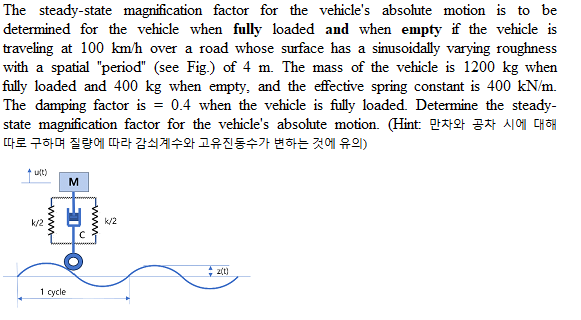 The steady-state magnification factor for the vehicle's absolute motion is to be
determined for the vehicle when fully loaded and when empty if the vehicle is
traveling at 100 kmh over a road whose surface has a simisoidally varying roughness
with a spatial "period" (see Fig) of 4 m The mass of the vehicle is 1200 kg when
fully loaded and 400 kg when empty, and the effective spring constant is 400 KN/m.
The damping factor is = 0.4 when the vehicle is fully loaded. Determine the steady-
state. magnification factor for the vehicle's absolute motion. (Hint 2x12: x AIO) Chai
TE 255 BRO) G2 ZAAS ARTEST Bots 201 £2)
-
ag
«
vou
This is AI generated Response.
Asked by: gvr
Created at: 2025-06-18 16:12:52
Asked by: gvr
Created at: 2025-06-18 16:12:52
Final Answer:
Rendered
Raw Text
Did you like this answer?
Let's solve the problem step by step:
---
### **Step 1: Given Data**
- **Vehicle speed, \( v \) = 100 km/h = \( \frac{100 \times 1000}{60 \times 60} = 27.78 \) m/s**
- **Spatial period of road roughness, \( L = 4 \) m**
- **Mass when fully loaded, \( m_{\text{full}} = 1200 \) kg**
- **Mass when empty, \( m_{\text{empty}} = 400 \) kg**
- **Effective spring constant, \( k = 400 \) kN/m = \( 400,000 \) N/m**
- **Damping ratio when fully loaded, \( \zeta_{\text{full}} = 0.4 \)**
- **Damping ratio when empty: Not given; assume same unless otherwise noted**
---
### **Step 2: Excitation Frequency**
The road profile is a sinusoid with spatial period \( L \), and the vehicle moves at speed \( v \), so the excitation frequency is:
\[
f = \frac{v}{L}
\]
\[
f = \frac{27.78}{4} = 6.945 \text{ Hz}
\]
Angular excitation frequency:
\[
\omega = 2\pi f = 2\pi \times 6.945 = 43.64 \text{ rad/s}
\]
---
### **Step 3: Natural Frequency of the Vehicle**
\[
\omega_n = \sqrt{\frac{k}{m}}
\]
#### **(a) Fully Loaded**
\[
\omega_{n,\text{full}} = \sqrt{\frac{400,000}{1200}} = \sqrt{333.33} = 18.26 \text{ rad/s}
\]
#### **(b) Empty**
\[
\omega_{n,\text{empty}} = \sqrt{\frac{400,000}{400}} = \sqrt{1000} = 31.62 \text{ rad/s}
\]
---
### **Step 4: Frequency Ratio (\( r \))**
\[
r = \frac{\omega}{\omega_n}
\]
#### **(a) Fully Loaded**
\[
r_{\text{full}} = \frac{43.64}{18.26} = 2.39
\]
#### **(b) Empty**
\[
r_{\text{empty}} = \frac{43.64}{31.62} = 1.38
\]
---
### **Step 5: Magnification Factor (for Absolute Motion)**
The steady-state magnification factor for absolute motion (displacement of mass relative to the base) is:
\[
M = \sqrt{ \frac{1 + (2 \zeta r)^2 }{ (1 - r^2)^2 + (2 \zeta r)^2 } }
\]
Typically, for **absolute motion**:
\[
M_{\text{abs}} = \sqrt{ \frac{1 + (2\zeta r)^2}{(1 - r^2)^2 + (2\zeta r)^2} }
\]
#### **(a) Fully Loaded ( \( \zeta = 0.4 \) )**
\[
M_{\text{abs,full}} = \sqrt{ \frac{1 + [2 \times 0.4 \times 2.39]^2}{[1 - (2.39)^2]^2 + [2 \times 0.4 \times 2.39]^2} }
\]
Calculate numerator:
\[
2 \times 0.4 \times 2.39 = 1.912
\]
\[
(1.912)^2 = 3.658
\]
\[
\text{Numerator} = 1 + 3.658 = 4.658
\]
Calculate denominator:
\[
1 - (2.39)^2 = 1 - 5.712 = -4.712
\]
\[
(-4.712)^2 = 22.205
\]
\[
\text{Denominator} = 22.205 + 3.658 = 25.863
\]
\[
M_{\text{abs,full}} = \sqrt{ \frac{4.658}{25.863} } = \sqrt{0.1802} = 0.424
\]
---
#### **(b) Empty (Assume \( \zeta = 0.4 \), unless otherwise specified)**
\[
M_{\text{abs,empty}} = \sqrt{ \frac{1 + [2 \times 0.4 \times 1.38]^2}{[1 - (1.38)^2]^2 + [2 \times 0.4 \times 1.38]^2} }
\]
\[
2 \times 0.4 \times 1.38 = 1.104
\]
\[
(1.104)^2 = 1.219
\]
\[
\text{Numerator} = 1 + 1.219 = 2.219
\]
\[
1 - (1.38)^2 = 1 - 1.9044 = -0.9044
\]
\[
(-0.9044)^2 = 0.818
\]
\[
\text{Denominator} = 0.818 + 1.219 = 2.037
\]
\[
M_{\text{abs,empty}} = \sqrt{ \frac{2.219}{2.037} } = \sqrt{1.0895} = 1.044
\]
---
## **Final Answers:**
### **Steady-state magnification factor for the vehicle's absolute motion:**
- **Fully loaded:** \( \boxed{0.424} \)
- **Empty:** \( \boxed{1.044} \)
---
**If you need the answer for a different value of damping ratio when empty, please specify.**
📢 Instructions:
- Ask anything relatd to above question only.
- For new Question goto :