 VIPSolutions
Give step-by-step solution with explanation and final answer:Exercise 1.6.3: Consider x" = x2. a) Draw the phase diagram, find the critical points, and mark them stable or unstable. b) Sketch typical solutions of the equation. ¢) Find Jim x(t) for the solution with the initial condition x(0) = —1.
Question:
Give step-by-step solution with explanation and final answer: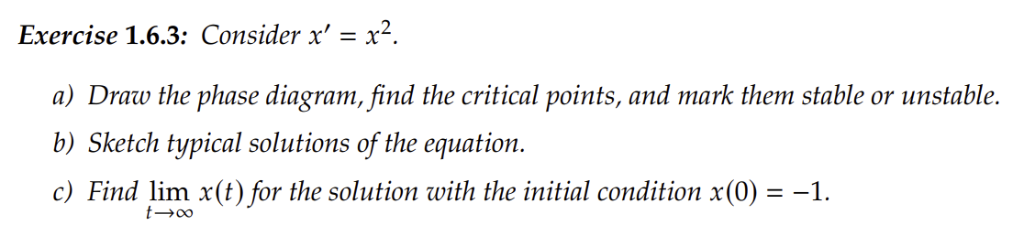 Exercise 1.6.3: Consider x" = x2.
a) Draw the phase diagram, find the critical points, and mark them stable or unstable.
b) Sketch typical solutions of the equation.
¢) Find Jim x(t) for the solution with the initial condition x(0) = —1.
This is AI generated Response.
Asked by: gvr
Created at: 2025-06-18 10:51:08
Asked by: gvr
Created at: 2025-06-18 10:51:08
Final Answer:
Rendered
Raw Text
Did you like this answer?
Let's solve each part step-by-step:
## Given:
\[
x' = x^2
\]
---
## (a) **Phase diagram, Critical points, Stability**
### **Critical points**
Critical points occur where \( x' = 0 \):
\[
x^2 = 0 \implies x = 0
\]
So, the only critical point is **\( x = 0 \)**.
### **Stability**
- For \( x > 0 \): \( x^2 > 0 \) so \( x' > 0 \) — solution moves away from 0 (increases).
- For \( x < 0 \): \( x^2 > 0 \) so \( x' > 0 \) — solution moves away from 0 (increases toward 0, but remains negative).
Thus, the critical point \( x = 0 \) is **unstable**.
### **Phase diagram**
- Draw a line for the \( x \)-axis.
- Mark the critical point at \( x = 0 \).
- Draw arrows pointing **right** (→) on both sides of \( x = 0 \) (since \( x' > 0 \) everywhere except at \( x = 0 \)).
---
## (b) **Typical Solutions**
Let's solve \( x' = x^2 \):
\[
\frac{dx}{dt} = x^2
\implies \frac{dx}{x^2} = dt
\]
Integrate both sides:
\[
\int x^{-2} dx = \int dt
\implies -x^{-1} = t + C
\implies -\frac{1}{x} = t + C
\implies x = -\frac{1}{t + C}
\]
**Typical solutions:**
- For \( x(0) > 0 \): \( x(t) \) increases and blows up to \( +\infty \) in finite time.
- For \( x(0) < 0 \): \( x(t) \) increases (becomes less negative), but stays negative and approaches 0 as \( t \to \infty \).
- For \( x(0) = 0 \): \( x(t) = 0 \) (constant solution).
---
## (c) **Limit as \( t \to \infty \) with \( x(0) = -1 \)**
From above, the solution is:
\[
x(t) = -\frac{1}{t + C}
\]
Find \( C \) using \( x(0) = -1 \):
\[
x(0) = -1 \implies -1 = -\frac{1}{0 + C} \implies 1 = \frac{1}{C} \implies C = 1
\]
So,
\[
x(t) = -\frac{1}{t + 1}
\]
Now, compute the limit:
\[
\lim_{t \to \infty} x(t) = \lim_{t \to \infty} -\frac{1}{t + 1} = 0
\]
---
## **Summary of Answers**
### **(a)**
- Critical point: \( x = 0 \) (unstable).
- Phase line: arrows pointing right everywhere except at \( x = 0 \).
### **(b)**
- General solution: \( x(t) = -\frac{1}{t + C} \)
- Solutions with \( x(0) > 0 \) blow up in finite time.
- Solutions with \( x(0) < 0 \) approach 0 from below as \( t \to \infty \).
### **(c)**
\[
\boxed{0}
\]
That is,
\[
\lim_{t \to \infty} x(t) = 0 \quad \text{for} \quad x(0) = -1.
\]
📢 Instructions:
- Ask anything relatd to above question only.
- For new Question goto :