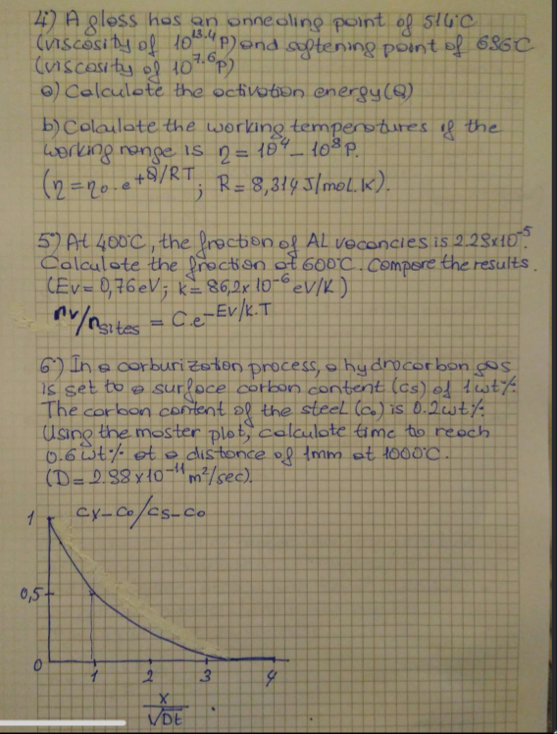
Give step-by-step solution with explanation and final answer:4) B gloss has an onnesling pont of S16'C
(isessity a] 10D ond axptening point 5 §36C-
(gcasity of 10°F)
0) Calculate he ochotion energy(Q)
B)Colailote the working temperstives (§ the.
Loring renge 1s. 0 = 16% 102%,
(p=g0 eR Rig 314 Slmet 10).
5) PH 4O0C., the Jrochibn 4 AL vocancies is 2.2807
Calculate the Jreckisa o 600C . Compare the results .
(Ev=076eV; kx R620 107% elf)
~Ev[L.T
[877 mn =Ce vi
6) In & corburizsten process, hydrocarbon gas
iKget toe butaes coton content (cs) of dwt
The corlon ¢ 4 54 the steel (ea) is 0.2 Ef
Using the master plot, calculate lime to reoch
bE LET ote distonce of Imm at 1660C
(D= 2I88¥10Mw?/gec),
Iv ley-co/fesico
+ hE |
Hii HEHE Hi iH
jSsEscasz cy HH
EHH HEH EEE HE EE EE EE
Question:
Give step-by-step solution with explanation and final answer:4) B gloss has an onnesling pont of S16'C
(isessity a] 10D ond axptening point 5 §36C-
(gcasity of 10°F)
0) Calculate he ochotion energy(Q)
B)Colailote the working temperstives (§ the.
Loring renge 1s. 0 = 16% 102%,
(p=g0 eR Rig 314 Slmet 10).
5) PH 4O0C., the Jrochibn 4 AL vocancies is 2.2807
Calculate the Jreckisa o 600C . Compare the results .
(Ev=076eV; kx R620 107% elf)
~Ev[L.T
[877 mn =Ce vi
6) In & corburizsten process, hydrocarbon gas
iKget toe butaes coton content (cs) of dwt
The corlon ¢ 4 54 the steel (ea) is 0.2 Ef
Using the master plot, calculate lime to reoch
bE LET ote distonce of Imm at 1660C
(D= 2I88¥10Mw?/gec),
Iv ley-co/fesico
+ hE |
Hii HEHE Hi iH
jSsEscasz cy HH
EHH HEH EEE HE EE EE EE
This is AI generated Response.
Asked by: gvr
Created at: 2025-06-18 09:28:30
Final Answer:
RenderedRaw Text
Did you like this answer?
Let's solve **Question 4** step by step:
---
### **4) A glass has an annealing point of 516°C (viscosity of 10¹³.⁴ P) and a softening point of 686°C (viscosity of 10⁷.⁶ P).**
#### **a) Calculate the activation energy (Q).**
Given:
- Annealing point, \( T_1 = 516°C = 789K \)
- Softening point, \( T_2 = 686°C = 959K \)
- Viscosity at \( T_1 \), \( \eta_1 = 10^{13.4} \) P
- Viscosity at \( T_2 \), \( \eta_2 = 10^{7.6} \) P
The viscosity equation:
\[
\eta = \eta_0 e^{Q/(RT)}
\]
Take logarithms:
\[
\ln \eta = \ln \eta_0 + \frac{Q}{R} \cdot \frac{1}{T}
\]
For two points:
\[
\ln \eta_1 - \ln \eta_2 = \frac{Q}{R} \left(\frac{1}{T_1} - \frac{1}{T_2}\right)
\]
\[
Q = R \cdot \frac{\ln (\eta_1/\eta_2)}{\left(\frac{1}{T_1} - \frac{1}{T_2}\right)}
\]
Plug in the values:
- \( R = 8.314 \) J/mol·K
\[
\ln (\eta_1/\eta_2) = \ln (10^{13.4}/10^{7.6}) = \ln (10^{5.8}) = 5.8 \ln 10 = 5.8 \times 2.303 = 13.357
\]
\[
\frac{1}{T_1} - \frac{1}{T_2} = \frac{1}{789} - \frac{1}{959}
\]
\[
= \frac{959 - 789}{789 \times 959}
\]
\[
= \frac{170}{756051} \approx 0.000225
\]
Now plug into Q:
\[
Q = 8.314 \times \frac{13.357}{0.000225}
\]
\[
Q \approx 8.314 \times 59364.44
\]
\[
Q \approx 493,606 \ \text{J/mol}
\]
\[
Q \approx 494 \ \text{kJ/mol}
\]
---
#### **b) Calculate the working temperatures if the working range is \( 2 \times 10^4 - 10^8 \) P.**
Let \( \eta_1 = 2 \times 10^4 \) P, \( \eta_2 = 10^8 \) P.
Again use:
\[
\ln \eta = \ln \eta_0 + \frac{Q}{R} \cdot \frac{1}{T}
\]
Set up two equations:
\[
\ln \eta_1 = \ln \eta_0 + \frac{Q}{R} \cdot \frac{1}{T_1}
\]
\[
\ln \eta_2 = \ln \eta_0 + \frac{Q}{R} \cdot \frac{1}{T_2}
\]
Subtract:
\[
\ln (\eta_2/\eta_1) = \frac{Q}{R} \left( \frac{1}{T_2} - \frac{1}{T_1} \right)
\]
\[
\ln (10^8/2 \times 10^4) = \ln (5 \times 10^3) = \ln 5 + \ln 10^3 = 1.609 + 6.908 = 8.517
\]
\[
8.517 = \frac{Q}{R} \left( \frac{1}{T_2} - \frac{1}{T_1} \right)
\]
\[
\frac{Q}{R} = \frac{493,606}{8.314} = 59,400
\]
So,
\[
8.517 = 59,400 \left( \frac{1}{T_2} - \frac{1}{T_1} \right)
\]
\[
\frac{1}{T_2} - \frac{1}{T_1} = \frac{8.517}{59,400} = 0.0001434
\]
Now, you need one more equation to solve for \( T_1 \) or \( T_2 \). Use the viscosity equation for one known point from part (a):
Let’s use \( \eta_2 = 10^8 \) at \( T_2 \):
\[
\ln 10^8 = \ln \eta_0 + \frac{Q}{R} \frac{1}{T_2}
\]
But we don't know \( \eta_0 \). To estimate, use the softening point (\( T_s = 959 K, \eta_s = 10^{7.6} \)):
\[
\ln 10^{7.6} = \ln \eta_0 + \frac{Q}{R} \frac{1}{959}
\]
\[
7.6 \times 2.303 = \ln \eta_0 + 59,400 \times \frac{1}{959}
\]
\[
17.499 = \ln \eta_0 + 61.92
\]
\[
\ln \eta_0 = 17.499 - 61.92 = -44.421
\]
Now use for \( T_2 \):
\[
\ln 10^8 = -44.421 + 59,400 \frac{1}{T_2}
\]
\[
18.420 = -44.421 + 59,400 \frac{1}{T_2}
\]
\[
18.420 + 44.421 = 59,400 \frac{1}{T_2}
\]
\[
62.841 = 59,400 \frac{1}{T_2}
\]
\[
\frac{1}{T_2} = \frac{62.841}{59,400} = 0.001058
\]
\[
T_2 = \frac{1}{0.001058} = 945 \text{ K}
\]
Now for \( T_1 \):
\[
\frac{1}{T_1} = \frac{1}{T_2} - 0.0001434 = 0.001058 - 0.0001434 = 0.0009146
\]
\[
T_1 = \frac{1}{0.0009146} = 1093 \text{ K}
\]
---
### **Final Answers**
**a) Activation energy:**
\[
Q \approx \boxed{494 \ \text{kJ/mol}}
\]
**b) Working temperature range:**
\[
\boxed{T_1 = 1093 \ \text{K} \ (820^\circ \text{C}), \quad T_2 = 945 \ \text{K} \ (672^\circ \text{C})}
\]
---
**Let me know if you'd like to see the solutions for 5 and 6 as well!**
VIPSolutions focuses on clear, step‑by‑step explanations so you can learn quickly. Whether you need an AI‑generated walkthrough or a short hint to get unstuck, each solution is organized for fast reading and easy review later.
Search similar questions, compare approaches, and bookmark the best answers for revision. Our goal is simple: quick, reliable study help that feels natural—not noisy.
 VIPSolutions
 4) B gloss has an onnesling pont of S16'C
(isessity a] 10D ond axptening point 5 §36C-
(gcasity of 10°F)
0) Calculate he ochotion energy(Q)
B)Colailote the working temperstives (§ the.
Loring renge 1s. 0 = 16% 102%,
(p=g0 eR Rig 314 Slmet 10).
5) PH 4O0C., the Jrochibn 4 AL vocancies is 2.2807
Calculate the Jreckisa o 600C . Compare the results .
(Ev=076eV; kx R620 107% elf)
~Ev[L.T
[877 mn =Ce vi
6) In & corburizsten process, hydrocarbon gas
iKget toe butaes coton content (cs) of dwt
The corlon ¢ 4 54 the steel (ea) is 0.2 Ef
Using the master plot, calculate lime to reoch
bE LET ote distonce of Imm at 1660C
(D= 2I88¥10Mw?/gec),
Iv ley-co/fesico
+ hE |
Hii HEHE Hi iH
jSsEscasz cy HH
EHH HEH EEE HE EE EE EE