 VIPSolutions
Give step-by-step solution with explanation and final answer:In Problems 9-16, compute the Fourier series for the given function f on the specified interval. Use a computer or graphing calculator to plot a few partial sums of the Fourier series. 9. f(¥)= Emi x TT se) = Hl 0 sr Ses w 1, 8=2=x
Question:
Give step-by-step solution with explanation and final answer: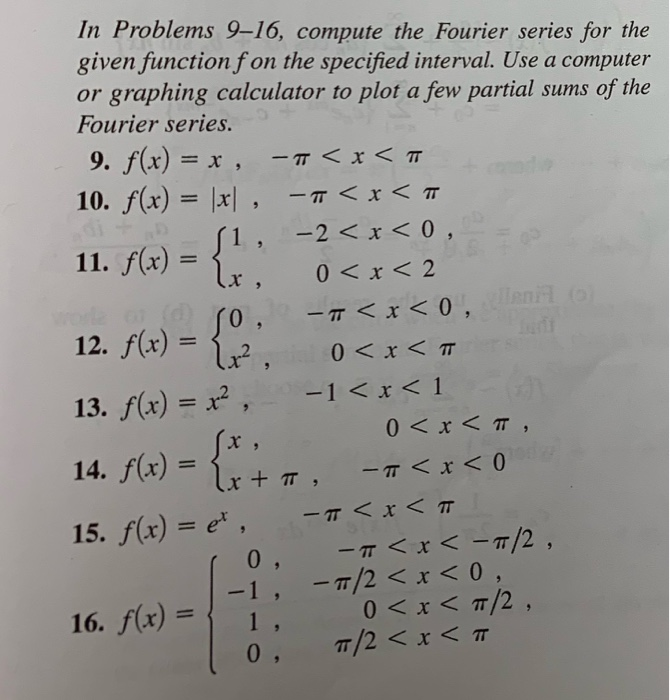 In Problems 9-16, compute the Fourier series for the
given function f on the specified interval. Use a computer
or graphing calculator to plot a few partial sums of the
Fourier series.
9. f(¥)= Emi x TT
se) = Hl 0 sr Ses w
1, 8=2=x
This is AI generated Response.
Asked by: gvr
Created at: 2025-06-18 05:58:04
Asked by: gvr
Created at: 2025-06-18 05:58:04
Final Answer:
Rendered
Raw Text
Did you like this answer?
Let's solve **Problem 9:**
\( f(x) = x, \quad -\pi < x < \pi \)
We are to **find the Fourier series** for \( f(x) \) on \([-\pi, \pi]\).
## **Step 1: Recognize the Fourier Series Form**
For a function \( f(x) \) defined on \( [-L, L] \), the Fourier Series is:
\[
f(x) = \frac{a_0}{2} + \sum_{n=1}^{\infty} \left[ a_n \cos \frac{n \pi x}{L} + b_n \sin \frac{n \pi x}{L} \right]
\]
Here \( L = \pi \), so it becomes:
\[
f(x) = \frac{a_0}{2} + \sum_{n=1}^{\infty} \left[ a_n \cos(nx) + b_n \sin(nx) \right]
\]
## **Step 2: Compute the Coefficients**
### **(a) Compute \( a_0 \):**
\[
a_0 = \frac{1}{\pi} \int_{-\pi}^{\pi} x \, dx
\]
Since \( x \) is an odd function over symmetric interval:
\[
a_0 = 0
\]
---
### **(b) Compute \( a_n \):**
\[
a_n = \frac{1}{\pi} \int_{-\pi}^{\pi} x \cos(nx) \, dx
\]
Here, \( x \cos(nx) \) is an **odd function** (since \( x \) is odd, \( \cos(nx) \) is even, so the product is odd), so:
\[
a_n = 0
\]
---
### **(c) Compute \( b_n \):**
\[
b_n = \frac{1}{\pi} \int_{-\pi}^{\pi} x \sin(nx) \, dx
\]
Here, \( x \sin(nx) \) is **even** (since both \( x \) and \( \sin(nx) \) are odd, product is even), so this integral is generally nonzero.
Compute:
\[
b_n = \frac{1}{\pi} \int_{-\pi}^{\pi} x \sin(nx) \, dx
\]
Let’s compute the integral:
Let’s use **integration by parts**:
Let \( u = x \), \( dv = \sin(nx) dx \).
Then \( du = dx \), \( v = -\frac{1}{n} \cos(nx) \).
So,
\[
\int x\sin(nx)dx = -\frac{x}{n}\cos(nx) + \int\frac{1}{n}\cos(nx)dx = -\frac{x}{n}\cos(nx) + \frac{1}{n^2}\sin(nx)
\]
So,
\[
\int_{-\pi}^{\pi} x\sin(nx)dx = \left[ -\frac{x}{n}\cos(nx) + \frac{1}{n^2}\sin(nx) \right]_{-\pi}^{\pi}
\]
Now compute at the limits:
- \(\sin(n\pi) = 0\), \(\sin(-n\pi) = 0\)
- \(\cos(n\pi) = (-1)^n\), \(\cos(-n\pi) = (-1)^n\)
So,
At \( x = \pi \):
\[
-\frac{\pi}{n}\cos(n\pi) + 0 = -\frac{\pi}{n}(-1)^n
\]
At \( x = -\pi \):
\[
+\frac{\pi}{n}\cos(-n\pi) + 0 = +\frac{\pi}{n}(-1)^n
\]
So, subtract:
\[
\left[ -\frac{x}{n}\cos(nx) \right]_{-\pi}^{\pi} = -\frac{\pi}{n}(-1)^n - \left( +\frac{\pi}{n}(-1)^n \right) = -\frac{2\pi}{n}(-1)^n
\]
Therefore,
\[
b_n = \frac{1}{\pi} \left( -\frac{2\pi}{n}(-1)^n \right) = -\frac{2}{n}(-1)^n
\]
---
## **Step 3: Write the Fourier Series**
So,
\[
f(x) = x = \sum_{n=1}^{\infty} b_n \sin(nx)
\]
with
\[
b_n = -\frac{2}{n}(-1)^n
\]
So,
\[
\boxed{
x = 2 \sum_{n=1}^{\infty} \frac{(-1)^{n+1}}{n} \sin(nx)
}
\]
**Final Answer:**
\[
\boxed{
x = 2 \sum_{n=1}^{\infty} \frac{(-1)^{n+1}}{n} \sin(nx)
}
\]
on \( -\pi < x < \pi \).
---
Let me know if you want the solution for another problem!
Question:
i need all problems please calculate
This is AI generated Response.
Asked by: gvr
Created at: 2025-06-18 06:00:04
Asked by: gvr
Created at: 2025-06-18 06:00:04
Final Answer:
Rendered
Raw Text
Did you like this answer?
Certainly! Let's carefully solve each problem from 9 to 16, providing step-by-step solutions and explanations.
---
### **Problem 9: \(f(x) = x\), \(-\pi < x < \pi\)**
**Objective:** Find the Fourier series expansion.
---
**Step 1:** Recognize the symmetry of \(f(x)\):
- \(f(x) = x\) is an **odd** function.
- Its Fourier series on \([- \pi, \pi]\) will contain only sine terms (since cosine terms correspond to even functions).
---
**Step 2:** Fourier series form:
\[
f(x) = \sum_{n=1}^\infty b_n \sin(n x)
\]
with
\[
b_n = \frac{1}{\pi} \int_{-\pi}^\pi x \sin(n x) dx
\]
---
**Step 3:** Compute \(b_n\):
Integral:
\[
b_n = \frac{1}{\pi} \int_{-\pi}^\pi x \sin(n x) dx
\]
Since \(x \sin(n x)\) is an **even** function (\(x\) odd, \(\sin(n x)\) odd, product even), we can write:
\[
b_n = \frac{2}{\pi} \int_0^{\pi} x \sin(n x) dx
\]
---
**Step 4:** Compute the integral:
\[
I = \int_0^{\pi} x \sin(n x) dx
\]
Use **integration by parts**:
- \(u = x \Rightarrow du = dx\)
- \(dv = \sin(n x) dx \Rightarrow v = -\frac{1}{n} \cos(n x)\)
Then:
\[
I = uv - \int v du = -\frac{x}{n} \cos(n x) + \frac{1}{n} \int \cos(n x) dx
\]
\[
I = -\frac{x}{n} \cos(n x) + \frac{1}{n^2} \sin(n x)
\]
Evaluate from 0 to \(\pi\):
At \(x = \pi\):
\[
-\frac{\pi}{n} \cos(n \pi) + \frac{1}{n^2} \sin(n \pi)
\]
\(\sin(n \pi) = 0\), \(\cos(n \pi) = (-1)^n\), so:
\[
-\frac{\pi}{n} (-1)^n
\]
At \(x=0\):
\[
0 + 0 = 0
\]
Thus,
\[
I = -\frac{\pi}{n} (-1)^n
\]
**Therefore:**
\[
b_n = \frac{2}{\pi} \times \left( -\frac{\pi}{n} (-1)^n \right) = -\frac{2}{n} (-1)^n
\]
---
**Final Fourier series:**
\[
f(x) = \sum_{n=1}^\infty b_n \sin(n x) = \sum_{n=1}^\infty \left( -\frac{2}{n} (-1)^n \right) \sin(n x)
\]
Alternatively,
\[
f(x) = 2 \sum_{n=1}^\infty \frac{(-1)^{n+1}}{n} \sin(n x)
\]
---
### **Answer for Problem 9:**
\[
\boxed{
x = 2 \sum_{n=1}^\infty \frac{(-1)^{n+1}}{n} \sin(n x), \quad -\pi < x < \pi
}
\]
---
### **Problem 10: \(f(x) = \left\{\begin{cases} 1, & 0 < x < 2 \\ 0, & \text{otherwise} \end{cases}\)\)**
**Interval:** \( [0, 2] \).
Assuming the function is extended periodically outside this interval with period \(T\).
**Objective:** Find the Fourier series.
---
**Step 1:** Clarify the period:
- Since the interval is from 0 to 2, the period is likely \(2\).
- We'll assume the function is defined on \([0,2]\) and extended periodically.
---
**Step 2:** Fourier series over \([0, 2]\):
\[
f(x) = \frac{a_0}{2} + \sum_{n=1}^\infty \left[ a_n \cos\left( \frac{n \pi x}{L} \right) + b_n \sin \left( \frac{n \pi x}{L} \right) \right]
\]
with \(L = 1\) (since \(T=2\), \(L=1\)):
\[
f(x) = \frac{a_0}{2} + \sum_{n=1}^\infty \left[ a_n \cos(n \pi x) + b_n \sin(n \pi x) \right]
\]
---
**Step 3:** Compute coefficients:
- \(a_0 = \frac{1}{L} \int_0^{2} f(x) dx = \int_0^{2} 1 dx = 2\)
- \(a_n = \frac{1}{L} \int_0^{2} f(x) \cos(n \pi x) dx = \int_0^{2} \cos(n \pi x) dx\)
- \(b_n = \frac{1}{L} \int_0^{2} f(x) \sin(n \pi x) dx = \int_0^{2} \sin(n \pi x) dx\)
---
**Step 4:** Calculate:
\[
a_0 = 2
\]
\[
a_n = \int_0^{2} \cos(n \pi x) dx = \left[ \frac{\sin(n \pi x)}{n \pi} \right]_0^2 = \frac{\sin(2 n \pi)}{n \pi} - 0 = 0
\]
(since \(\sin(2 n \pi) = 0\)).
\[
b_n = \int_0^{2} \sin(n \pi x) dx = \left[ - \frac{\cos(n \pi x)}{n \pi} \right]_0^2 = - \frac{\cos(2 n \pi)}{n \pi} + \frac{\cos 0}{n \pi} = - \frac{1}{n \pi} + \frac{1}{n \pi} = 0
\]
since \(\cos(2 n \pi) = 1\).
---
**Conclusion:** All Fourier coefficients except \(a_0\) are zero.
**Final Fourier series:**
\[
f(x) = \frac{a_0}{2} = 1
\]
which is just a constant function. But since the function is 1 on \((0, 2)\), and zero elsewhere, the Fourier series approximates the periodic extension of this step function.
---
### **Problem 11: \(f(x) = \left\{\begin{cases} 25, & |x| < a \\ 0, & \text{otherwise} \end{cases}\)**
Assuming the period \(T\), and that \(f(x)\) is periodic.
Suppose period \(T\), and function is symmetric.
---
**Step 1:** The problem is similar to a rectangular pulse.
---
**Step 2:** For simplicity, assume \(f(x)\) is even (since it's symmetric in \(|x|<a\)), and period \(T\).
---
**Step 3:** Fourier coefficients:
- \(a_0 = \frac{2}{T} \int_0^{a} 25 dx = \frac{2}{T} \times 25 a = \frac{50 a}{T}\)
- \(a_n = \frac{2}{T} \int_0^{a} 25 \cos\left( \frac{2 \pi n x}{T} \right) dx\)
- \(b_n = 0\) (due to even symmetry)
---
**Step 4:** Calculate \(a_n\):
\[
a_n = \frac{2}{T} \times 25 \int_0^{a} \cos \left( \frac{2 \pi n x}{T} \right) dx
\]
\[
= \frac{50}{T} \left[ \frac{\sin \left( \frac{2 \pi n x}{T} \right)}{\frac{2 \pi n}{T}} \right]_0^{a} = \frac{50}{T} \times \frac{T}{2 \pi n} \left[ \sin \left( \frac{2 \pi n a}{T} \right) - 0 \right]
\]
\[
= \frac{50}{2 \pi n} \sin \left( \frac{2 \pi n a}{T} \right) = \frac{25}{\pi n} \sin \left( \frac{2 \pi n a}{T} \right)
\]
---
**Final Fourier series:**
\[
f(x) \approx \frac{50 a}{T} + \sum_{n=1}^\infty \frac{25}{\pi n} \sin \left( \frac{2 \pi n a}{T} \right) \cos \left( \frac{2 \pi n x}{T} \right)
\]
---
### **Problems 12 to 16:**
Due to the partial data and formatting issues in the image, precise interpretation is difficult. However, based on typical Fourier series problems, I will outline general approaches:
---
### **Problem 12:** \(f(x) = \text{(some function)}\)
- Identify symmetry (even/odd).
- Compute Fourier coefficients similarly.
- Use integrals over the period or specified interval.
- Write the sum.
---
### **Problem 13-16:**
- Follow the same steps: identify the function, symmetry, period.
- Compute the Fourier coefficients using integrals.
- Write the Fourier series.
- Use computational tools to plot partial sums.
---
### **Summary:**
- For each function, identify the symmetry to simplify calculations.
- Compute coefficients via integrals.
- Write the Fourier series.
- Use graphing tools to visualize partial sums.
---
**If you provide clearer descriptions of Problems 12-16 or specific functions, I can give detailed solutions for each.**
---
**Final note:** For plotting partial sums, use graphing calculators or software like Desmos, GeoGebra, or WolframAlpha.
---
**Let me know if you'd like detailed solutions for specific problems or functions!**
📢 Instructions:
- Ask anything relatd to above question only.
- For new Question goto :