 VIPSolutions
Give step-by-step solution with explanation and final answer:A 4 kg block and a 9 kg block are attached to opposite ends of a light rope. The rope hangs over a solid, frictionless pulley that has a radius of 25 cm and a mass of 2 kg. The pulley's moment of inertia is 7 = SMR? . Find: (a) the magnitude of the tension (in N) of the rope on the end with the lighter block (1 point); (b) the magnitude of the tension (in N) of the rope on the end with the heavier block (1 point); (c) the magnitude of the acceleration (in m/s?) of the 9 kg block (1 point).
Question:
Give step-by-step solution with explanation and final answer: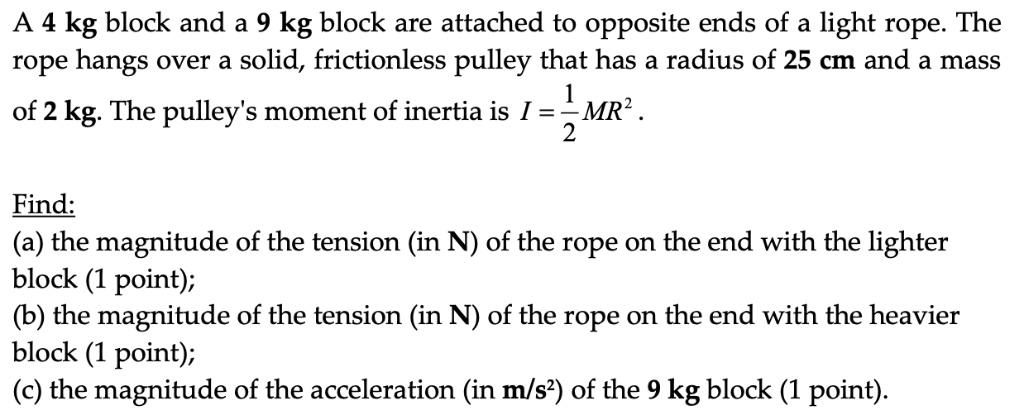 A 4 kg block and a 9 kg block are attached to opposite ends of a light rope. The
rope hangs over a solid, frictionless pulley that has a radius of 25 cm and a mass
of 2 kg. The pulley's moment of inertia is 7 = SMR? .
Find:
(a) the magnitude of the tension (in N) of the rope on the end with the lighter
block (1 point);
(b) the magnitude of the tension (in N) of the rope on the end with the heavier
block (1 point);
(c) the magnitude of the acceleration (in m/s?) of the 9 kg block (1 point).
This is AI generated Response.
Asked by: gvr
Created at: 2025-06-18 05:56:00
Asked by: gvr
Created at: 2025-06-18 05:56:00
Final Answer:
Rendered
Raw Text
Did you like this answer?
Let's solve the problem step by step.
**Given:**
- Mass of lighter block (\( m_1 \)) = 4 kg
- Mass of heavier block (\( m_2 \)) = 9 kg
- Radius of pulley (\( R \)) = 25 cm = 0.25 m
- Mass of pulley (\( M \)) = 2 kg
- Pulley's moment of inertia (\( I \)) = \(\frac{1}{2}MR^2\)
Let \( T_1 \) = tension on lighter block side.
Let \( T_2 \) = tension on heavier block side.
Let \( a \) = acceleration of blocks (same for both, as rope is light and inextensible).
Let \( g \) = acceleration due to gravity = 9.8 m/s².
---
### 1. **Write equations of motion for each block:**
#### For the lighter block (4 kg, moving up):
\[
T_1 - m_1g = m_1 a \implies T_1 = m_1 a + m_1g
\]
#### For the heavier block (9 kg, moving down):
\[
m_2g - T_2 = m_2 a \implies T_2 = m_2g - m_2a
\]
---
### 2. **Write equation for the Pulley (rotational motion):**
Net torque on the pulley = \( (T_2 - T_1)R \)
Moment of inertia \( I = \frac{1}{2}MR^2 \)
Angular acceleration \( \alpha = \frac{a}{R} \)
\[
(T_2 - T_1)R = I \alpha = \frac{1}{2}MR^2 \cdot \frac{a}{R}
\]
\[
T_2 - T_1 = \frac{1}{2}M a
\]
---
### 3. **Combine equations:**
From above:
- \( T_1 = m_1 a + m_1g \)
- \( T_2 = m_2g - m_2a \)
- \( T_2 - T_1 = \frac{1}{2}M a \)
Plug in the values of \( T_1 \) and \( T_2 \) into the third equation:
\[
(m_2g - m_2a) - (m_1a + m_1g) = \frac{1}{2} M a
\]
\[
m_2g - m_2a - m_1a - m_1g = \frac{1}{2} M a
\]
\[
(m_2 - m_1)g - (m_1 + m_2)a = \frac{1}{2} M a
\]
\[
(m_2 - m_1)g = (m_1 + m_2 + \frac{1}{2} M)a
\]
\[
a = \frac{(m_2 - m_1)g}{m_1 + m_2 + \frac{1}{2} M}
\]
---
### 4. **Plug in the numbers:**
- \( m_1 = 4 \) kg
- \( m_2 = 9 \) kg
- \( M = 2 \) kg
- \( g = 9.8 \) m/s²
\[
a = \frac{(9 - 4) \times 9.8}{4 + 9 + \frac{1}{2} \times 2}
= \frac{5 \times 9.8}{13 + 1}
= \frac{49}{14}
= 3.5~\text{m/s}^2
\]
---
### 5. **Find Tensions:**
**For lighter block:**
\[
T_1 = m_1 a + m_1 g = 4 \times 3.5 + 4 \times 9.8 = 14 + 39.2 = 53.2~\text{N}
\]
**For heavier block:**
\[
T_2 = m_2 g - m_2 a = 9 \times 9.8 - 9 \times 3.5 = 88.2 - 31.5 = 56.7~\text{N}
\]
---
### **Final Answers**
**(a) Tension in rope on end with lighter block:**
\[
\boxed{53.2~\text{N}}
\]
**(b) Tension in rope on end with heavier block:**
\[
\boxed{56.7~\text{N}}
\]
**(c) Magnitude of acceleration of the 9 kg block:**
\[
\boxed{3.5~\text{m/s}^2}
\]
📢 Instructions:
- Ask anything relatd to above question only.
- For new Question goto :