 VIPSolutions
Give step-by-step solution with explanation and final answer:Two point charges -2q, q at distance d and 3d respectively, in the presence of hollow , grounded, conducting sphere of inner radius a , Using the method of imaging find the electric force acting on charge q
Question:
Give step-by-step solution with explanation and final answer: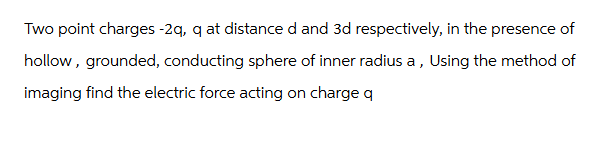 Two point charges -2q, q at distance d and 3d respectively, in the presence of
hollow , grounded, conducting sphere of inner radius a , Using the method of
imaging find the electric force acting on charge q
This is AI generated Response.
Asked by: gvr
Created at: 2025-06-17 20:10:46
Asked by: gvr
Created at: 2025-06-17 20:10:46
Final Answer:
Rendered
Raw Text
Did you like this answer?
Let's break down and solve the problem step by step:
### **Problem Recap**
- Two point charges: \( -2q \) at distance \( d \) and \( q \) at distance \( 3d \) from the center of a hollow, grounded, conducting sphere of inner radius \( a \).
- **Goal:** Using the **method of images**, find the **electric force on charge \( q \)**.
---
## **Step 1: Setup and Image Charges**
When a point charge is placed outside a grounded conducting sphere, it induces an image charge inside the sphere.
For a charge \( Q \) at distance \( r \) from the center of a grounded sphere of radius \( a \):
- **Image charge \( Q' \):**
\[
Q' = -Q \frac{a}{r}
\]
- **Image charge position:** At distance \( r' = \frac{a^2}{r} \) from the center, along the line joining the center and the real charge.
### **For This Problem**
We have **two real charges**:
1. \( -2q \) at \( r_1 = d \)
2. \( q \) at \( r_2 = 3d \)
#### **Image Charges:**
- For \( -2q \) at \( d \):
- Image charge: \( Q_1' = 2q \frac{a}{d} \)
- Image position: \( r_1' = \frac{a^2}{d} \)
- For \( q \) at \( 3d \):
- Image charge: \( Q_2' = -q \frac{a}{3d} \)
- Image position: \( r_2' = \frac{a^2}{3d} \)
---
## **Step 2: Forces Acting on Charge \( q \) at \( 3d \)**
The **total force on \( q \) at \( 3d \)** is the sum of the forces from:
1. The real charge \( -2q \) at \( d \)
2. The image charge \( Q_1' \) at \( r_1' \)
3. The image charge \( Q_2' \) at \( r_2' \)
(Remember, the image charge of \( q \) is only a mathematical device for boundary conditions and does **not** exert a force on its own real charge.)
---
### 1. **Force due to real charge \( -2q \) at \( d \):**
\[
F_1 = \frac{1}{4\pi\epsilon_0} \frac{q \cdot (-2q)}{(3d - d)^2} = -\frac{2q^2}{4\pi\epsilon_0 (2d)^2} = -\frac{q^2}{8\pi\epsilon_0 d^2}
\]
---
### 2. **Force due to image of \( -2q \): \( Q_1' = 2q \frac{a}{d} \) at \( r_1' = \frac{a^2}{d} \):**
Separation between \( q \) at \( 3d \) and image at \( a^2/d \):
\[
R_2 = 3d - \frac{a^2}{d}
\]
\[
F_2 = \frac{1}{4\pi\epsilon_0} \frac{q \cdot 2q \frac{a}{d}}{\left(3d - \frac{a^2}{d}\right)^2}
= \frac{2q^2 a/d}{4\pi\epsilon_0 \left(3d - \frac{a^2}{d}\right)^2}
= \frac{2q^2 a}{4\pi\epsilon_0 d \left(3d - \frac{a^2}{d}\right)^2}
\]
---
### 3. **Force due to image of \( q \): \( Q_2' = -q \frac{a}{3d} \) at \( r_2' = \frac{a^2}{3d} \):**
Separation between \( q \) at \( 3d \) and its image at \( a^2/(3d) \):
\[
R_3 = 3d - \frac{a^2}{3d}
\]
\[
F_3 = \frac{1}{4\pi\epsilon_0} \frac{q \cdot \left(-q \frac{a}{3d}\right)}{\left(3d - \frac{a^2}{3d}\right)^2}
= -\frac{q^2 a}{12\pi\epsilon_0 d \left(3d - \frac{a^2}{3d}\right)^2}
\]
---
## **Step 3: Add Up the Forces**
Total force on \( q \):
\[
\boxed{
F_{\text{total}} = F_1 + F_2 + F_3
}
\]
Substitute the values:
\[
F_{\text{total}} = -\frac{q^2}{8\pi\epsilon_0 d^2}
+ \frac{2q^2 a}{4\pi\epsilon_0 d \left(3d - \frac{a^2}{d}\right)^2}
- \frac{q^2 a}{12\pi\epsilon_0 d \left(3d - \frac{a^2}{3d}\right)^2}
\]
Or, simplifying the coefficients:
\[
\boxed{
F_{\text{total}} = -\frac{q^2}{8\pi\epsilon_0 d^2}
+ \frac{q^2 a}{2\pi\epsilon_0 d \left(3d - \frac{a^2}{d}\right)^2}
- \frac{q^2 a}{12\pi\epsilon_0 d \left(3d - \frac{a^2}{3d}\right)^2}
}
\]
---
### **Final Answer**
\[
\boxed{
\text{The electric force acting on charge } q \text{ is:}
}
\]
\[
\boxed{
F = -\frac{q^2}{8\pi\epsilon_0 d^2}
+ \frac{q^2 a}{2\pi\epsilon_0 d \left(3d - \frac{a^2}{d}\right)^2}
- \frac{q^2 a}{12\pi\epsilon_0 d \left(3d - \frac{a^2}{3d}\right)^2}
}
\]
**Direction:** Along the line joining the charges and the center (radially outward/inward depending on sign).
📢 Instructions:
- Ask anything relatd to above question only.
- For new Question goto :