Give step-by-step solution with explanation and final answer:Fractice with Area cstimates, the
FTC, and Antiderivatives
Understanding Area Estimates
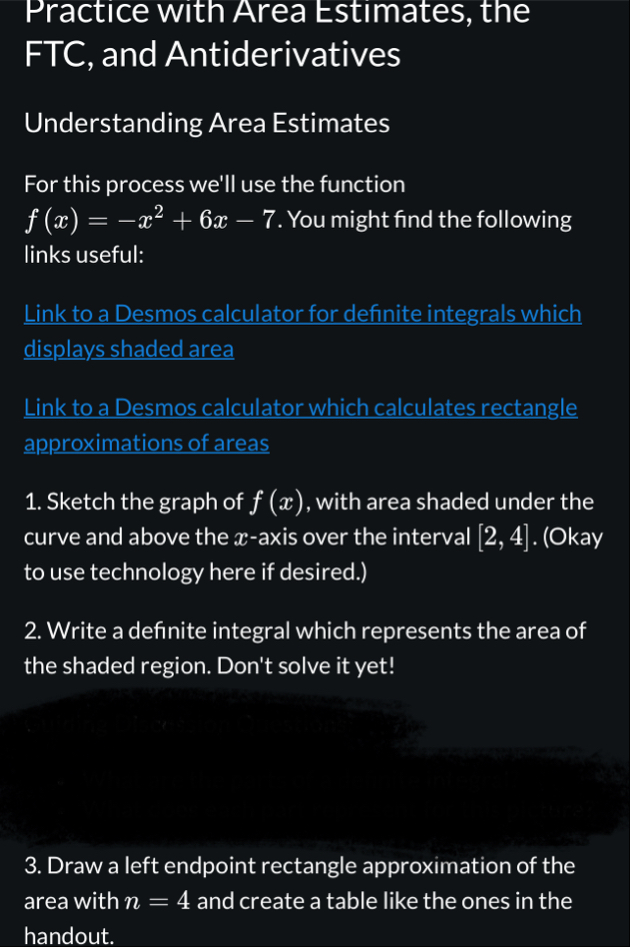
For this process we'll use the function
f(z) = —z% + 6x — 7. You might find the following
links useful:
Link to a Desmos calculator for definite integrals which
displays shaded area
Link to a Desmos calculator which calculates rectangle
approximations of areas
1. Sketch the graph of f (z), with area shaded under the
curve and above the z-axis over the interval (2, 4]. (Okay
to use technology here if desired.)
2. Write a definite integral which represents the area of
the shaded region. Don't solve it yet!
3. Draw a left endpoint rectangle approximation of the
area with = 4 and create a table like the ones in the
handout.
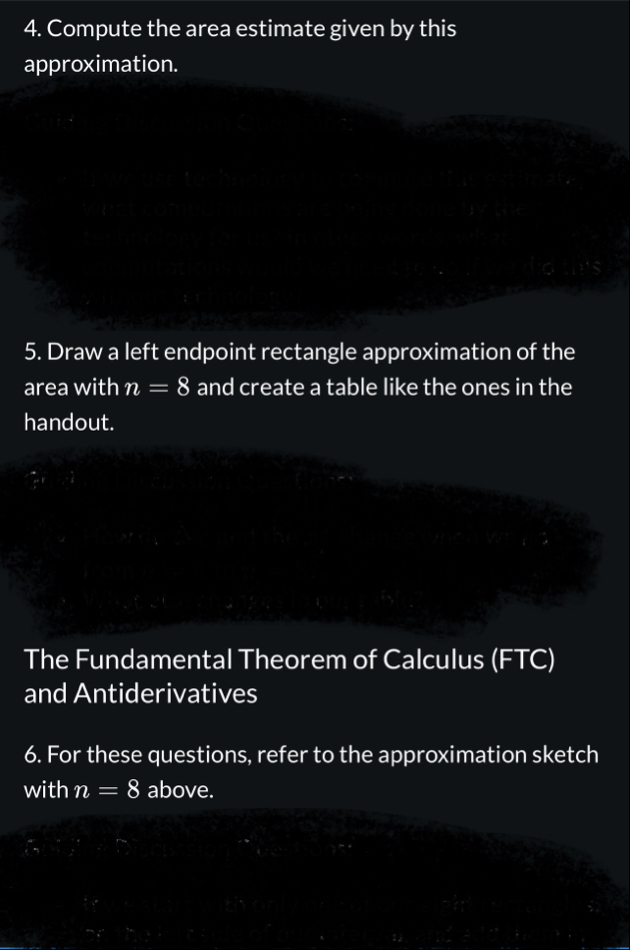
4. Compute the area estimate given by this
approximation.
5. Draw a left endpoint rectangle approximation of the
areawithn = 8 and create a table like the ones in the
handout.
The Fundamental Theorem of Calculus (FTC)
and Antiderivatives
6. For these questions, refer to the approximation sketch
withn = 8 above.
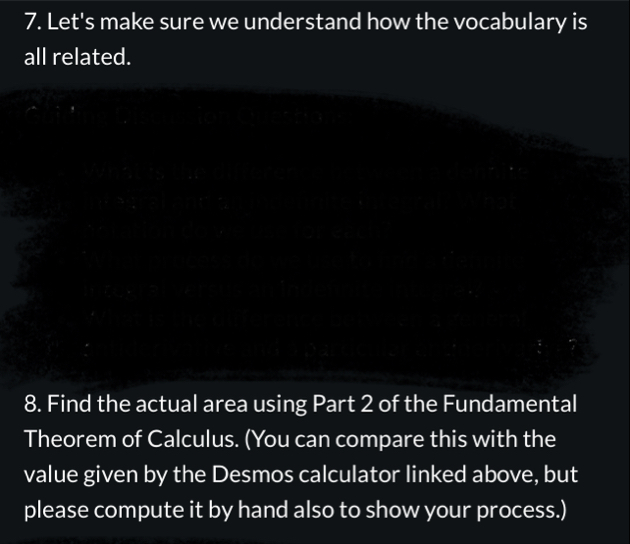
7. Let's make sure we understand how the vocabulary is
all related.
8. Find the actual area using Part 2 of the Fundamental
Theorem of Calculus. (You can compare this with the
value given by the Desmos calculator linked above, but
please compute it by hand also to show your process.)
Question:
Give step-by-step solution with explanation and final answer:Fractice with Area cstimates, the
FTC, and Antiderivatives
Understanding Area Estimates
For this process we'll use the function
f(z) = —z% + 6x — 7. You might find the following
links useful:
Link to a Desmos calculator for definite integrals which
displays shaded area
Link to a Desmos calculator which calculates rectangle
approximations of areas
1. Sketch the graph of f (z), with area shaded under the
curve and above the z-axis over the interval (2, 4]. (Okay
to use technology here if desired.)
2. Write a definite integral which represents the area of
the shaded region. Don't solve it yet!
3. Draw a left endpoint rectangle approximation of the
area with = 4 and create a table like the ones in the
handout.
4. Compute the area estimate given by this
approximation.
5. Draw a left endpoint rectangle approximation of the
areawithn = 8 and create a table like the ones in the
handout.
The Fundamental Theorem of Calculus (FTC)
and Antiderivatives
6. For these questions, refer to the approximation sketch
withn = 8 above.
7. Let's make sure we understand how the vocabulary is
all related.
8. Find the actual area using Part 2 of the Fundamental
Theorem of Calculus. (You can compare this with the
value given by the Desmos calculator linked above, but
please compute it by hand also to show your process.)
This is AI generated Response.
Asked by: gvr
Created at: 2025-06-17 19:52:20
Final Answer:
RenderedRaw Text
Did you like this answer?
Let's go step-by-step through the process for the function \( f(x) = -x^2 + 6x - 7 \) over the interval \([2, 4]\):
---
### **Step 1: Sketch the graph and shade the area**
- The function \( f(x) = -x^2 + 6x - 7 \) is a downward-opening parabola.
- You're interested in the area under the curve from \( x = 2 \) to \( x = 4 \) and above the x-axis.
---
### **Step 2: Write the definite integral**
The area under the curve from \( x=2 \) to \( x=4 \) is:
\[
\int_{2}^{4} (-x^2 + 6x - 7) \, dx
\]
---
### **Step 3: Left endpoint rectangle approximation with \( n = 4 \)**
- Interval: \([2, 4]\)
- Width: \( \Delta x = \frac{4-2}{4} = 0.5 \)
- Left endpoints: \( x_0 = 2, x_1 = 2.5, x_2 = 3, x_3 = 3.5 \)
Evaluate \( f(x) \) at these points:
\[
\begin{align*}
f(2) &= -(2)^2 + 6(2) - 7 = -4 + 12 - 7 = 1 \\
f(2.5) &= -(2.5)^2 + 6(2.5) - 7 = -6.25 + 15 - 7 = 1.75 \\
f(3) &= -(3)^2 + 6(3) - 7 = -9 + 18 - 7 = 2 \\
f(3.5) &= -(3.5)^2 + 6(3.5) - 7 = -12.25 + 21 - 7 = 1.75 \\
\end{align*}
\]
Table:
| i | \( x_i \) | \( f(x_i) \) |
|---|-----------|--------------|
| 0 | 2.0 | 1.00 |
| 1 | 2.5 | 1.75 |
| 2 | 3.0 | 2.00 |
| 3 | 3.5 | 1.75 |
---
### **Step 4: Compute the area estimate (\( n = 4 \), left endpoint)**
\[
\text{Area} \approx \Delta x \left[ f(2) + f(2.5) + f(3) + f(3.5) \right]
= 0.5 \times (1 + 1.75 + 2 + 1.75) = 0.5 \times 6.5 = 3.25
\]
---
### **Step 5: Left endpoint rectangle approximation with \( n = 8 \)**
- Width: \( \Delta x = \frac{4-2}{8} = 0.25 \)
- Left endpoints: \( x_0 = 2, x_1 = 2.25, x_2 = 2.5, x_3 = 2.75, x_4 = 3, x_5 = 3.25, x_6 = 3.5, x_7 = 3.75 \)
Calculate \( f(x) \) at each:
\[
\begin{align*}
f(2) &= 1 \\
f(2.25) &= -(2.25)^2 + 6(2.25) - 7 = -5.0625 + 13.5 - 7 = 1.4375 \\
f(2.5) &= 1.75 \\
f(2.75) &= -(2.75)^2 + 6(2.75) - 7 = -7.5625 + 16.5 - 7 = 1.9375 \\
f(3) &= 2 \\
f(3.25) &= -(3.25)^2 + 6(3.25) - 7 = -10.5625 + 19.5 - 7 = 1.9375 \\
f(3.5) &= 1.75 \\
f(3.75) &= -(3.75)^2 + 6(3.75) - 7 = -14.0625 + 22.5 - 7 = 1.4375 \\
\end{align*}
\]
Table:
| i | \( x_i \) | \( f(x_i) \) |
|---|-----------|--------------|
| 0 | 2.00 | 1.00 |
| 1 | 2.25 | 1.44 |
| 2 | 2.50 | 1.75 |
| 3 | 2.75 | 1.94 |
| 4 | 3.00 | 2.00 |
| 5 | 3.25 | 1.94 |
| 6 | 3.50 | 1.75 |
| 7 | 3.75 | 1.44 |
---
### **Step 6: Area estimate for \( n = 8 \)**
Add up the values:
\[
\text{Sum} = 1 + 1.4375 + 1.75 + 1.9375 + 2 + 1.9375 + 1.75 + 1.4375 = 13.25
\]
\[
\text{Area} \approx 0.25 \times 13.25 = 3.3125
\]
---
### **Step 7: Vocabulary**
- **Definite Integral**: The exact value of the area under the curve between two points.
- **Approximate Integral**: Using methods like rectangles (Riemann sums) to estimate the area.
- **Antiderivative**: A function whose derivative is the given function (used to compute definite integrals).
---
### **Step 8: Find the actual area using the Fundamental Theorem of Calculus**
First, find the antiderivative \( F(x) \):
\[
\int (-x^2 + 6x - 7) dx = -\frac{1}{3}x^3 + 3x^2 - 7x + C
\]
Evaluate from 2 to 4:
\[
F(4) = -\frac{1}{3}(4)^3 + 3(4)^2 - 7(4)
= -\frac{64}{3} + 48 - 28
= -\frac{64}{3} + 20
\]
\[
F(2) = -\frac{1}{3}(8) + 3(4) - 7(2)
= -\frac{8}{3} + 12 - 14
= -\frac{8}{3} - 2
\]
Now, subtract:
\[
\text{Area} = F(4) - F(2)
= \left(-\frac{64}{3} + 20\right) - \left(-\frac{8}{3} - 2\right)
= -\frac{64}{3} + 20 + \frac{8}{3} + 2
= \left(-\frac{64}{3} + \frac{8}{3}\right) + (20 + 2)
= -\frac{56}{3} + 22
\]
\[
22 - \frac{56}{3} = \frac{66}{3} - \frac{56}{3} = \frac{10}{3} \approx 3.333
\]
---
## **Final Answers**
1. **Definite integral for area:** \( \int_2^4 (-x^2 + 6x - 7)\,dx \)
2. **Left endpoint estimate, \( n=4 \):** \( 3.25 \)
3. **Left endpoint estimate, \( n=8 \):** \( 3.3125 \)
4. **Actual area:** \( \frac{10}{3} \approx 3.333 \)
Let me know if you'd like a graph, more explanation, or calculations for right endpoints!
Question:
i need detailed calculations along with the final answer
This is AI generated Response.
Asked by: gvr
Created at: 2025-06-17 19:54:34
Final Answer:
RenderedRaw Text
Did you like this answer?
Certainly! Let's walk through the entire problem step-by-step with detailed calculations, explanations, and the final answers.
---
### **Given function:**
\[
f(x) = -x^2 + 6x - 7
\]
**Interval:** \([2, 4]\)
---
### **Step 1: Sketch and understand the graph**
- The function is a downward-opening parabola because the coefficient of \(x^2\) is negative.
- Our goal is to find the area under this curve from \(x=2\) to \(x=4\).
---
### **Step 2: Write the definite integral**
The exact area under \(f(x)\) from 2 to 4 is:
\[
\boxed{
\int_{2}^{4} (-x^2 + 6x - 7) \, dx
}
\]
---
### **Step 3: Left endpoint rectangle approximation with \( n=4 \)**
- **Number of rectangles:** \( n = 4 \)
- **Width of each rectangle:**
\[
\Delta x = \frac{b - a}{n} = \frac{4 - 2}{4} = 0.5
\]
- **Left endpoints:**
\[
x_0 = 2,\quad x_1 = 2.5,\quad x_2 = 3,\quad x_3 = 3.5
\]
- **Evaluate \(f(x)\) at these points:**
1. \(f(2)\):
\[
f(2) = - (2)^2 + 6 \times 2 - 7 = -4 + 12 - 7 = 1
\]
2. \(f(2.5)\):
\[
f(2.5) = - (2.5)^2 + 6 \times 2.5 - 7 = -6.25 + 15 - 7 = 1.75
\]
3. \(f(3)\):
\[
f(3) = -9 + 18 - 7 = 2
\]
4. \(f(3.5)\):
\[
f(3.5) = -12.25 + 21 - 7 = 1.75
\]
- **Table of values:**
| \(i\) | \(x_i\) | \(f(x_i)\) |
|--------|---------|------------|
| 0 | 2.0 | 1.00 |
| 1 | 2.5 | 1.75 |
| 2 | 3.0 | 2.00 |
| 3 | 3.5 | 1.75 |
- **Approximate area using left endpoints:**
\[
\text{Area} \approx \Delta x \times \left( f(x_0) + f(x_1) + f(x_2) + f(x_3) \right)
\]
\[
= 0.5 \times (1 + 1.75 + 2 + 1.75) = 0.5 \times 6.5 = \boxed{3.25}
\]
---
### **Step 4: Left endpoint rectangle approximation with \( n=8 \)**
- **Number of rectangles:** \( n=8 \)
- **Width:**
\[
\Delta x = \frac{4 - 2}{8} = 0.25
\]
- **Left endpoints:**
\[
x_i = 2 + i \times 0.25,\quad i=0,1,\dots,7
\]
\[
x_0=2,\quad x_1=2.25,\quad x_2=2.5,\quad x_3=2.75,\quad x_4=3,\quad x_5=3.25,\quad x_6=3.5,\quad x_7=3.75
\]
- **Evaluate \(f(x)\) at each:**
1. \(f(2)\):
\[
-4 + 12 - 7 = 1
\]
2. \(f(2.25)\):
\[
- (2.25)^2 + 6 \times 2.25 - 7 = -5.0625 + 13.5 - 7 = 1.4375
\]
3. \(f(2.5)\):
\[
-6.25 + 15 - 7 = 1.75
\]
4. \(f(2.75)\):
\[
-7.5625 + 16.5 - 7 = 1.9375
\]
5. \(f(3)\):
\[
-9 + 18 - 7 = 2
\]
6. \(f(3.25)\):
\[
-10.5625 + 19.5 - 7 = 1.9375
\]
7. \(f(3.5)\):
\[
-12.25 + 21 - 7 = 1.75
\]
8. \(f(3.75)\):
\[
-14.0625 + 22.5 - 7 = 1.4375
\]
- **Sum of function values:**
\[
1 + 1.4375 + 1.75 + 1.9375 + 2 + 1.9375 + 1.75 + 1.4375 = 13.25
\]
- **Approximate area:**
\[
\boxed{
0.25 \times 13.25 = 3.3125
}
\]
---
### **Step 5: Actual area using the Fundamental Theorem of Calculus**
- **Find an antiderivative \(F(x)\) of \(f(x)\):**
\[
f(x) = -x^2 + 6x - 7
\]
Integral:
\[
F(x) = \int (-x^2 + 6x - 7) dx = - \frac{x^3}{3} + 3x^2 - 7x + C
\]
- **Evaluate \(F(4)\):**
\[
F(4) = - \frac{(4)^3}{3} + 3 \times (4)^2 - 7 \times 4
= - \frac{64}{3} + 3 \times 16 - 28
= - \frac{64}{3} + 48 - 28
= - \frac{64}{3} + 20
\]
Expressed with common denominator:
\[
F(4) = - \frac{64}{3} + \frac{60}{3} = - \frac{4}{3}
\]
- **Evaluate \(F(2)\):**
\[
F(2) = - \frac{8}{3} + 3 \times 4 - 14
= - \frac{8}{3} + 12 - 14
= - \frac{8}{3} - 2
\]
Expressed with denominator 3:
\[
F(2) = - \frac{8}{3} - \frac{6}{3} = - \frac{14}{3}
\]
- **Compute the definite integral:**
\[
\text{Area} = F(4) - F(2) = \left(- \frac{4}{3}\right) - \left(- \frac{14}{3}\right) = - \frac{4}{3} + \frac{14}{3} = \frac{10}{3}
\]
- **Final exact area:**
\[
\boxed{
\frac{10}{3} \approx 3.3333
}
\]
---
### **### **Summary of Results:**
| Step | Description | Result |
|---------|------------------------------|------------------|
| **Exact integral** | \(\int_2^4 (-x^2 + 6x -7) dx\) | \(\boxed{\frac{10}{3} \approx 3.3333}\) |
| **n=4 approximation** | Left endpoints sum | **3.25** |
| **n=8 approximation** | Left endpoints sum | **3.3125** |
---
**Note:** The approximations get closer to the exact value as \(n\) increases. Here, the \(n=8\) estimate (3.3125) is very close to the actual area (about 3.3333).
---
If you'd like further steps (right endpoints, midpoints, or graphing), just ask!
VIPSolutions focuses on clear, step‑by‑step explanations so you can learn quickly. Whether you need an AI‑generated walkthrough or a short hint to get unstuck, each solution is organized for fast reading and easy review later.
Search similar questions, compare approaches, and bookmark the best answers for revision. Our goal is simple: quick, reliable study help that feels natural—not noisy.
 VIPSolutions
 Fractice with Area cstimates, the
FTC, and Antiderivatives
Understanding Area Estimates
For this process we'll use the function
f(z) = —z% + 6x — 7. You might find the following
links useful:
Link to a Desmos calculator for definite integrals which
displays shaded area
Link to a Desmos calculator which calculates rectangle
approximations of areas
1. Sketch the graph of f (z), with area shaded under the
curve and above the z-axis over the interval (2, 4]. (Okay
to use technology here if desired.)
2. Write a definite integral which represents the area of
the shaded region. Don't solve it yet!
3. Draw a left endpoint rectangle approximation of the
area with = 4 and create a table like the ones in the
handout.
4. Compute the area estimate given by this
approximation.
5. Draw a left endpoint rectangle approximation of the
areawithn = 8 and create a table like the ones in the
handout.
The Fundamental Theorem of Calculus (FTC)
and Antiderivatives
6. For these questions, refer to the approximation sketch
withn = 8 above.
7. Let's make sure we understand how the vocabulary is
all related.
8. Find the actual area using Part 2 of the Fundamental
Theorem of Calculus. (You can compare this with the
value given by the Desmos calculator linked above, but
please compute it by hand also to show your process.)