 VIPSolutions
Give step-by-step solution with explanation and final answer:Exercise 412 Consider the dimensionless Hamiltonian 7 = $72 + Li? (with F = —id dx) whose wave function at time f = 01s given by : i i f W(x. 0) = T=po(x) + evi (6) + =a), 7 A To 411. EXERCISES m where vo) = hme, p16) = Fre", and vate) = plo (262 = 1) 2 © Calculate Ax, Ap, form = 0, 1 where Ax, = (pal A21y) — (yal Xv)” (6) Caleulate il yo(x), vo(x), i y1 (x). yy (x), 30d s(x), where the operators and arcdefined by = (X +d/dx)/v2 and at = (¥-d/dx)/V2
Question:
Give step-by-step solution with explanation and final answer: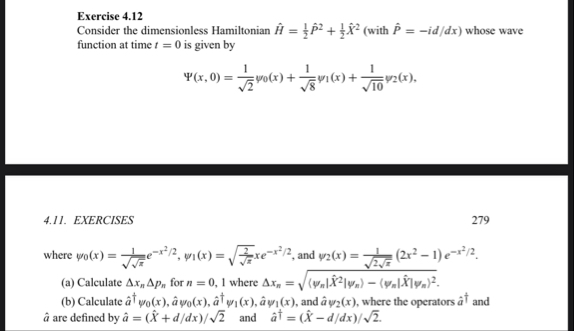 Exercise 412
Consider the dimensionless Hamiltonian 7 = $72 + Li? (with F = —id dx) whose wave
function at time f = 01s given by :
i i f
W(x. 0) = T=po(x) + evi (6) + =a),
7 A To
411. EXERCISES m
where vo) = hme, p16) = Fre", and vate) = plo (262 = 1) 2
© Calculate Ax, Ap, form = 0, 1 where Ax, = (pal A21y) — (yal Xv)”
(6) Caleulate il yo(x), vo(x), i y1 (x). yy (x), 30d s(x), where the operators and
arcdefined by = (X +d/dx)/v2 and at = (¥-d/dx)/V2
This is AI generated Response.
Asked by: gvr
Created at: 2025-06-17 19:42:52
Asked by: gvr
Created at: 2025-06-17 19:42:52
Final Answer:
Rendered
Raw Text
Did you like this answer?
Let's solve **Exercise 4.12** **step-by-step** as per your request.
---
## **Given:**
The Hamiltonian:
\[
\hat{H} = \frac{1}{2} \hat{P}^2 + \frac{1}{2} \hat{X}^2
\]
with \(\hat{P} = -i \frac{d}{dx}\).
Wave function at time \( t=0 \):
\[
\Psi(x,0) = \frac{1}{\sqrt{2}} \psi_0(x) + \frac{1}{\sqrt{8}} \psi_1(x) + \frac{1}{\sqrt{10}} \psi_2(x)
\]
The normalized eigenfunctions:
\[
\begin{align*}
\psi_0(x) &= \frac{1}{\sqrt{\sqrt{\pi}}} e^{-x^2/2} \\
\psi_1(x) &= \frac{\sqrt{2}}{\sqrt[4]{\pi}} x e^{-x^2/2} \\
\psi_2(x) &= \frac{1}{\sqrt{2\sqrt{\pi}}} (2x^2-1) e^{-x^2/2}
\end{align*}
\]
---
### **(a) Calculate \(\Delta x_n, \Delta p_n\) for \(n=0,1\)**
#### **For Harmonic Oscillator Eigenstates**
For the 1D quantum harmonic oscillator, the uncertainties in \(x\) and \(p\) for eigenstate \(\psi_n(x)\) are standard results:
\[
\Delta x_n = \sqrt{ \langle x^2 \rangle_n - \langle x \rangle_n^2 }
\]
\[
\Delta p_n = \sqrt{ \langle p^2 \rangle_n - \langle p \rangle_n^2 }
\]
For the dimensionless oscillator:
- \(\langle x \rangle_n = 0\)
- \(\langle p \rangle_n = 0\)
- \(\langle x^2 \rangle_n = n + \frac{1}{2}\)
- \(\langle p^2 \rangle_n = n + \frac{1}{2}\)
So,
\[
\Delta x_n = \Delta p_n = \sqrt{ n + \frac{1}{2} }
\]
#### **Explicitly:**
- For \(n = 0\):
\[
\Delta x_0 = \Delta p_0 = \sqrt{ \frac{1}{2} } = \frac{1}{\sqrt{2}}
\]
- For \(n = 1\):
\[
\Delta x_1 = \Delta p_1 = \sqrt{ 1 + \frac{1}{2} } = \sqrt{ \frac{3}{2} } = \frac{\sqrt{6}}{2}
\]
---
### **(b) Calculate \( \hat{a}^\dagger \psi_0(x),\, \hat{a}\psi_0(x),\, \hat{a}^\dagger\psi_1(x),\, \hat{a}\psi_1(x),\, \hat{a}\psi_2(x) \) **
The annihilation and creation operators:
\[
\hat{a} = \frac{1}{\sqrt{2}} \left( x + \frac{d}{dx} \right), \quad
\hat{a}^\dagger = \frac{1}{\sqrt{2}} \left( x - \frac{d}{dx} \right)
\]
These act on harmonic oscillator eigenstates as:
\[
\hat{a} \psi_n(x) = \sqrt{n} \psi_{n-1}(x)
\]
\[
\hat{a}^\dagger \psi_n(x) = \sqrt{n+1} \psi_{n+1}(x)
\]
#### **Now, let's compute:**
- \( \hat{a}^\dagger \psi_0(x) = \sqrt{1} \psi_1(x) = \psi_1(x) \)
- \( \hat{a} \psi_0(x) = 0 \) (since \( n = 0 \))
- \( \hat{a}^\dagger \psi_1(x) = \sqrt{2} \psi_2(x) \)
- \( \hat{a} \psi_1(x) = \sqrt{1} \psi_0(x) = \psi_0(x) \)
- \( \hat{a} \psi_2(x) = \sqrt{2} \psi_1(x) \)
---
## **Final Answers:**
### **(a)**
\[
\boxed{
\begin{aligned}
\Delta x_0 = \Delta p_0 &= \frac{1}{\sqrt{2}} \\
\Delta x_1 = \Delta p_1 &= \frac{\sqrt{6}}{2}
\end{aligned}
}
\]
### **(b)**
\[
\boxed{
\begin{aligned}
\hat{a}^\dagger \psi_0(x) &= \psi_1(x) \\
\hat{a} \psi_0(x) &= 0 \\
\hat{a}^\dagger \psi_1(x) &= \sqrt{2} \psi_2(x) \\
\hat{a} \psi_1(x) &= \psi_0(x) \\
\hat{a} \psi_2(x) &= \sqrt{2} \psi_1(x) \\
\end{aligned}
}
\]
If you need the explicit action in terms of \(x\), let me know!
Question:
i need 2 lines pure theory for explanation
This is AI generated Response.
Asked by: gvr
Created at: 2025-06-17 19:48:25
Asked by: gvr
Created at: 2025-06-17 19:48:25
Final Answer:
Rendered
Raw Text
Did you like this answer?
In the harmonic oscillator, the uncertainties in position and momentum for eigenstates are given by \(\Delta x_n = \Delta p_n = \sqrt{n + \frac{1}{2}}\), reflecting minimal uncertainty states. The ladder operators \(\hat{a}\) and \(\hat{a}^\dagger\) act to lower or raise the quantum number \(n\) by one, satisfying \(\hat{a} \psi_n = \sqrt{n} \psi_{n-1}\) and \(\hat{a}^\dagger \psi_n = \sqrt{n+1} \psi_{n+1}\).
📢 Instructions:
- Ask anything relatd to above question only.
- For new Question goto :