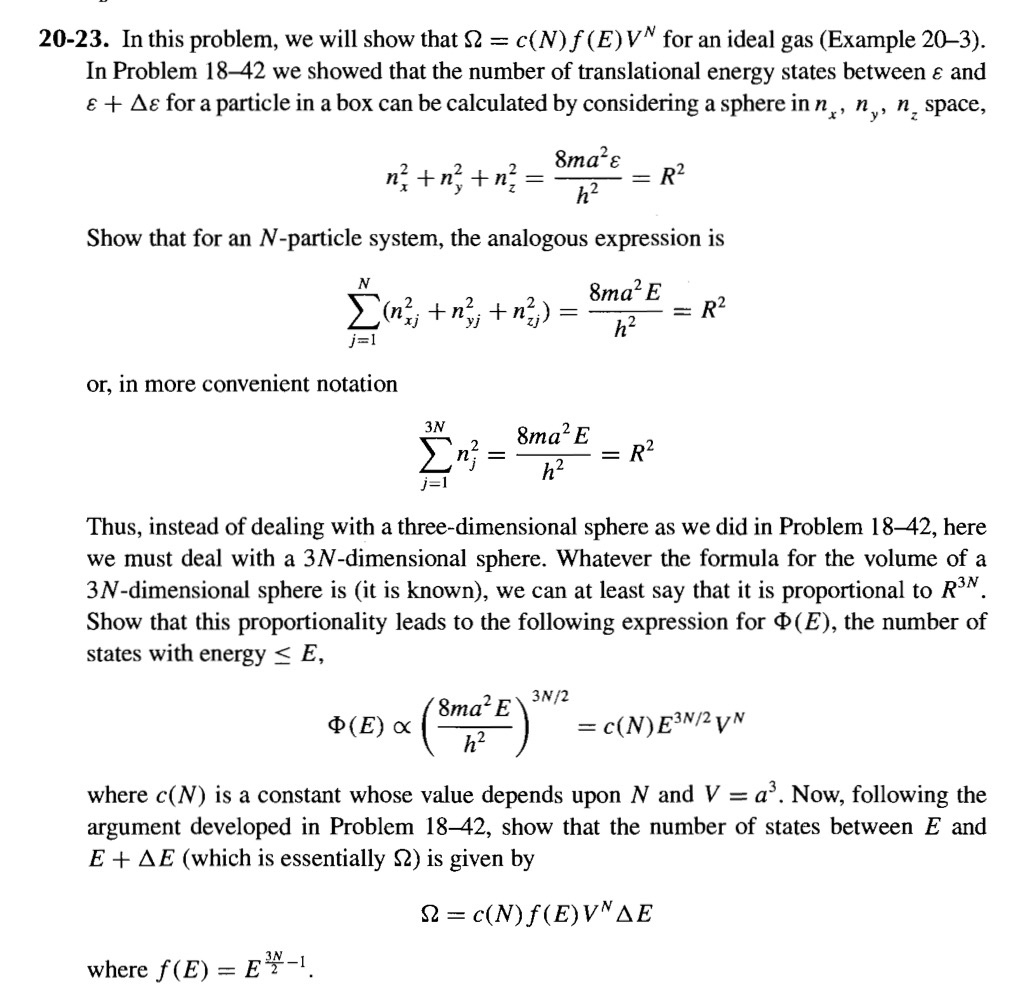
Give step-by-step solution with explanation and final answer:20-23. In this problem, we will show that Q = c(N) f (E) V" for an ideal gas (Example 20-3).
In Problem 18-42 we showed that the number of translational energy states between ¢ and
€ + Ac for a particle in a box can be calculated by considering asphereinn_, n , n_space,
8ma’e
Bp 2 spe id 2
mtn tn =—m—=R
Show that for an N-particle system, the analogous expression is
N 2
8ma”E
Dk nl nl) = ws LS
j=1
or, in more convenient notation
3N 2
8ma’E
2 2
dom=—p—=R
j=l
Thus, instead of dealing with a three-dimensional sphere as we did in Problem 18-42, here
we must deal with a 3N-dimensional sphere. Whatever the formula for the volume of a
3N-dimensional sphere is (it is known), we can at least say that it is proportional to R*".
Show that this proportionality leads to the following expression for ®(E), the number of
states with energy < E,
sma E\
B(E) (25) = c(N)ENRYN
where ¢(N) is a constant whose value depends upon N and V = a*. Now, following the
argument developed in Problem 18-42, show that the number of states between E and
E + AE (which is essentially 2) is given by
Q=c(N)f(E)V¥AE
where f(E) = E¥,
Question:
Give step-by-step solution with explanation and final answer:20-23. In this problem, we will show that Q = c(N) f (E) V" for an ideal gas (Example 20-3).
In Problem 18-42 we showed that the number of translational energy states between ¢ and
€ + Ac for a particle in a box can be calculated by considering asphereinn_, n , n_space,
8ma’e
Bp 2 spe id 2
mtn tn =—m—=R
Show that for an N-particle system, the analogous expression is
N 2
8ma”E
Dk nl nl) = ws LS
j=1
or, in more convenient notation
3N 2
8ma’E
2 2
dom=—p—=R
j=l
Thus, instead of dealing with a three-dimensional sphere as we did in Problem 18-42, here
we must deal with a 3N-dimensional sphere. Whatever the formula for the volume of a
3N-dimensional sphere is (it is known), we can at least say that it is proportional to R*".
Show that this proportionality leads to the following expression for ®(E), the number of
states with energy < E,
sma E\
B(E) (25) = c(N)ENRYN
where ¢(N) is a constant whose value depends upon N and V = a*. Now, following the
argument developed in Problem 18-42, show that the number of states between E and
E + AE (which is essentially 2) is given by
Q=c(N)f(E)V¥AE
where f(E) = E¥,
This is AI generated Response.
Asked by: gvr
Created at: 2025-06-17 18:37:37
Final Answer:
RenderedRaw Text
Did you like this answer?
Let's break down the problem and show the derivation step-by-step:
---
### **Step 1: Generalizing to an N-particle System**
For a single particle, the energy states can be represented as a sphere in \( n_x, n_y, n_z \) space:
\[
n_x^2 + n_y^2 + n_z^2 = \frac{8ma^2 \epsilon}{h^2} = R^2
\]
For **N particles**, sum over all particles:
\[
\sum_{j=1}^N (n_{xj}^2 + n_{yj}^2 + n_{zj}^2) = \frac{8ma^2 E}{h^2} = R^2
\]
Or, combining all 3N indices:
\[
\sum_{j=1}^{3N} n_j^2 = \frac{8ma^2 E}{h^2} = R^2
\]
---
### **Step 2: Number of States ≤ E — Volume of a 3N-dimensional Sphere**
The number of states with energy ≤ E is proportional to the **volume of a 3N-dimensional sphere** of radius \( R \):
\[
\Phi(E) \propto R^{3N}
\]
Since
\[
R^2 = \frac{8ma^2 E}{h^2} \implies R = \left( \frac{8ma^2 E}{h^2} \right)^{1/2}
\]
So,
\[
R^{3N} = \left( \frac{8ma^2 E}{h^2} \right)^{3N/2}
\]
Thus,
\[
\Phi(E) \propto \left( \frac{8ma^2 E}{h^2} \right)^{3N/2}
\]
Or, as given:
\[
\Phi(E) = c(N) E^{3N/2} V^N
\]
where \( c(N) \) is a constant and \( V = a^3 \).
---
### **Step 3: Number of States Between \( E \) and \( E + \Delta E \) (\( \Omega \))**
The number of states in the energy shell \( E \) to \( E + \Delta E \) is:
\[
\Omega = \frac{d\Phi(E)}{dE} \Delta E
\]
From above,
\[
\Phi(E) = c(N) V^N E^{3N/2}
\]
So,
\[
\frac{d\Phi(E)}{dE} = c(N) V^N \cdot \frac{3N}{2} E^{3N/2 - 1}
\]
Set
\[
f(E) = E^{3N/2 - 1}
\]
Therefore,
\[
\Omega = c(N) f(E) V^N \Delta E
\]
---
### **Step 4: Final Answer**
\[
\boxed{
\Omega = c(N) f(E) V^N \Delta E
}
\]
where
\[
f(E) = E^{3N/2 - 1}
\]
---
### **Summary of Steps:**
1. **Generalize to N particles:** The number of quantum states is determined by the volume of a sphere in 3N-dimensional space.
2. **Proportional to \( R^{3N} \):** Relate energy to the radius, and thus to the number of states.
3. **Differentiate to get states in \( E \) to \( E + \Delta E \):** \( \Omega = \frac{d\Phi}{dE} \Delta E \).
4. **Arrive at final form:** \( \Omega = c(N) f(E) V^N \Delta E \), with \( f(E) = E^{3N/2 - 1} \).
Let me know if you'd like the explicit form for \( c(N) \) or a deeper explanation of any step!
VIPSolutions focuses on clear, step‑by‑step explanations so you can learn quickly. Whether you need an AI‑generated walkthrough or a short hint to get unstuck, each solution is organized for fast reading and easy review later.
Search similar questions, compare approaches, and bookmark the best answers for revision. Our goal is simple: quick, reliable study help that feels natural—not noisy.
 VIPSolutions
 20-23. In this problem, we will show that Q = c(N) f (E) V" for an ideal gas (Example 20-3).
In Problem 18-42 we showed that the number of translational energy states between ¢ and
€ + Ac for a particle in a box can be calculated by considering asphereinn_, n , n_space,
8ma’e
Bp 2 spe id 2
mtn tn =—m—=R
Show that for an N-particle system, the analogous expression is
N 2
8ma”E
Dk nl nl) = ws LS
j=1
or, in more convenient notation
3N 2
8ma’E
2 2
dom=—p—=R
j=l
Thus, instead of dealing with a three-dimensional sphere as we did in Problem 18-42, here
we must deal with a 3N-dimensional sphere. Whatever the formula for the volume of a
3N-dimensional sphere is (it is known), we can at least say that it is proportional to R*".
Show that this proportionality leads to the following expression for ®(E), the number of
states with energy < E,
sma E\
B(E) (25) = c(N)ENRYN
where ¢(N) is a constant whose value depends upon N and V = a*. Now, following the
argument developed in Problem 18-42, show that the number of states between E and
E + AE (which is essentially 2) is given by
Q=c(N)f(E)V¥AE
where f(E) = E¥,