 VIPSolutions
Give step-by-step solution with explanation and final answer:2» In the circuit shown in the figure, Vo = V3 = 14.0 V and = Ry = Ry = Rs = Ry = Rs = 75.0. Current I; flows to "the left through R;, and I; = 0.210 A. ] R, Rr ® Determine the current I flowing through R,. Assume the direction of positive current flow is downward Vv fA through Ry. R, Va Rg Determine the voltage Vs across Ry. rR \ 4 CEE » Determine the power Ps dissipated by Rs. p=] w # TOOLS x10”
Question:
Give step-by-step solution with explanation and final answer: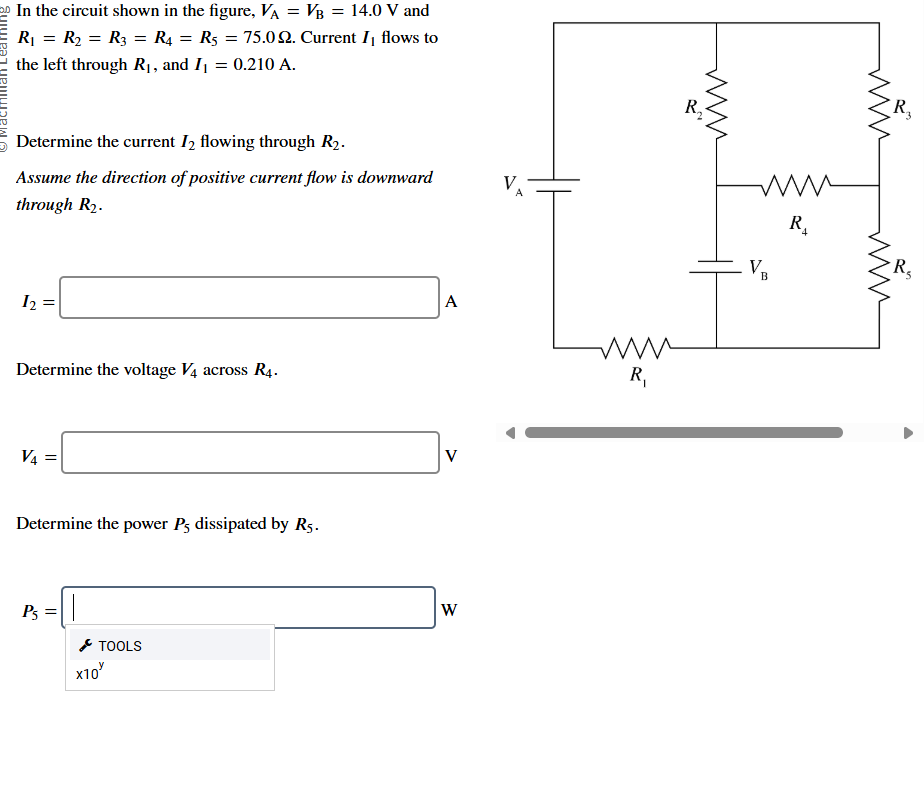 2» In the circuit shown in the figure, Vo = V3 = 14.0 V and
= Ry = Ry = Rs = Ry = Rs = 75.0. Current I; flows to
"the left through R;, and I; = 0.210 A.
] R, Rr
® Determine the current I flowing through R,.
Assume the direction of positive current flow is downward Vv
fA
through Ry.
R,
Va Rg
Determine the voltage Vs across Ry. rR
\
4 CEE »
Determine the power Ps dissipated by Rs.
p=] w
# TOOLS
x10”
This is AI generated Response.
Asked by: gvr
Created at: 2025-06-17 08:03:29
Asked by: gvr
Created at: 2025-06-17 08:03:29
Final Answer:
Rendered
Raw Text
Did you like this answer?
Let’s solve the circuit step by step:
### **Given:**
- \( V_A = V_B = 14.0\, \text{V} \)
- \( R_1 = R_2 = R_3 = R_4 = R_5 = 75.0\, \Omega \)
- \( I_1 = 0.210\, \text{A} \) flows through \( R_1 \) (to the left).
---
## **Step 1: Find \( I_2 \) (Current through \( R_2 \))**
**Let's label the loop currents as follows:**
- Let \( I_2 \) be the current through \( R_2 \) (downward as positive).
- \( I_1 \) is already given (left through \( R_1 \)).
### **Loop Equations**
#### **Loop 1: VA → R1 → R2 → VA**
The loop equation:
\[
V_A - I_1 R_1 - I_2 R_2 = 0
\]
\[
14.0 - (0.210)(75.0) - I_2 (75.0) = 0
\]
\[
14.0 - 15.75 - 75.0 I_2 = 0
\]
\[
-1.75 - 75.0 I_2 = 0
\]
\[
75.0 I_2 = -1.75
\]
\[
I_2 = -\frac{1.75}{75.0} = -0.0233\, \text{A}
\]
#### **So:**
\[
\boxed{I_2 = -0.0233\, \text{A}}
\]
(The negative sign means the actual direction is **upward** through \( R_2 \), opposite to the assumed direction.)
---
## **Step 2: Find \( V_4 \) (Voltage across \( R_4 \))**
\( R_4 \) is in the branch parallel to \( R_2 \). The voltage across \( R_4 \) is the same as the voltage across the combination of \( R_3 \) and \( R_5 \).
First, find the voltage at the node between \( R_1 \) and \( R_2 \):
### **Voltage drop across \( R_1 \):**
\[
V_{R_1} = I_1 \cdot R_1 = 0.210 \times 75.0 = 15.75\, \text{V}
\]
### **Voltage at the node after \( R_1 \):**
\[
V_{\text{node}} = V_A - V_{R_1} = 14.0 - 15.75 = -1.75\, \text{V}
\]
### **Voltage across \( R_4 \):**
The voltage across \( R_4 \) is the difference between the node voltage (after \( R_1 \)) and the voltage at the bottom (which is ground, or 0V):
\[
V_4 = V_B - V_{\text{node}}
\]
\[
V_4 = 14.0 - (-1.75) = 15.75\, \text{V}
\]
#### **So:**
\[
\boxed{V_4 = 15.75\, \text{V}}
\]
---
## **Step 3: Find \( P_5 \) (Power dissipated by \( R_5 \))**
\( R_5 \) is in series with \( R_4 \) and \( R_3 \), all of which are in parallel with the \( R_2 \) branch.
### **Current through \( R_5 \):**
The voltage across the \( R_4 + R_5 \) branch is \( V_4 = 15.75\, \text{V} \), and \( R_5 = 75.0\, \Omega \).
First, the total resistance in this path is \( R_3 + R_4 + R_5 = 75.0 + 75.0 + 75.0 = 225.0\, \Omega \).
The current through this branch:
\[
I_{\text{branch}} = \frac{V_4}{R_3 + R_4 + R_5}
= \frac{15.75}{225.0}
= 0.0700\, \text{A}
\]
The current through \( R_5 \) is the same as in this branch.
### **Power dissipated by \( R_5 \):**
\[
P_5 = I^2 R_5
= (0.0700)^2 \cdot 75.0
= 0.0049 \cdot 75.0
= 0.3675\, \text{W}
\]
#### **So:**
\[
\boxed{P_5 = 0.368\, \text{W}}
\]
---
## **Final Answers**
### 1. \( I_2 = \boxed{-0.0233\, \text{A}} \)
### 2. \( V_4 = \boxed{15.75\, \text{V}} \)
### 3. \( P_5 = \boxed{0.368\, \text{W}} \)
Let me know if you'd like a circuit diagram or further clarification!
📢 Instructions:
- Ask anything relatd to above question only.
- For new Question goto :