 VIPSolutions
Give step-by-step solution with explanation and final answer:Suppose R is the shaded region in the figure, and f(z, y) is a continuous function on R. Find the limits of integration for the following iterated integrals. BD @ [[1@naa= [ [senda J ilo o D Fon o [sean [[" sedsa ee 7
Question:
Give step-by-step solution with explanation and final answer: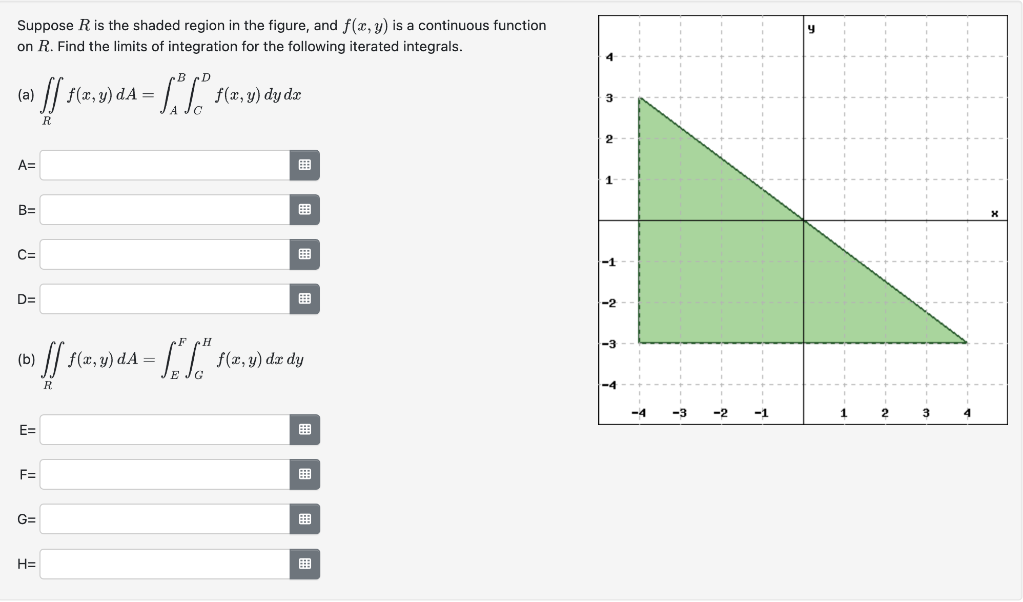 Suppose R is the shaded region in the figure, and f(z, y) is a continuous function
on R. Find the limits of integration for the following iterated integrals.
BD
@ [[1@naa= [ [senda
J ilo
o D
Fon
o [sean [[" sedsa
ee
7
This is AI generated Response.
Asked by: gvr
Created at: 2025-06-17 08:01:20
Asked by: gvr
Created at: 2025-06-17 08:01:20
Final Answer:
Rendered
Raw Text
Did you like this answer?
Let's analyze the region \( R \) step by step.
### Step 1: **Identify the region \( R \)**
The shaded region is a right triangle with vertices at \((-3, 3)\), \((3, -3)\), and \((-3, -3)\).
#### The boundaries:
- **Left and right:** \(x\) ranges from \(-3\) to \(3\).
- **Bottom:** \(y = -3\).
- **Top:** The line from \((-3, 3)\) to \((3, -3)\), which is \(y = -x\).
---
## (a) \(\iint_R f(x, y) dA = \int_A^B \int_C^D f(x, y) dy\,dx\)
This means **outer integral is over \(x\)**, and for each \(x\), **inner is over \(y\)**.
- \(x\) ranges from \(-3\) to \(3\).
- For each \(x\), \(y\) ranges from the bottom (\(y = -3\)) up to the line (\(y = -x\)).
So:
- \(A = -3\)
- \(B = 3\)
- \(C = -3\)
- \(D = -x\)
---
## (b) \(\iint_R f(x, y) dA = \int_E^F \int_G^H f(x, y) dx\,dy\)
This means **outer integral is over \(y\)**, and for each \(y\), **inner is over \(x\)**.
- \(y\) ranges from \(-3\) to \(3\).
- For each \(y\), \(x\) ranges from the left edge (\(x = -3\)) up to the line (\(x = -y\)).
So:
- \(E = -3\)
- \(F = 3\)
- \(G = -3\)
- \(H = -y\)
---
## **Final Answers**
**(a)**
- \(A = -3\)
- \(B = 3\)
- \(C = -3\)
- \(D = -x\)
**(b)**
- \(E = -3\)
- \(F = 3\)
- \(G = -3\)
- \(H = -y\)
---
### **Summary Table**
| | Lower Limit | Upper Limit |
|------|-------------|-------------|
| (a) | \( x: -3 \) | \( x: 3 \) |
| | \( y: -3 \) | \( y: -x \) |
| (b) | \( y: -3 \) | \( y: 3 \) |
| | \( x: -3 \) | \( x: -y \) |
Let me know if you need the integrals written out!
📢 Instructions:
- Ask anything relatd to above question only.
- For new Question goto :