 VIPSolutions
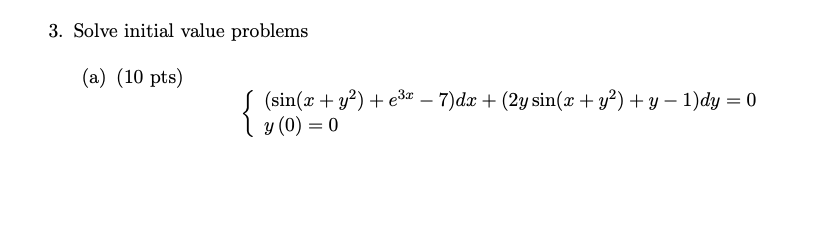
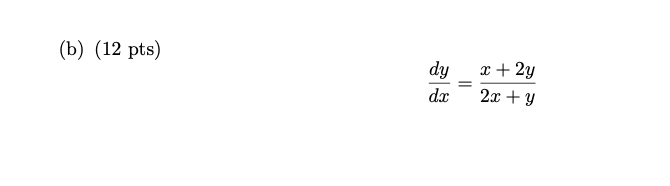
Give step-by-step solution with explanation and final answer:4. Given equation E14 Ny=z+1 (a) (10 pts) Find general solutions. (b) (2 pts) Give the largest interval where solution exists. (c) (2 pts) Find transient term if there is any. (b) (10 pts) { 4% =ylay® -1) y(0)=1 3. Solve initial value problems (2) (10 pts) { (sin(z +3?) + €** — T)dz + (2ysin(z + y?) +y — 1)dy = 0 y(0)=0 b) (12 pt (b) (12 pts) wat dz 2z+y 2. Find general solutions of the given differential equations. (2) (10 pts) & =eVpetY
Question:
Give step-by-step solution with explanation and final answer: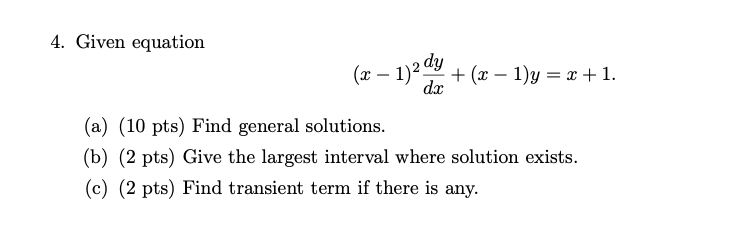

 4. Given equation
E14 Ny=z+1
(a) (10 pts) Find general solutions.
(b) (2 pts) Give the largest interval where solution exists.
(c) (2 pts) Find transient term if there is any.
(b) (10 pts)
{ 4% =ylay® -1)
y(0)=1
3. Solve initial value problems
(2) (10 pts)
{ (sin(z +3?) + €** — T)dz + (2ysin(z + y?) +y — 1)dy = 0
y(0)=0
b) (12 pt
(b) (12 pts) wat
dz 2z+y
2. Find general solutions of the given differential equations.
(2) (10 pts)
& =eVpetY
This is AI generated Response.
Asked by: gvr
Created at: 2025-06-17 07:28:19
Asked by: gvr
Created at: 2025-06-17 07:28:19
Final Answer:
Rendered
Raw Text
Did you like this answer?
Let's go through each problem one by one with step-by-step solutions and explanations.
---
## **2(a).**
\[
\frac{dy}{dx} = e^{-y} + e^{2x-y}
\]
**Step 1: Factor \( e^{-y} \):**
\[
e^{-y} + e^{2x-y} = e^{-y}(1 + e^{2x})
\]
**Step 2: Separate variables:**
\[
\frac{dy}{dx} = e^{-y}(1 + e^{2x})
\]
\[
e^{y}\,dy = (1 + e^{2x})\,dx
\]
**Step 3: Integrate both sides:**
\[
\int e^{y}\,dy = \int (1 + e^{2x})\,dx
\]
\[
e^{y} = x + \frac{1}{2}e^{2x} + C
\]
**Final Answer:**
\[
\boxed{e^{y} = x + \frac{1}{2}e^{2x} + C}
\]
---
## **3(a).**
\[
\begin{cases}
(\sin(x + y^2) + e^{3x} - 7)\,dx + (2y\sin(x + y^2) + y - 1)\,dy = 0 \\
y(0) = 0
\end{cases}
\]
**Step 1: Check if the equation is exact.**
Let \( M(x,y) = \sin(x+y^2) + e^{3x} - 7 \), \( N(x,y) = 2y\sin(x+y^2) + y - 1 \).
\[
\frac{\partial M}{\partial y} = \frac{\partial}{\partial y}\left(\sin(x+y^2)\right) = 2y\cos(x+y^2)
\]
\[
\frac{\partial N}{\partial x} = 2y\cos(x+y^2)
\]
They are equal, so the equation is **exact**.
**Step 2: Find potential function \( F(x,y) \):**
\[
F_x = M, \quad F_y = N
\]
Integrate \( M \) with respect to \( x \):
\[
F(x, y) = \int (\sin(x+y^2) + e^{3x} - 7) dx
\]
\[
= -\cos(x+y^2) + \frac{1}{3}e^{3x} - 7x + h(y)
\]
Differentiate with respect to \( y \) and set equal to \( N \):
\[
F_y = 2y\sin(x+y^2) + h'(y)
\]
Set equal to \( N \):
\[
2y\sin(x+y^2) + h'(y) = 2y\sin(x+y^2) + y - 1
\implies h'(y) = y - 1
\implies h(y) = \frac{1}{2}y^2 - y
\]
**So,**
\[
F(x, y) = -\cos(x+y^2) + \frac{1}{3}e^{3x} - 7x + \frac{1}{2}y^2 - y
\]
The solution is:
\[
F(x, y) = C
\]
Substitute \( y(0) = 0 \):
\[
-\cos(0 + 0^2) + \frac{1}{3}e^{0} - 7(0) + \frac{1}{2}(0)^2 - 0 = C
\implies -1 + \frac{1}{3} = C
\implies C = -\frac{2}{3}
\]
**Final Answer:**
\[
\boxed{-\cos(x+y^2) + \frac{1}{3}e^{3x} - 7x + \frac{1}{2}y^2 - y = -\frac{2}{3}}
\]
---
## **3(b).**
\[
\frac{dy}{dx} = \frac{x + 2y}{2x + y}
\]
**Step 1: Substitute \( u = x + 2y \).**
Let’s try \( y = vx \) (homogeneous equation):
Rewrite:
\[
\frac{dy}{dx} = \frac{x + 2y}{2x + y}
\]
Let \( y = vx \implies \frac{dy}{dx} = v + x\frac{dv}{dx} \)
\[
v + x\frac{dv}{dx} = \frac{x + 2vx}{2x + vx}
= \frac{x(1 + 2v)}{x(2 + v)} = \frac{1 + 2v}{2 + v}
\]
\[
x\frac{dv}{dx} = \frac{1 + 2v}{2 + v} - v
= \frac{1 + 2v - v(2 + v)}{2 + v}
= \frac{1 + 2v - 2v - v^2}{2 + v}
= \frac{1 - v^2}{2 + v}
\]
So:
\[
\frac{2 + v}{1 - v^2} dv = \frac{dx}{x}
\]
**Step 2: Separate and integrate**
\[
\frac{2 + v}{1 - v^2} = \frac{2}{1 - v^2} + \frac{v}{1 - v^2}
\]
\[
\frac{2}{1 - v^2} = \frac{1}{1 - v} + \frac{1}{1 + v}
\]
\[
\frac{v}{1 - v^2} = \frac{1}{2} \left( \frac{1}{1 - v} - \frac{1}{1 + v} \right)
\]
So,
\[
\frac{2 + v}{1 - v^2} = \frac{1}{1 - v} + \frac{1}{1 + v} + \frac{1}{2}\left(\frac{1}{1 - v} - \frac{1}{1 + v}\right)
= \frac{1 + \frac{1}{2}}{1 - v} + \frac{1 - \frac{1}{2}}{1 + v}
= \frac{3/2}{1 - v} + \frac{1/2}{1 + v}
\]
Integrate:
\[
\int \left( \frac{3/2}{1 - v} + \frac{1/2}{1 + v} \right) dv = \int \frac{dx}{x}
\]
\[
-\frac{3}{2} \ln|1 - v| + \frac{1}{2} \ln|1 + v| = \ln|x| + C
\]
**Step 3: Substitute back \( v = y/x \):**
\[
-\frac{3}{2} \ln|1 - y/x| + \frac{1}{2} \ln|1 + y/x| = \ln|x| + C
\]
Or rearrange as:
\[
\ln \left| \frac{(1 + y/x)^{1/2}}{(1 - y/x)^{3/2}} \right| = \ln|x| + C
\]
Exponentiate both sides:
\[
\frac{(1 + y/x)^{1/2}}{(1 - y/x)^{3/2}} = K x
\]
or equivalently:
\[
\boxed{\frac{\sqrt{1 + y/x}}{(1 - y/x)^{3/2}} = Cx}
\]
---
## **4(a).**
\[
(x-1)^2 \frac{dy}{dx} + (x-1)y = x+1
\]
**Step 1: Divide both sides by \((x-1)^2\):**
\[
\frac{dy}{dx} + \frac{1}{x-1}y = \frac{x+1}{(x-1)^2}
\]
This is a linear ODE.
**Step 2: Find integrating factor:**
\[
\mu(x) = \exp\left(\int \frac{1}{x-1}dx\right) = |x-1|
\]
(For \(x > 1\), \(x-1\). For \(x < 1\), \(-(x-1)\). Consider \(x-1\) for now.)
Multiply both sides by \(x-1\):
\[
(x-1)\frac{dy}{dx} + y = \frac{x+1}{x-1}
\]
**Step 3: Recognize left side as derivative:**
\[
\frac{d}{dx} \left( y(x-1) \right ) = \frac{x+1}{x-1}
\]
**Step 4: Integrate both sides:**
\[
y(x-1) = \int \frac{x+1}{x-1} dx
\]
\[
\frac{x+1}{x-1} = 1 + \frac{2}{x-1}
\]
So:
\[
y(x-1) = \int \left( 1 + \frac{2}{x-1} \right) dx = x + 2\ln|x-1| + C
\]
\[
y = \frac{x + 2\ln|x-1| + C}{x-1}
\]
**Final Answer:**
\[
\boxed{y(x) = \frac{x + 2\ln|x-1| + C}{x-1}}
\]
---
**4(b). Largest interval:**
The solution and coefficients are not defined at \(x=1\). So the largest interval is \(\boxed{(-\infty, 1)}\) or \(\boxed{(1, \infty)}\) depending on initial conditions.
---
**4(c). Transient term:**
The transient term is the term that vanishes as \(x \to \infty\), i.e., the term containing \(C\).
\[
\boxed{\text{Transient term: } \frac{C}{x-1}}
\]
---
If you need solutions for other parts, let me know!
Question:
i need only all parts final Answers
This is AI generated Response.
Asked by: gvr
Created at: 2025-06-17 07:36:12
Asked by: gvr
Created at: 2025-06-17 07:36:12
Final Answer:
Rendered
Raw Text
Did you like this answer?
Certainly! Here are the final answers for all parts:
---
**2(a).**
**General solution:**
\[
\boxed{e^{y} = x + \frac{1}{2}e^{2x} + C}
\]
**Largest interval where solution exists:**
\[
\boxed{(-\infty, \infty)}
\]
**Transient term (if any):**
\[
\text{No transient term} \quad (\text{since the solution is explicit})
\]
---
**3(a).**
**Solution of the IVP:**
\[
\boxed{-\cos(x + y^2) + \frac{1}{3}e^{3x} - 7x + \frac{1}{2} y^2 - y = -\frac{2}{3}
\]
**Initial condition \( y(0)=0 \) verified:**
Yes.
---
**3(b).**
**General solution:**
\[
\boxed{\frac{\sqrt{1 + y/x}}{(1 - y/x)^{3/2}} = C x}
\]
---
**4(a).**
**Solution:**
\[
\boxed{ y(x) = \frac{x + 2 \ln|x-1| + C}{x-1} }
\]
**Largest interval of existence:**
\[
\boxed{(-\infty, 1)} \quad \text{or} \quad (1, \infty), \text{depending on initial conditions}
\]
**Transient term:**
\[
\boxed{\frac{C}{x-1}}
\]
---
Let me know if you'd like any further clarifications!
📢 Instructions:
- Ask anything relatd to above question only.
- For new Question goto :