 VIPSolutions
Give step-by-step solution with explanation and final answer:10. Unlike simple interest, compound interest is never found using a: 2365-day year b formula
Question:
Give step-by-step solution with explanation and final answer: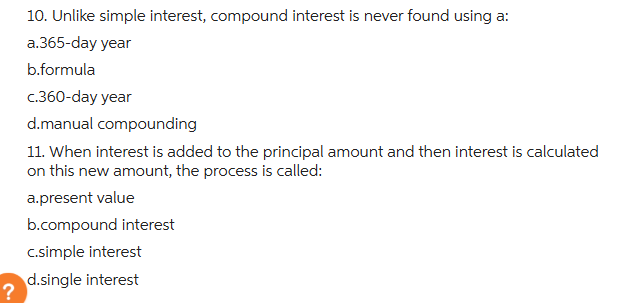 10. Unlike simple interest, compound interest is never found using a:
2365-day year
b formula
This is AI generated Response.
Asked by: gvr
Created at: 2025-06-17 06:42:14
Asked by: gvr
Created at: 2025-06-17 06:42:14
Final Answer:
Rendered
Raw Text
Did you like this answer?
Let's solve each question step-by-step:
---
**Question 10:**
*Unlike simple interest, compound interest is never found using a:*
- **a. 365-day year**
Compound interest can be calculated using a 365-day year.
- **b. formula**
Compound interest requires a formula for calculation.
- **c. 360-day year**
Sometimes, financial institutions use a 360-day year for calculations.
- **d. manual compounding**
Compound interest is based on interest on interest, and it is not practical to do it by "manual compounding" (i.e., without using a formula or calculation method).
**Step-by-step reasoning:**
Compound interest is commonly calculated using formulas, and sometimes using 360 or 365 days for the year. However, "manual compounding" is not a recognized method to calculate compound interest, because you need a systematic formula or method.
**Final answer for 10:**
**d. manual compounding**
---
**Question 11:**
*When interest is added to the principal amount and then interest is calculated on this new amount, the process is called:*
- **a. present value**
Present value refers to the current worth of a future sum of money.
- **b. compound interest**
This is when interest is calculated on the principal and any previously earned interest.
- **c. simple interest**
Interest is calculated only on the principal, not on previously earned interest.
- **d. single interest**
This term is not standard in finance.
**Step-by-step reasoning:**
When interest is repeatedly added to the principal and then new interest is calculated on this increased amount, it is called **compound interest**.
**Final answer for 11:**
**b. compound interest**
---
**Summary of answers:**
- **10:** d. manual compounding
- **11:** b. compound interest
📢 Instructions:
- Ask anything relatd to above question only.
- For new Question goto :