Give step-by-step solution with explanation and final answer:
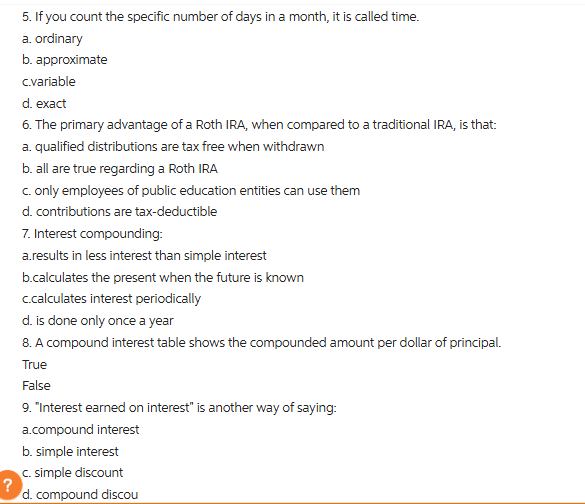
i need detailed explanation of each option along with the final Answer5. If you count the specific number of days in a month, its called time.
a ordinary
b. approximate
cvarizble
d exact
6.The primary advantage of a Roth IRA, when compared to a traditional IRA, is that:
a qualified distributions are tax free when withdrawn
b. al are true regarding a Roth IRA
only employees of public education entities can use them
d. contributions are tax-deductible
7. Interest compounding:
‘results in less interest than simple interest
b.calculates the present when the future is known
calculates interest periodically
dis done only once a year
8A compound interest table shows the compounded amount per dollar of principal.
True
False.
9. "Interest eamed on interest” is another way of saying
2.compound interest
b. simple interest
C simple discount
D: compound discou
Question:
Give step-by-step solution with explanation and final answer:
i need detailed explanation of each option along with the final Answer5. If you count the specific number of days in a month, its called time.
a ordinary
b. approximate
cvarizble
d exact
6.The primary advantage of a Roth IRA, when compared to a traditional IRA, is that:
a qualified distributions are tax free when withdrawn
b. al are true regarding a Roth IRA
only employees of public education entities can use them
d. contributions are tax-deductible
7. Interest compounding:
‘results in less interest than simple interest
b.calculates the present when the future is known
calculates interest periodically
dis done only once a year
8A compound interest table shows the compounded amount per dollar of principal.
True
False.
9. "Interest eamed on interest” is another way of saying
2.compound interest
b. simple interest
C simple discount
D: compound discou
This is AI generated Response.
Asked by: gvr
Created at: 2025-06-17 06:32:32
Final Answer:
RenderedRaw Text
Did you like this answer?
Let's solve each question step by step with detailed explanations for each option:
---
### 5. If you count the specific number of days in a month, it is called time.
- **a. ordinary**: In finance, "ordinary" time typically refers to using a standard 30-day month or 360-day year.
- **b. approximate**: This means an estimated value, not exact.
- **c. variable**: Means changing or not fixed.
- **d. exact**: **Correct Answer**. When you count the specific number of days in a month (e.g., 28, 29, 30, or 31), it is referred to as "exact" time.
**Final Answer: d. exact**
---
### 6. The primary advantage of a Roth IRA, when compared to a traditional IRA, is that:
- **a. qualified distributions are tax free when withdrawn**: **Correct Answer**. The main advantage of a Roth IRA is that withdrawals in retirement are tax-free if rules are followed.
- **b. all are true regarding a Roth IRA**: Not all statements here are true about Roth IRAs.
- **c. only employees of public education entities can use them**: This is false; anyone with earned income can use a Roth IRA.
- **d. contributions are tax-deductible**: This is true for traditional IRAs, not Roth IRAs.
**Final Answer: a. qualified distributions are tax free when withdrawn**
---
### 7. Interest compounding:
- **a. results in less interest than simple interest**: False—compounding results in more interest, not less.
- **b. calculates the present when the future is known**: This describes discounting, not compounding.
- **c. calculates interest periodically**: **Correct Answer**. Compounding means interest is calculated at set intervals and added to the principal, so future interest is earned on interest.
- **d. is done only once a year**: Not necessarily; can be quarterly, monthly, daily, etc.
**Final Answer: c. calculates interest periodically**
---
### 8. A compound interest table shows the compounded amount per dollar of principal.
- **True**: **Correct Answer**. Compound interest tables show how much $1 will grow to after interest is compounded over time.
- **False**: Incorrect.
**Final Answer: True**
---
### 9. "Interest earned on interest" is another way of saying:
- **a. compound interest**: **Correct Answer**. Compound interest means you earn interest not just on the principal but also on the previously earned interest.
- **b. simple interest**: Simple interest is only earned on the original principal.
- **c. simple discount**: Not related to earning interest on interest.
- **d. compound discou**: This is not a standard term.
**Final Answer: a. compound interest**
---
## **Summary Table**
| Q# | Correct Answer | Explanation |
|----|:--------------:|-----------------------------------------------------------------------------|
| 5 | d. exact | Counting specific days is "exact" time. |
| 6 | a. | Roth IRA's main advantage: tax-free withdrawals. |
| 7 | c. | Compounding means calculating interest periodically. |
| 8 | True | Compound interest tables show the growth per dollar of principal. |
| 9 | a. | "Interest earned on interest" is compound interest. |
Question:
i need each option explanation with subheading
This is AI generated Response.
Asked by: gvr
Created at: 2025-06-17 06:34:20
Final Answer:
RenderedRaw Text
Did you like this answer?
Certainly! Here's a detailed step-by-step explanation for each question, including explanations for all options.
---
### 5. If you count the specific number of days in a month, it is called time.
**Options:**
- **a. ordinary**
*Explanation:* In finance, "ordinary" time often refers to a standardized period, like a 30-day month or a 360-day year, used for calculations. It does not refer to counting specific days in a particular month, so this is not the correct answer here.
- **b. approximate**
*Explanation:* Approximate means an estimation or rough calculation. Counting specific days in a month is precise, so this does not fit.
- **c. variable**
*Explanation:* Variable indicates something that changes. Counting days in a month varies because months have different lengths, but the term "variable" isn't used specifically for this context.
- **d. exact**
*Explanation:* When you count the precise number of days in a month (e.g., 28, 29, 30, or 31), it is called "exact" time. This is the correct term because it refers to the precise count of days.
**Final answer:** **d. exact**
---
### 6. The primary advantage of a Roth IRA, when compared to a traditional IRA, is that:
**Options:**
- **a. qualified distributions are tax free when withdrawn**
*Explanation:* Correct. Roth IRAs allow you to withdraw earnings tax-free if certain conditions are met (e.g., account held for 5 years and age 59½). This is the main benefit over traditional IRAs, where withdrawals are taxed.
- **b. all are true regarding a Roth IRA**
*Explanation:* Not accurate since some statements are false; for example, contributions to Roth IRAs are not tax-deductible, unlike traditional IRAs.
- **c. only employees of public education entities can use them**
*Explanation:* Incorrect. Roth IRAs are available to anyone with earned income, not just public education employees.
- **d. contributions are tax-deductible**
*Explanation:* This applies to traditional IRAs, not Roth IRAs. Contributions to Roth IRAs are made with after-tax dollars.
**Final answer:** **a. qualified distributions are tax free when withdrawn**
---
### 7. Interest compounding:
**Options:**
- **a. results in less interest than simple interest**
*Explanation:* False. Compound interest results in more interest accumulated over time because interest earns interest.
- **b. calculates the present when the future is known**
*Explanation:* This describes discounting, not compounding. It involves finding present value given a future amount.
- **c. calculates interest periodically**
*Explanation:* Correct. Compounding involves calculating interest at regular intervals (daily, monthly, quarterly, annually) and adding it to the principal, so interest is earned on accumulated interest.
- **d. is done only once a year**
*Explanation:* Incorrect. Compounding can occur at any interval: yearly, quarterly, monthly, daily, etc.
**Final answer:** **c. calculates interest periodically**
---
### 8. A compound interest table shows the compounded amount per dollar of principal.
**Options:**
- **True**
*Explanation:* Correct. Such tables show how much each dollar grows after a certain period with compound interest, making it easier to calculate future values.
- **False**
*Explanation:* Incorrect, as tables do exist that show this information.
**Final answer:** **True**
---
### 9. "Interest earned on interest" is another way of saying:
**Options:**
- **a. compound interest**
*Explanation:* Correct. Compound interest involves earning interest on both the original principal and previously accumulated interest.
- **b. simple interest**
*Explanation:* Incorrect. Simple interest is earned only on the original principal, not on accumulated interest.
- **c. simple discount**
*Explanation:* Not related. Discounting involves reducing a future value to present value, not earning interest on interest.
- **d. compound discou**
*Explanation:* Likely a typo or incomplete term; not relevant here.
**Final answer:** **a. compound interest**
---
**Summary:**
- **Question 5:** d. exact
- **Question 6:** a. qualified distributions are tax free when withdrawn
- **Question 7:** c. calculates interest periodically
- **Question 8:** True
- **Question 9:** a. compound interest
Let me know if you'd like further clarification!
VIPSolutions focuses on clear, step‑by‑step explanations so you can learn quickly. Whether you need an AI‑generated walkthrough or a short hint to get unstuck, each solution is organized for fast reading and easy review later.
Search similar questions, compare approaches, and bookmark the best answers for revision. Our goal is simple: quick, reliable study help that feels natural—not noisy.
 VIPSolutions
 5. If you count the specific number of days in a month, its called time.
a ordinary
b. approximate
cvarizble
d exact
6.The primary advantage of a Roth IRA, when compared to a traditional IRA, is that:
a qualified distributions are tax free when withdrawn
b. al are true regarding a Roth IRA
only employees of public education entities can use them
d. contributions are tax-deductible
7. Interest compounding:
‘results in less interest than simple interest
b.calculates the present when the future is known
calculates interest periodically
dis done only once a year
8A compound interest table shows the compounded amount per dollar of principal.
True
False.
9. "Interest eamed on interest” is another way of saying
2.compound interest
b. simple interest
C simple discount
D: compound discou