 VIPSolutions
Give step-by-step solution with explanation and final answer:5. A hockey puck having a mass of 0.40 kg slides on the frictionless, horizontal surface of an ice rink. Two hockey sticks strike the puck simultaneously, exerting the forces on the puck shown in the figure below. The force Fy has a magnitude of 4.0 N, and is directed at 6; = 26 below the r axis. The force I; has a magnitude of 7.0 N and its direction is fz = 50° above the r axis. Determine both the magnitude and the direction of the puck’s acceleration. | " 4 . ; 20° F
Question:
Give step-by-step solution with explanation and final answer: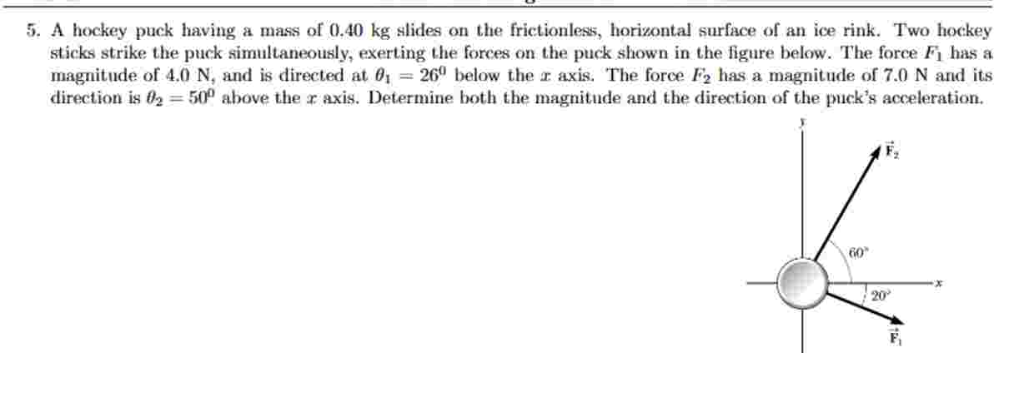 5. A hockey puck having a mass of 0.40 kg slides on the frictionless, horizontal surface of an ice rink. Two hockey
sticks strike the puck simultaneously, exerting the forces on the puck shown in the figure below. The force Fy has a
magnitude of 4.0 N, and is directed at 6; = 26 below the r axis. The force I; has a magnitude of 7.0 N and its
direction is fz = 50° above the r axis. Determine both the magnitude and the direction of the puck’s acceleration.
|
"
4 .
; 20°
F
This is AI generated Response.
Asked by: gvr
Created at: 2025-06-17 06:05:02
Asked by: gvr
Created at: 2025-06-17 06:05:02
Final Answer:
Rendered
Raw Text
Did you like this answer?
Let's break down the problem step by step:
### **Given:**
- Mass of puck, \( m = 0.40 \) kg
- Force \( F_1 = 4.0 \) N at \( \theta_1 = 20^\circ \) **below** the x-axis (so, -20° from x-axis)
- Force \( F_2 = 7.0 \) N at \( \theta_2 = 50^\circ \) **above** the x-axis
- **Frictionless** surface
### **Step 1: Decompose Forces into Components**
#### **For \( F_1 \):**
\[
\text{Components:}
\]
\[
F_{1x} = F_1 \cos(-20^\circ) = 4.0 \cos(-20^\circ)
\]
\[
F_{1y} = F_1 \sin(-20^\circ) = 4.0 \sin(-20^\circ)
\]
#### **For \( F_2 \):**
\[
F_{2x} = F_2 \cos(50^\circ) = 7.0 \cos(50^\circ)
\]
\[
F_{2y} = F_2 \sin(50^\circ) = 7.0 \sin(50^\circ)
\]
---
### **Step 2: Calculate Components Numerically**
#### **\( F_1 \) Components:**
- \( \cos(-20^\circ) = \cos(20^\circ) = 0.9397 \)
- \( \sin(-20^\circ) = -0.3420 \)
\[
F_{1x} = 4.0 \times 0.9397 = 3.7588 \text{ N}
\]
\[
F_{1y} = 4.0 \times (-0.3420) = -1.368 \text{ N}
\]
#### **\( F_2 \) Components:**
- \( \cos(50^\circ) = 0.6428 \)
- \( \sin(50^\circ) = 0.7660 \)
\[
F_{2x} = 7.0 \times 0.6428 = 4.4996 \text{ N}
\]
\[
F_{2y} = 7.0 \times 0.7660 = 5.362 \text{ N}
\]
---
### **Step 3: Add the Components**
\[
F_{x,\text{total}} = F_{1x} + F_{2x} = 3.7588 + 4.4996 = 8.2584 \text{ N}
\]
\[
F_{y,\text{total}} = F_{1y} + F_{2y} = (-1.368) + 5.362 = 3.994 \text{ N}
\]
---
### **Step 4: Find Magnitude of Net Force**
\[
F_{\text{net}} = \sqrt{F_{x,\text{total}}^2 + F_{y,\text{total}}^2}
\]
\[
= \sqrt{(8.2584)^2 + (3.994)^2}
\]
\[
= \sqrt{68.187 + 15.952}
\]
\[
= \sqrt{84.139}
\]
\[
= 9.175 \text{ N}
\]
---
### **Step 5: Find Direction of Net Force**
\[
\theta = \arctan\left(\frac{F_{y,\text{total}}}{F_{x,\text{total}}}\right)
= \arctan\left(\frac{3.994}{8.2584}\right)
\]
\[
= \arctan(0.484)
\]
\[
= 25.8^\circ
\]
**This angle is above the x-axis.**
---
### **Step 6: Find Acceleration**
\[
a = \frac{F_{\text{net}}}{m}
= \frac{9.175}{0.40}
= 22.94 \text{ m/s}^2
\]
---
## **Final Answers**
### **Magnitude of acceleration:**
\[
\boxed{22.9 \text{ m/s}^2}
\]
### **Direction of acceleration:**
\[
\boxed{25.8^\circ\ \text{above the x-axis}}
\]
---
If you need a diagram or further explanation, let me know!
Question:
i need 2 lines pure theory for explanation
This is AI generated Response.
Asked by: gvr
Created at: 2025-06-17 06:07:29
Asked by: gvr
Created at: 2025-06-17 06:07:29
Final Answer:
Rendered
Raw Text
Did you like this answer?
The net acceleration of the puck is determined by vector addition of all applied forces, using their components along the coordinate axes. The resulting force's magnitude and direction are then obtained from the combined components, and the acceleration is found by dividing this net force by the mass.
📢 Instructions:
- Ask anything relatd to above question only.
- For new Question goto :