 VIPSolutions
Give step-by-step solution with explanation and final answer:1 an po) JEyeTT— ‘ nde Ered u ot Yes) (0) State (do ot rove) hcp de detion of o, in5) = 1 2.20 pot) Uo trite lo thee he th 4-5 hn sti f .3, 3 0 oi) (0 thee sn elt Veer the og of the tog eo cove pein and th min J"? (aio i desi off ded sk pe) (0) Caml tet f(r) = 3% - 21+ 1. Fi the cption often ioe 0 the curve at froresalins 30 pot) Spon 5. are ileal cin of , sd 574-35 = 0. Us lc dir nto td 5. ond 0 mpl he as 510 pois) Ug Wt method, ppm 27 wih or ew th § That Besta Luck
Question:
Give step-by-step solution with explanation and final answer: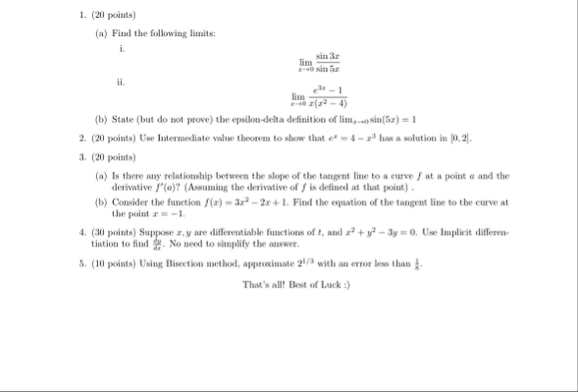 1 an po)
JEyeTT—
‘ nde
Ered
u
ot
Yes)
(0) State (do ot rove) hcp de detion of o, in5) = 1
2.20 pot) Uo trite lo thee he th 4-5 hn sti f .3,
3 0 oi)
(0 thee sn elt Veer the og of the tog eo cove pein and th
min J"? (aio i desi off ded sk pe)
(0) Caml tet f(r) = 3% - 21+ 1. Fi the cption often ioe 0 the curve at
froresalins
30 pot) Spon 5. are ileal cin of , sd 574-35 = 0. Us lc dir
nto td 5. ond 0 mpl he as
510 pois) Ug Wt method, ppm 27 wih or ew th §
That Besta Luck
This is AI generated Response.
Asked by: gvr
Created at: 2025-06-17 05:58:04
Asked by: gvr
Created at: 2025-06-17 05:58:04
Final Answer:
Rendered
Raw Text
Did you like this answer?
Let's solve the problems step by step as requested:
---
## **1. (20 points)**
### (a) Find the following limits:
#### (i) \(\lim_{x \to 0} \frac{\sin 3x}{\sin 5x}\)
**Step 1:** Recall that \(\lim_{x \to 0} \frac{\sin(ax)}{ax} = 1\).
\[
\frac{\sin 3x}{\sin 5x} = \frac{\sin 3x}{3x} \cdot \frac{5x}{\sin 5x} \cdot \frac{3x}{5x}
\]
**Step 2:** Take the limit:
\[
\lim_{x \to 0} \frac{\sin 3x}{\sin 5x} = \lim_{x \to 0} \left(\frac{\sin 3x}{3x} \cdot \frac{5x}{\sin 5x} \cdot \frac{3}{5}\right)
\]
Each limit:
- \(\lim_{x \to 0} \frac{\sin 3x}{3x} = 1\)
- \(\lim_{x \to 0} \frac{5x}{\sin 5x} = 1\)
So,
\[
\lim_{x \to 0} \frac{\sin 3x}{\sin 5x} = 1 \cdot 1 \cdot \frac{3}{5} = \frac{3}{5}
\]
**Final answer:**
\[
\boxed{\frac{3}{5}}
\]
---
#### (ii) \(\lim_{x \to 2} \frac{x^2 - 1}{x^2(x^2-4)}\)
**Step 1:** Substitute \(x = 2\):
- \(x^2 - 1 = 4 - 1 = 3\)
- \(x^2 = 4\)
- \(x^2 - 4 = 0\)
So denominator is zero: \(4 \times 0 = 0\), numerator is 3. So, the function approaches infinity or negative infinity. Let's check the sign:
- For \(x \to 2^+\): \(x^2-4\) is slightly positive, denominator positive, numerator positive: \(+\infty\)
- For \(x \to 2^-\): \(x^2-4\) is slightly negative, denominator negative, numerator positive: \(-\infty\)
**So the limit does not exist (infinite discontinuity).**
**Final Answer:**
\[
\boxed{\text{The limit does not exist (approaches } +\infty \text{ from right and } -\infty \text{ from left)}}
\]
---
### (b) State (but do not prove) the epsilon-delta definition of \(\lim_{x \to 0} \sin(5x) = 0\):
**Answer:**
For every \(\epsilon > 0\), there exists a \(\delta > 0\) such that for all \(x\),
\[
0 < |x| < \delta \implies |\sin(5x) - 0| < \epsilon
\]
---
## **2. (20 points)**
Use the Intermediate Value Theorem to show that \(e^x = 4 - x^2\) has a solution in \([0,2]\).
**Step 1:** Define \(f(x) = e^x - 4 + x^2\).
**Step 2:** Check values at the endpoints:
- \(f(0) = 1 - 4 + 0 = -3\)
- \(f(2) = e^2 - 4 + 4 = e^2 \approx 7.389 > 0\)
**Step 3:** Since \(f(0) < 0\) and \(f(2) > 0\), by the Intermediate Value Theorem, \(f(x)\) has a root in \((0,2)\).
**Final Answer:**
By the intermediate value theorem, there exists \(c \in (0,2)\) such that \(e^c = 4 - c^2\).
---
## **3. (20 points)**
### (a) Is there any relationship between the slope of the tangent line to a curve \(f\) at a point \(a\) and the derivative \(f'(a)\)?
**Answer:**
Yes. The slope of the tangent line to the curve \(y=f(x)\) at the point \(x=a\) is exactly the value of the derivative at that point, \(f'(a)\).
---
### (b) Consider \(f(x) = 3x^2 - 2x + 1\). Find the equation of the tangent line at \(x = -1\).
**Step 1:** Calculate \(f(-1)\):
\[
f(-1) = 3(-1)^2 - 2(-1) + 1 = 3(1) + 2 + 1 = 6
\]
**Step 2:** Find \(f'(x)\):
\[
f'(x) = 6x - 2
\]
\[
f'(-1) = 6(-1) - 2 = -6 - 2 = -8
\]
**Step 3:** Equation of tangent line:
\[
y - f(-1) = f'(-1)(x + 1)
\]
\[
y - 6 = -8(x + 1) \implies y = -8x - 8 + 6 \implies y = -8x - 2
\]
**Final answer:**
\[
\boxed{y = -8x - 2}
\]
---
## **4. (30 points)**
Suppose \(x, y\) are differentiable functions of \(t\), and \(x^2 + y^2 - 3y = 0\). Use implicit differentiation to find \(\frac{dy}{dt}\). (No need to simplify.)
**Differentiate both sides with respect to \(t\):**
\[
\frac{d}{dt}(x^2 + y^2 - 3y) = 0
\]
\[
2x\frac{dx}{dt} + 2y\frac{dy}{dt} - 3\frac{dy}{dt} = 0
\]
\[
2x\frac{dx}{dt} + (2y - 3)\frac{dy}{dt} = 0
\]
**Solve for \(\frac{dy}{dt}\):**
\[
(2y - 3)\frac{dy}{dt} = -2x\frac{dx}{dt}
\]
\[
\frac{dy}{dt} = \frac{-2x}{2y - 3}\frac{dx}{dt}
\]
**Final answer:**
\[
\boxed{\frac{dy}{dt} = \frac{-2x}{2y - 3} \frac{dx}{dt}}
\]
---
## **5. (10 points)**
Using the Bisection method, approximate \(2^{1/3}\) with error less than \(\frac{1}{2}\).
Let \(f(x) = x^3 - 2\).
- \(f(1) = 1 - 2 = -1\)
- \(f(2) = 8 - 2 = 6\)
So root is in \([1,2]\).
**Bisection steps:**
1. \(x_1 = 1\), \(x_2 = 2\)
2. \(x_m = 1.5\), \(f(1.5) = (1.5)^3 - 2 = 3.375 - 2 = 1.375\) (root is between 1 and 1.5)
3. \(x_m = 1.25\), \(f(1.25) = (1.25)^3 - 2 = 1.953125 - 2 = -0.046875\) (root is between 1.25 and 1.5)
4. \(x_m = 1.375\), \(f(1.375) = (1.375)^3 - 2 = 2.595703125 - 2 = 0.595703125\) (root is between 1.25 and 1.375)
5. \(x_m = 1.3125\), \(f(1.3125) = (1.3125)^3 - 2 = 2.260986328125 - 2 = 0.260986328125\) (root is between 1.25 and 1.3125)
The interval is \([1.25, 1.3125]\), with width \(0.0625\), less than \(0.5\).
**Approximate value:**
The midpoint \(x \approx 1.3125\).
**Final answer:**
\[
\boxed{2^{1/3} \approx 1.3125 \text{ (with error less than } \frac{1}{2})}
\]
---
Let me know if you need further clarifications on any part!
Question:
i need all parts only final Answers
This is AI generated Response.
Asked by: gvr
Created at: 2025-06-17 05:59:14
Asked by: gvr
Created at: 2025-06-17 05:59:14
Final Answer:
Rendered
Raw Text
Did you like this answer?
Certainly! Here are the final answers for each part:
1. **Limit \(\lim_{x \to 0} \frac{\sin 3x}{\sin 5x}\):**
\(\boxed{\frac{3}{5}}\)
2. **Limit \(\lim_{x \to 2} \frac{x^2 - 1}{x^2(x^2-4)}\):**
Does not exist (approaches \(\pm \infty\)).
3. **Epsilon-delta definition of \(\lim_{x \to 0} \sin(5x) = 0\):**
For every \(\epsilon > 0\), there exists \(\delta > 0\) such that if \(0 < |x| < \delta\), then \(|\sin(5x)| < \epsilon\).
4. **Existence of solution to \(e^x = 4 - x^2\) in \([0,2]\):**
Yes, there is at least one solution in \((0,2)\).
5. **Relationship between slope and derivative:**
Yes, the slope of the tangent line at a point is \(f'(a)\).
6. **Tangent line to \(f(x) = 3x^2 - 2x + 1\) at \(x=-1\):**
\[
\boxed{y = -8x - 2}
\]
7. **Implicit differentiation result for \(x^2 + y^2 - 3y= 0\):**
\[
\boxed{\frac{dy}{dt} = \frac{-2x}{2y - 3} \frac{dx}{dt}}
\]
8. **Approximation of \(2^{1/3}\) via Bisection with error < 0.5:**
\(\boxed{1.3125}\)
Let me know if you'd like any further details!
📢 Instructions:
- Ask anything relatd to above question only.
- For new Question goto :