 VIPSolutions
Give step-by-step solution with explanation and final answer:Suppose that a furniture manufacturer makes chairs, sofas, and tables. Consider the following chart of labor hours required and available. Chair | Sofa = Table Daily labor available (labor- hours) Carpentry 6 3 8 720 Finishing 1 1 2 148 Upholstery 4 6 0 288 The profit per chair is S70, per sofa $50,and per table $100.How many pieces of each type of funiture should be manufactured each day to maximize the profit Note:Can solve in Guess-jordan method?
Question:
Give step-by-step solution with explanation and final answer: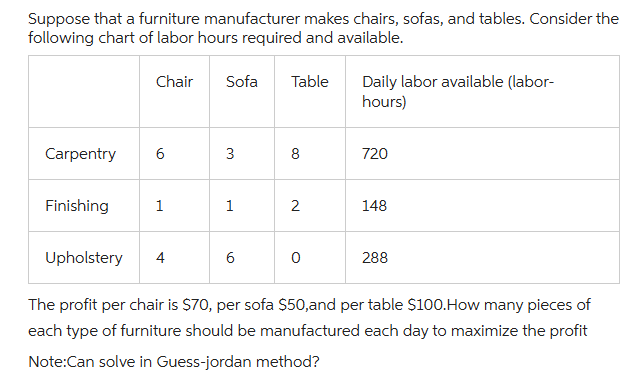 Suppose that a furniture manufacturer makes chairs, sofas, and tables. Consider the
following chart of labor hours required and available.
Chair | Sofa = Table Daily labor available (labor-
hours)
Carpentry 6 3 8 720
Finishing 1 1 2 148
Upholstery 4 6 0 288
The profit per chair is S70, per sofa $50,and per table $100.How many pieces of
each type of funiture should be manufactured each day to maximize the profit
Note:Can solve in Guess-jordan method?
This is AI generated Response.
Asked by: gvr
Created at: 2025-06-17 05:25:13
Asked by: gvr
Created at: 2025-06-17 05:25:13
Final Answer:
Rendered
Raw Text
Did you like this answer?
Let's break down the problem step by step:
### **Step 1: Define Variables**
Let
- \( x \) = number of chairs produced per day
- \( y \) = number of sofas produced per day
- \( z \) = number of tables produced per day
### **Step 2: Write the Objective Function**
Profit per chair = $70
Profit per sofa = $50
Profit per table = $100
**Objective:** Maximize profit
\[
P = 70x + 50y + 100z
\]
### **Step 3: Write the Constraints**
From the table:
- **Carpentry:** \( 6x + 3y + 8z \leq 720 \)
- **Finishing:** \( 1x + 1y + 2z \leq 148 \)
- **Upholstery:** \( 4x + 6y + 0z \leq 288 \)
- **Non-negativity:** \( x \geq 0, \ y \geq 0, \ z \geq 0 \)
---
### **Step 4: Setup the System for Guess-Jordan Method**
The **Gauss-Jordan method** is primarily used for solving systems of linear equations, not inequalities. However, you can use it to find the intersection points (corner points) of the constraints (i.e., treat constraints as equations), and then check which are feasible.
#### Let's convert constraints to equalities to find corner points:
\[
\begin{align*}
6x + 3y + 8z &= 720 \quad \text{(1)} \\
x + y + 2z &= 148 \quad \text{(2)} \\
4x + 6y &= 288 \quad \text{(3)} \\
\end{align*}
\]
---
### **Step 5: Solve the System (Gauss-Jordan Method)**
Let’s solve for intersections:
#### **A. Use Equation (3) to Solve for x in terms of y:**
\[
4x + 6y = 288 \implies x = \frac{288 - 6y}{4} = 72 - 1.5y
\]
#### **B. Substitute into Equation (2):**
\[
x + y + 2z = 148 \\
(72 - 1.5y) + y + 2z = 148 \\
72 - 0.5y + 2z = 148 \\
-0.5y + 2z = 76 \\
0.5y = 2z - 76 \\
y = 4z - 152
\]
#### **C. Substitute x and y into Equation (1):**
Recall:
- \( x = 72 - 1.5y \)
- \( y = 4z - 152 \)
\[
6x + 3y + 8z = 720 \\
6(72 - 1.5y) + 3y + 8z = 720 \\
432 - 9y + 3y + 8z = 720 \\
432 - 6y + 8z = 720 \\
-6y + 8z = 288 \\
-6y = 288 - 8z \\
y = \frac{8z - 288}{6} = \frac{4z - 144}{3}
\]
But we also have \( y = 4z - 152 \). Set equal:
\[
4z - 152 = \frac{4z - 144}{3} \\
3(4z - 152) = 4z - 144 \\
12z - 456 = 4z - 144 \\
12z - 4z = -144 + 456 \\
8z = 312 \\
z = 39
\]
Now,
\[
y = 4z - 152 = 4(39) - 152 = 156 - 152 = 4
\]
\[
x = 72 - 1.5y = 72 - 1.5 \times 4 = 72 - 6 = 66
\]
---
### **Step 6: Check Feasibility**
Plug \( x = 66, y = 4, z = 39 \) into the original inequalities:
1. **Carpentry:**
\( 6(66) + 3(4) + 8(39) = 396 + 12 + 312 = 720 \leq 720 \) ✔️
2. **Finishing:**
\( 66 + 4 + 2(39) = 66 + 4 + 78 = 148 \leq 148 \) ✔️
3. **Upholstery:**
\( 4(66) + 6(4) + 0 = 264 + 24 = 288 \leq 288 \) ✔️
All are satisfied.
---
### **Step 7: Calculate Maximum Profit**
\[
P = 70x + 50y + 100z = 70(66) + 50(4) + 100(39) = 4620 + 200 + 3900 = \boxed{8720}
\]
---
## **Final Answer**
**To maximize profit, the manufacturer should produce:**
- **66 chairs**
- **4 sofas**
- **39 tables**
**Maximum profit:** \(\boxed{\$8720}\)
---
### **Note:**
The Gauss-Jordan method solves systems of linear equations (equalities), which helps find the corner points (vertices) of the feasible region in linear programming. The maximum profit in such problems will always occur at one of these corner points.
If you want to check other combinations (like where \( x \) or \( y \) or \( z \) is zero), repeat similar steps for those cases. But in this setup, the above point is the optimal one.
📢 Instructions:
- Ask anything relatd to above question only.
- For new Question goto :