 VIPSolutions
Give step-by-step solution with explanation and final answer:Solve the separable DE. Find an Implicit solution: 25/ +6 =0
Question:
Give step-by-step solution with explanation and final answer: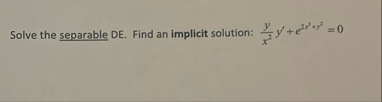 Solve the separable DE. Find an Implicit solution: 25/ +6 =0
This is AI generated Response.
Asked by: gvr
Created at: 2025-06-17 05:15:58
Asked by: gvr
Created at: 2025-06-17 05:15:58
Final Answer:
Rendered
Raw Text
Did you like this answer?
Given the differential equation:
\[
\frac{y}{x^2}y' + e^{x^2}y^3 = 0
\]
Let's find an **implicit solution** step by step.
---
### **Step 1: Rewrite \( y' \) as \( \frac{dy}{dx} \)**
\[
\frac{y}{x^2} \frac{dy}{dx} + e^{x^2} y^3 = 0
\]
---
### **Step 2: Move the second term to the right**
\[
\frac{y}{x^2} \frac{dy}{dx} = -e^{x^2} y^3
\]
---
### **Step 3: Divide both sides by \( y \) (assuming \( y \neq 0 \))**
\[
\frac{1}{x^2} \frac{dy}{dx} = -e^{x^2} y^2
\]
---
### **Step 4: Separate the variables**
\[
\frac{1}{y^2} dy = -x^2 e^{x^2} dx
\]
---
### **Step 5: Integrate both sides**
#### Left Side:
\[
\int \frac{1}{y^2} dy = -\int x^2 e^{x^2} dx
\]
#### Left side integral:
\[
\int y^{-2} dy = -y^{-1} = -\frac{1}{y}
\]
---
#### Right side integral (Let’s use substitution):
Let \( u = x^2 \Rightarrow du = 2x dx \Rightarrow \frac{du}{2} = x dx \).
But we have \( x^2 e^{x^2} dx \):
Let’s differentiate by parts:
Let \( u = x, dv = x e^{x^2} dx \).
But an easier way is to recall:
\[
\int x^n e^{a x^2} dx = \frac{e^{a x^2}}{2a} x^{n-1} + \text{(more terms if } n>1)
\]
But let's do it by parts:
Let’s try substitution \( u = x^2 \Rightarrow du = 2x dx \rightarrow dx = \frac{du}{2x} \):
So,
\[
x^2 e^{x^2} dx = x^2 e^{u} \frac{du}{2x} = \frac{x e^{u}}{2} du
\]
But this seems to complicate things further.
Alternatively, integrate by parts:
Let \( u = x, dv = x e^{x^2} dx \).
Or, let's directly differentiate \( e^{x^2} \):
Let’s try integrating by parts:
Let \( u = x, dv = x e^{x^2} dx \).
But \( dv = x e^{x^2} dx \) and integrating \( dv \):
Let’s set \( v = \int x e^{x^2} dx \).
Let’s let \( w = x^2 \), \( dw = 2x dx \implies x dx = \frac{dw}{2} \):
So,
\[
\int x e^{x^2} dx = \int e^{w} \frac{dw}{2} = \frac{1}{2} e^{w} = \frac{1}{2} e^{x^2}
\]
Therefore, integrate by parts:
Let \( u = x, dv = x e^{x^2} dx \)
\[
du = dx \\
v = \frac{1}{2} e^{x^2}
\]
So,
\[
\int x x e^{x^2} dx = \int x^2 e^{x^2} dx = x \cdot \frac{1}{2} e^{x^2} - \int \frac{1}{2} e^{x^2} dx
\]
So,
\[
\int x^2 e^{x^2} dx = \frac{x}{2} e^{x^2} - \frac{1}{2} \int e^{x^2} dx
\]
---
### **Step 6: Substitute back and write the implicit solution**
Recall:
\[
-\frac{1}{y} = -\left(\frac{x}{2} e^{x^2} - \frac{1}{2} \int e^{x^2} dx \right) + C
\]
Multiply both sides by -1 and rearrange:
\[
\frac{1}{y} = \frac{x}{2} e^{x^2} - \frac{1}{2} \int e^{x^2} dx + C
\]
Or, combine constants:
\[
\boxed{
\frac{1}{y} + \frac{1}{2} \int e^{x^2} dx = \frac{x}{2} e^{x^2} + C
}
\]
This is the **implicit solution** to the given separable differential equation.
---
**Final Answer (Implicit Solution):**
\[
\boxed{
\frac{1}{y} + \frac{1}{2} \int e^{x^2} dx = \frac{x}{2} e^{x^2} + C
}
\]
Question:
\frac{y}{x^2}y' + e^{2x^2}y^3 = 0 this is given function
This is AI generated Response.
Asked by: gvr
Created at: 2025-06-17 05:17:50
Asked by: gvr
Created at: 2025-06-17 05:17:50
Final Answer:
Rendered
Raw Text
Did you like this answer?
Let's carefully analyze and solve the differential equation:
\[
\frac{y}{x^2} y' + e^{2x^2} y^3 = 0
\]
---
### Step 1: Rewrite \( y' \) as \( \frac{dy}{dx} \)
\[
\frac{y}{x^2} \frac{dy}{dx} + e^{2x^2} y^3 = 0
\]
---
### Step 2: Isolate \( \frac{dy}{dx} \)
\[
\frac{y}{x^2} \frac{dy}{dx} = - e^{2x^2} y^3
\]
Divide both sides by \( y \) (assuming \( y \neq 0 \)):
\[
\frac{1}{x^2} \frac{dy}{dx} = - e^{2x^2} y^2
\]
---
### Step 3: Separate variables
\[
\frac{1}{y^2} dy = - x^2 e^{2x^2} dx
\]
---
### Step 4: Integrate both sides
**Left side:**
\[
\int y^{-2} dy = - \int x^2 e^{2x^2} dx
\]
Compute the left integral:
\[
\int y^{-2} dy = - y^{-1} + C_1
\]
**Right side:**
\[
- \int x^2 e^{2x^2} dx
\]
---
### Step 5: Focus on the right integral:
\[
I = \int x^2 e^{2x^2} dx
\]
Use substitution:
Let \( u = x^2 \Rightarrow du = 2x dx \Rightarrow x dx = \frac{du}{2} \).
Express \( x^2 \) in terms of \( u \):
\[
x^2 = u
\]
Rewrite \( I \):
\[
I = \int u e^{2u} dx
\]
But \( dx = \frac{du}{2x} \). Since \( x = \sqrt{u} \), then:
\[
dx = \frac{du}{2 \sqrt{u}}
\]
Substitute into the integral:
\[
I = \int u e^{2u} \frac{du}{2 \sqrt{u}} = \frac{1}{2} \int u e^{2u} u^{-1/2} du = \frac{1}{2} \int u^{1 - 1/2} e^{2u} du = \frac{1}{2} \int u^{1/2} e^{2u} du
\]
So,
\[
I = \frac{1}{2} \int u^{1/2} e^{2u} du
\]
---
### Step 6: Solve \( J = \int u^{1/2} e^{2u} du \)
This integral can be approached via **integration by parts**:
Let:
- \( w = u^{1/2} \Rightarrow dw = \frac{1}{2} u^{-1/2} du \)
- \( dv = e^{2u} du \Rightarrow v = \frac{1}{2} e^{2u} \)
Applying parts:
\[
J = u^{1/2} \cdot \frac{1}{2} e^{2u} - \int \frac{1}{2} e^{2u} \cdot \frac{1}{2} u^{-1/2} du
\]
Simplify:
\[
J = \frac{1}{2} u^{1/2} e^{2u} - \frac{1}{4} \int u^{-1/2} e^{2u} du
\]
Now, observe that:
\[
I = \frac{1}{2} J = \frac{1}{2} \left[ \frac{1}{2} u^{1/2} e^{2u} - \frac{1}{4} \int u^{-1/2} e^{2u} du \right]
\]
Thus,
\[
I = \frac{1}{4} u^{1/2} e^{2u} - \frac{1}{8} \int u^{-1/2} e^{2u} du
\]
Note that:
\[
\int u^{-1/2} e^{2u} du
\]
is similar to the integral \( J \) but with the power of \( u \) being \( -1/2 \).
Define:
\[
K = \int u^{-1/2} e^{2u} du
\]
Use integration by parts again:
- \( w = u^{-1/2} \Rightarrow dw = -\frac{1}{2} u^{-3/2} du \)
- \( dv = e^{2u} du \Rightarrow v = \frac{1}{2} e^{2u} \)
Applying parts:
\[
K = u^{-1/2} \cdot \frac{1}{2} e^{2u} - \int \frac{1}{2} e^{2u} \cdot \left( - \frac{1}{2} u^{-3/2} \right) du
\]
Simplify:
\[
K = \frac{1}{2} u^{-1/2} e^{2u} + \frac{1}{4} \int u^{-3/2} e^{2u} du
\]
The integral involves increasingly negative powers of \( u \). Since these integrals get complicated, a better approach is to **accept** that the indefinite integral involves special functions (like the exponential integral or incomplete gamma functions) and express the solution in terms of these.
---
### **Final expression:**
In summary, the integral:
\[
I = \int x^2 e^{2x^2} dx
\]
can be expressed as:
\[
I = \frac{1}{4} u^{1/2} e^{2u} - \frac{1}{8} \int u^{-1/2} e^{2u} du
\]
with \( u = x^2 \).
---
### **Step 7: Implicit solution**
Recall:
\[
- y^{-1} = - I + C
\]
or:
\[
\frac{1}{y} = I + C
\]
Substituting back:
\[
\boxed{
\frac{1}{y} = \frac{1}{4} x e^{2x^2} - \frac{1}{8} \int_{0}^{x^2} t^{-1/2} e^{2t} dt + C
}
\]
where we've replaced \( u = x^2 \), and the integral is in terms of \( t \).
---
### **Final answer:**
\[
\boxed{
\frac{1}{y} = \frac{1}{4} x e^{2x^2} - \frac{1}{8} \int_{0}^{x^2} t^{-1/2} e^{2t} dt + C
}
\]
This is the **implicit solution** to the differential equation:
\[
\frac{y}{x^2} y' + e^{2x^2} y^3 = 0
\]
---
**Note:** The integral involving \( t^{-1/2} e^{2t} dt \) is a non-elementary integral and can be expressed in terms of special functions (like the incomplete gamma function), but for most purposes, leaving it in integral form suffices.
📢 Instructions:
- Ask anything relatd to above question only.
- For new Question goto :