 VIPSolutions
Give step-by-step solution with explanation and final answer:Consider the volume obtained by rotating abou ol the -ans th region thocuves Y= B — Ly = 4 — 2: ang 5 oe 1H o0clo Complete the followin tasks (a) Dotormine tho nis of nario we use the ying Compute the volume the soldescribed shove, + °""1EH Nels Meta to | (0) Stato tho cylindrical shell base rach asa unction of x RED AR ines sone hte sa ren
Question:
Give step-by-step solution with explanation and final answer: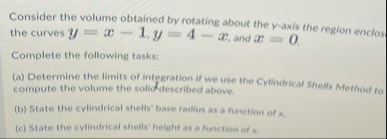 Consider the volume obtained by rotating abou
ol the -ans th region
thocuves Y= B — Ly = 4 — 2: ang 5 oe 1H o0clo
Complete the followin tasks
(a) Dotormine tho nis of nario we use the ying
Compute the volume the soldescribed shove, + °""1EH Nels Meta to
| (0) Stato tho cylindrical shell base rach asa unction of x
RED AR ines sone hte sa ren
This is AI generated Response.
Asked by: gvr
Created at: 2025-06-17 04:46:36
Asked by: gvr
Created at: 2025-06-17 04:46:36
Final Answer:
Rendered
Raw Text
Did you like this answer?
Let's go step by step through the problem:
### **Given:**
- Curves: \( y = x - 1 \), \( y = 4 - x \), and \( x = 0 \)
- Solid obtained by rotating the enclosed region about the **y-axis**
- **Method:** Cylindrical Shells
---
## **(a) Limits of Integration**
### **Step 1: Find the intersection points**
Set \( y = x - 1 \) equal to \( y = 4 - x \):
\[
x - 1 = 4 - x
\]
\[
2x = 5
\]
\[
x = \frac{5}{2}
\]
Check where \( x = 0 \) fits in:
- At \( x = 0 \), \( y = -1 \) from \( y = x - 1 \)
- At \( x = \frac{5}{2} \), both curves meet at \( y = \frac{3}{2} \)
So, the **limits for \( x \)** are from \( 0 \) to \( \frac{5}{2} \).
**Final Answer for (a):**
\[
\boxed{0 \leq x \leq \frac{5}{2}}
\]
---
## **(b) Cylindrical Shells' Base Radius as a Function of \( x \)**
The **cylindrical shell** at position \( x \) has radius = distance from the y-axis (since we rotate around y-axis):
\[
\text{Radius} = x
\]
**Final Answer for (b):**
\[
\boxed{\text{Base radius as a function of } x: \quad r(x) = x}
\]
---
## **(c) Cylindrical Shells' Height as a Function of \( x \)**
For each \( x \), the height is the vertical distance between the two curves:
\[
\text{Height} = (\text{Upper curve}) - (\text{Lower curve})
\]
- Upper curve: \( y = 4 - x \)
- Lower curve: \( y = x - 1 \)
So:
\[
\text{Height} = (4 - x) - (x - 1) = 4 - x - x + 1 = 5 - 2x
\]
**Final Answer for (c):**
\[
\boxed{\text{Height as a function of } x: \quad h(x) = 5 - 2x}
\]
---
## **Summary Table**
| Part | Answer |
|------|--------|
| (a) | \( 0 \leq x \leq \frac{5}{2} \) |
| (b) | \( r(x) = x \) |
| (c) | \( h(x) = 5 - 2x \) |
Let me know if you'd like to compute the actual volume as well!
📢 Instructions:
- Ask anything relatd to above question only.
- For new Question goto :