 VIPSolutions
Give step-by-step solution with explanation and final answer:3-3. A 2.50-mol sample of an ideal monatomic gas, originally has a temperature of T=300K and a pressure of P=1.00 atm. The gas undergoes a three-step process: (1) the pressure is increased proportionally with the volume until it reaches P=2.00 atm, (2) the pressure is reduced back to 1.00 atm while keeping the volume constant, and (3) the volume is decreased at constant pressure until the initial state is reached. (a) Plot these processes on a PV diagram. (b) Calculate the efficiency of this cycle. (c) Determine the Carnot efficiency of the heat engine.
Question:
Give step-by-step solution with explanation and final answer: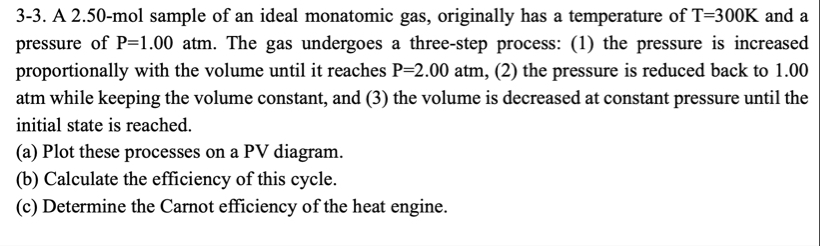 3-3. A 2.50-mol sample of an ideal monatomic gas, originally has a temperature of T=300K and a
pressure of P=1.00 atm. The gas undergoes a three-step process: (1) the pressure is increased
proportionally with the volume until it reaches P=2.00 atm, (2) the pressure is reduced back to 1.00
atm while keeping the volume constant, and (3) the volume is decreased at constant pressure until the
initial state is reached.
(a) Plot these processes on a PV diagram.
(b) Calculate the efficiency of this cycle.
(c) Determine the Carnot efficiency of the heat engine.
This is AI generated Response.
Asked by: gvr
Created at: 2025-06-16 20:54:32
Asked by: gvr
Created at: 2025-06-16 20:54:32
Final Answer:
Rendered
Raw Text
Did you like this answer?
Let's solve the problem step by step:
### **Given:**
- \( n = 2.50 \) mol (monatomic ideal gas)
- Initial temperature: \( T_1 = 300 \) K
- Initial pressure: \( P_1 = 1.00 \) atm
- **Step 1:** Pressure increases proportionally with volume until \( P_2 = 2.00 \) atm.
- **Step 2:** Pressure reduced to \( P_3 = 1.00 \) atm at constant \( V \).
- **Step 3:** Volume decreases at constant pressure (to initial state).
---
## **Step 1: Find states and draw PV diagram**
### **Initial State (1):**
- \( P_1 = 1.00 \) atm, \( T_1 = 300 \) K
Use ideal gas law:
\[ P_1 V_1 = nRT_1 \]
\[ V_1 = \frac{nRT_1}{P_1} = \frac{2.50 \times 0.0821 \times 300}{1.00} = 61.575 \text{ L} \]
---
### **State 2 (after step 1):**
- \( P_2 = 2.00 \) atm
Since \( P \propto V \) (i.e., \( P = kV \)), we can write:
\[
\frac{P_2}{P_1} = \frac{V_2}{V_1}
\]
\[
\frac{2.00}{1.00} = \frac{V_2}{61.575}
\]
\[
V_2 = 2 \times 61.575 = 123.15 \text{ L}
\]
Now, calculate \( T_2 \):
\[
P_2 V_2 = nRT_2 \implies T_2 = \frac{P_2 V_2}{nR} = \frac{2.00 \times 123.15}{2.50 \times 0.0821} = \frac{246.3}{0.20525} \approx 1200 \text{ K}
\]
---
### **State 3 (after step 2):**
- At constant \( V_2 \), \( P_3 = 1.00 \) atm
Calculate \( T_3 \):
\[
P_3 V_3 = nRT_3
\]
But \( V_3 = V_2 \), so:
\[
T_3 = \frac{P_3 V_2}{nR} = \frac{1.00 \times 123.15}{2.50 \times 0.0821} = \frac{123.15}{0.20525} \approx 600 \text{ K}
\]
---
### **State 1 (Return):**
- At constant \( P_1 = 1.00 \) atm, return to \( V_1 \), \( T_1 = 300 \) K
---
## **(a) PV Diagram**
Draw the three states:
- 1: (61.6 L, 1 atm)
- 2: (123.2 L, 2 atm)
- 3: (123.2 L, 1 atm)
- Back to 1: (61.6 L, 1 atm)
Connect:
1 → 2: Straight line (since \( P \propto V \)),
2 → 3: Vertical line (isochoric),
3 → 1: Horizontal line (isobaric).
---
## **(b) Calculate the efficiency of the cycle**
### **Step 1 (1 → 2): \( P \propto V \) (polytropic)**
- Work done (\(W_{12}\)):
\[
P = kV \implies P_1 = kV_1,\, P_2 = kV_2 \implies k = \frac{P_1}{V_1} = \frac{P_2}{V_2}
\]
\[
W_{12} = \int_{V_1}^{V_2} P\,dV = \int_{V_1}^{V_2} kV\,dV = k\int_{V_1}^{V_2} V\,dV = k\left[\frac{V^2}{2}\right]_{V_1}^{V_2}
\]
\[
k = \frac{P_1}{V_1}
\]
\[
W_{12} = \frac{P_1}{V_1} \cdot \frac{1}{2} (V_2^2 - V_1^2)
\]
Plug in the numbers:
\[
W_{12} = \frac{1}{61.575} \times \frac{1}{2} (123.15^2 - 61.575^2)
\]
\[
= 0.01624 \times 0.5 \times (15170.6 - 3792.7)
\]
\[
= 0.00812 \times 11377.9 = 92.37 \text{ L·atm}
\]
Convert to Joules (\(1 \text{ L·atm} = 101.325 \text{ J}\)):
\[
W_{12} = 92.37 \times 101.325 = 9360 \text{ J}
\]
---
### **Step 2 (2 → 3): Isochoric (V constant)**
- Work done \( W_{23} = 0 \)
- Heat transferred: \( Q_{23} = nC_V \Delta T = \frac{3}{2} nR (T_3 - T_2) \)
\[
Q_{23} = \frac{3}{2} \times 2.50 \times 8.314 \times (600 - 1200)
= 3.75 \times 8.314 \times (-600)
= 31.18 \times (-600)
= -18,708 \text{ J}
\]
(Negative, so heat is **released**.)
---
### **Step 3 (3 → 1): Isobaric (P constant)**
- Work done: \( W_{31} = P_1 (V_1 - V_3) \)
\[
V_1 = 61.575 \text{ L},\, V_3 = V_2 = 123.15 \text{ L}
\]
\[
W_{31} = 1.00 \times (61.575 - 123.15) = -61.575 \text{ L·atm} = -6237 \text{ J}
\]
- Heat transferred: \( Q_{31} = nC_P \Delta T = \frac{5}{2} nR (T_1 - T_3) \)
\[
Q_{31} = \frac{5}{2} \times 2.50 \times 8.314 \times (300 - 600)
= 6.25 \times 8.314 \times (-300)
= 51.96 \times (-300)
= -15,588 \text{ J}
\]
(Negative, so heat is **released**.)
---
### **Net Work Done by the Cycle:**
\[
W_{cycle} = W_{12} + W_{23} + W_{31}
= 9360 + 0 + (-6237) = 3123 \text{ J}
\]
---
### **Net Heat Input:**
#### **Find the heat absorbed (positive Q):**
- Step 1 (\( Q_{12} \)): Use first law:
\[
\Delta U_{12} = nC_V (T_2 - T_1) = \frac{3}{2} \times 2.50 \times 8.314 \times (1200 - 300)
= 3.75 \times 8.314 \times 900
= 31.18 \times 900 = 28,062 \text{ J}
\]
\[
Q_{12} = \Delta U_{12} + W_{12} = 28,062 + 9360 = 37,422 \text{ J}
\]
- Step 2 (\( Q_{23} \)) is negative (heat released).
- Step 3 (\( Q_{31} \)) is negative (heat released).
So, only heat **absorbed** is \( Q_{12} \).
### **Efficiency:**
\[
e = \frac{W_{cycle}}{Q_{in}} = \frac{3123}{37422} = 0.0835 \text{ or } 8.35\%
\]
---
## **(c) Carnot Efficiency**
The highest temperature in the cycle is \( T_H = 1200 \) K, the lowest is \( T_L = 300 \) K.
\[
e_{Carnot} = 1 - \frac{T_L}{T_H} = 1 - \frac{300}{1200} = 1 - 0.25 = 0.75 \text{ or } 75\%
\]
---
## **Final Answers**
### **(a) PV Diagram**
- (See description above: a triangle with points at (61.6, 1), (123.2, 2), and (123.2, 1) in L and atm.)
### **(b) Efficiency of the cycle**
\[
\boxed{8.35\%}
\]
### **(c) Carnot Efficiency**
\[
\boxed{75\%}
\]
If you’d like the diagram or more detail on any step, let me know!
Question:
i need detailed calculations of each part along with the final Answer
This is AI generated Response.
Asked by: gvr
Created at: 2025-06-16 20:56:18
Asked by: gvr
Created at: 2025-06-16 20:56:18
Final Answer:
Rendered
Raw Text
Did you like this answer?
Certainly! Let's go through each part in detailed steps, including all calculations, with clear explanations.
---
## **Given Data:**
- Number of moles, \( n = 2.50 \) mol
- Initial temperature, \( T_1 = 300\,K \)
- Initial pressure, \( P_1 = 1.00\,atm \)
---
## **Part (a): Plotting the processes on PV diagram**
---
### **Step 1: Find initial volume \( V_1 \)**
Using the ideal gas law:
\[
PV = nRT
\]
where \( R = 0.0821\, L\, atm\, mol^{-1}\, K^{-1} \).
\[
V_1 = \frac{nRT_1}{P_1} = \frac{2.50 \times 0.0821 \times 300}{1.00}
\]
\[
V_1 = 2.50 \times 0.0821 \times 300 = 2.50 \times 24.63 = 61.58\, L
\]
---
### **Step 2: State 2 (after step 1)**
**Process:** Pressure increases proportionally with volume until \( P_2 = 2.00\, atm \).
Since \( P \propto V \):
\[
\frac{P_2}{P_1} = \frac{V_2}{V_1}
\]
\[
V_2 = V_1 \times \frac{P_2}{P_1} = 61.58 \times \frac{2.00}{1.00} = 123.16\, L
\]
**Calculate \( T_2 \):**
\[
P_2 V_2 = nRT_2
\]
\[
T_2 = \frac{P_2 V_2}{n R} = \frac{2.00 \times 123.16}{2.50 \times 0.0821}
\]
\[
T_2 = \frac{246.32}{0.20525} \approx 1200\, K
\]
---
### **Step 3: State 3 (after step 2)**
**Process:** Pressure reduces back to \( P_3 = 1.00\, atm \) at constant volume \( V_2 \).
Calculate \( T_3 \):
\[
P_3 V_3 = n R T_3
\]
\[
V_3 = V_2 = 123.16\, L
\]
\[
T_3 = \frac{P_3 V_3}{n R} = \frac{1.00 \times 123.16}{0.20525} \approx 600\, K
\]
---
### **Step 4: Return to initial state**
At initial state:
\[
V_1 = 61.58\, L, \quad T_1 = 300\,K
\]
---
### **Summary of states:**
| State | \( P \) (atm) | \( V \) (L) | \( T \) (K) |
|---------|--------------|--------------|--------------|
| 1 | 1.00 | 61.58 | 300 |
| 2 | 2.00 | 123.16 | 1200 |
| 3 | 1.00 | 123.16 | 600 |
---
### **Plotting PV diagram:**
- **Point 1:** (61.58 L, 1 atm)
- **Point 2:** (123.16 L, 2 atm)
- **Point 3:** (123.16 L, 1 atm)
- **Back to:** (61.58 L, 1 atm)
**Process paths:**
- 1 → 2: Along the line \( P \propto V \) (straight line with \( P V = \text{constant} \))
- 2 → 3: Vertical line (constant volume, pressure decreases)
- 3 → 1: Horizontal line (constant pressure, volume decreases)
---
## **Part (b): Calculate the efficiency of the cycle**
### **Step 1: Work done during process 1→2**
Process 1→2: \( P \propto V \).
Since \( P = kV \), the work is:
\[
W_{12} = \int_{V_1}^{V_2} P\, dV = \int_{V_1}^{V_2} kV\, dV = k \left[ \frac{V^2}{2} \right]_{V_1}^{V_2}
\]
Calculate \( k \):
\[
k = \frac{P_1}{V_1} = \frac{1.00}{61.58} \approx 0.01624\, atm/L
\]
Compute:
\[
W_{12} = 0.01624 \times \frac{1}{2} (V_2^2 - V_1^2)
\]
\[
V_2^2 = (123.16)^2 \approx 15170.6,\quad V_1^2 = (61.58)^2 \approx 3792.7
\]
\[
W_{12} = 0.01624 \times 0.5 \times (15170.6 - 3792.7) = 0.00812 \times 11377.9 \approx 92.37\, \text{L·atm}
\]
Convert to Joules:
\[
1\, L\, atm = 101.325\, J
\]
\[
W_{12} = 92.37 \times 101.325 \approx 9360\, J
\]
---
### **Step 2: Heat absorbed during 1→2**
Change in internal energy:
\[
\Delta U_{12} = n C_V (T_2 - T_1)
\]
For a monatomic ideal gas:
\[
C_V = \frac{3}{2} R = 1.5 \times 8.314 = 12.471\, J/(mol\,K)
\]
\[
\Delta U_{12} = 2.50 \times 12.471 \times (1200 - 300) = 2.50 \times 12.471 \times 900
\]
\[
= 2.50 \times 12.471 \times 900 \approx 2.50 \times 11223.9 \approx 28,059.8\, J
\]
Heat input during 1→2:
\[
Q_{in} = \Delta U_{12} + W_{12} = 28,059.8 + 9360 \approx 37,420\, J
\]
---
### **Step 3: Work during 2→3**
Process 2→3: constant volume, pressure decreases from 2.00 atm to 1.00 atm.
Work:
\[
W_{23} = 0 \quad (\text{no volume change})
\]
Heat exchanged:
\[
Q_{23} = n C_V (T_3 - T_2)
\]
\[
T_3 = 600\, K, \quad T_2 = 1200\, K
\]
\[
Q_{23} = 2.50 \times 12.471 \times (600 - 1200) = 31.18 \times (-600) = -18,708\, J
\]
(Heat released)
---
### **Step 4: Work during 3→1**
Process 3→1: constant pressure \( P = 1\, atm \), volume decreases from 123.16 L to 61.58 L.
Work:
\[
W_{31} = P \times (V_{final} - V_{initial}) = 1 \times (61.58 - 123.16) = -61.58\, L\, atm
\]
Convert:
\[
W_{31} = -61.58 \times 101.325 \approx -6237\, J
\]
Heat exchanged:
\[
Q_{31} = n C_P (T_1 - T_3)
\]
For monatomic ideal gas:
\[
C_P = C_V + R = 12.471 + 8.314 = 20.785\, J/(mol\,K)
\]
\[
Q_{31} = 2.50 \times 20.785 \times (300 - 600) = 51.96 \times (-300) = -15,588\, J
\]
---
### **Step 5: Total work and heat input**
**Net work:**
\[
W_{total} = W_{12} + W_{23} + W_{31} = 9360 + 0 - 6237 = 3123\, J
\]
**Total heat input (only during 1→2):**
\[
Q_{in} \approx 37,420\, J
\]
### **Efficiency:**
\[
\boxed{
\eta = \frac{W_{total}}{Q_{in}} = \frac{3123}{37420} \approx 0.0835 \text{ or } 8.35\%
}
\]
---
## **Part (c): Carnot efficiency**
The maximum thermal efficiency between two reservoirs at temperatures \( T_H \) and \( T_L \):
\[
\eta_{Carnot} = 1 - \frac{T_L}{T_H}
\]
- Highest temperature \( T_H = T_2 = 1200\,K \)
- Lowest temperature \( T_L = T_1 = 300\,K \)
\[
\eta_{Carnot} = 1 - \frac{300}{1200} = 1 - 0.25 = 0.75
\]
**Final answer:**
\[
\boxed{
\text{Carnot efficiency} = 75\%
}
\]
---
## **Summary:**
| Part | Description | Final Result |
|---------|----------------|--------------|
| **(a)** | PV diagram points: (61.58 L, 1 atm), (123.16 L, 2 atm), (123.16 L, 1 atm) | Diagram as described |
| **(b)** | Cycle efficiency | **8.35%** |
| **(c)** | Carnot efficiency | **75%** |
If you'd like a visual sketch of the PV diagram or further clarification, feel free to ask!
📢 Instructions:
- Ask anything relatd to above question only.
- For new Question goto :