 VIPSolutions
Give step-by-step solution with explanation and final answer:y y= 102% — $aF x 0 4 ‘The diagram shows the curve with equation y = 104 — 3% for x > 0. ‘The curve meets the x-axis at the points (0, 0) and (4, 0). Find the area of the shaded region. 4] 1 3 The diagram shows the curve with equation y = 10x2 - 52 for x> 0. The curve meets the x - axis at the points (0,0) and (4,0). Find the area of the shaded region.
Question:
Give step-by-step solution with explanation and final answer: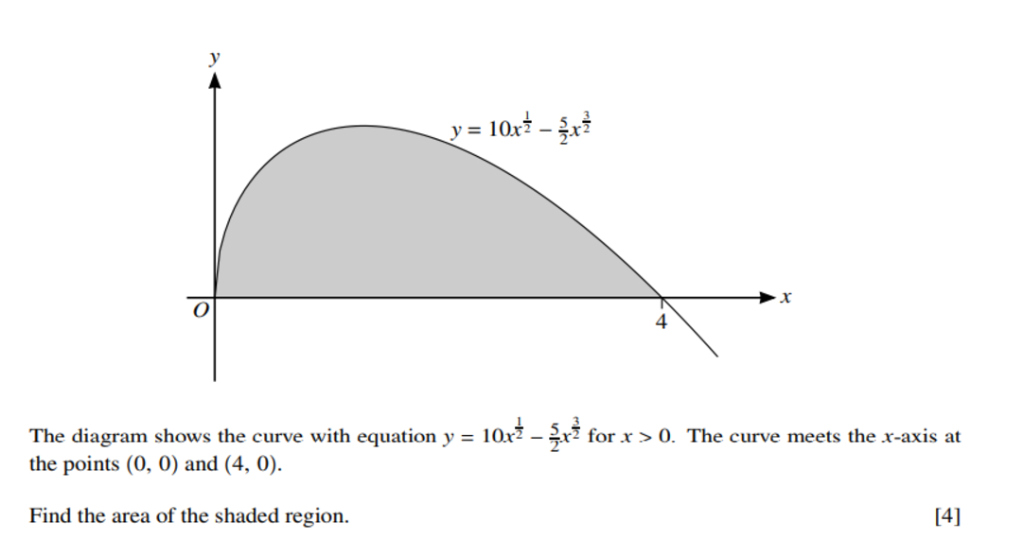
 y
y= 102% — $aF
x
0 4
‘The diagram shows the curve with equation y = 104 — 3% for x > 0. ‘The curve meets the x-axis at
the points (0, 0) and (4, 0).
Find the area of the shaded region. 4]
1 3
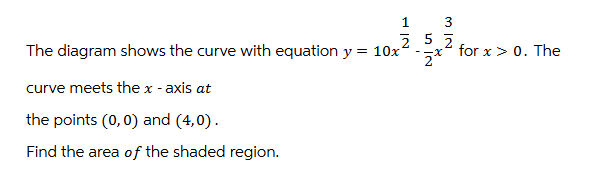
The diagram shows the curve with equation y = 10x2 - 52 for x> 0. The
curve meets the x - axis at
the points (0,0) and (4,0).
Find the area of the shaded region.
This is AI generated Response.
Asked by: gvr
Created at: 2025-06-16 20:30:32
Asked by: gvr
Created at: 2025-06-16 20:30:32
Final Answer:
Rendered
Raw Text
Did you like this answer?
Let's solve the problem step-by-step:
**Given:**
The curve is \( y = 10x^{1/2} - \frac{5}{2}x^{3/2} \)
It meets the x-axis at \( (0,0) \) and \( (4,0) \).
We are asked to find the area of the shaded region under the curve from \( x = 0 \) to \( x = 4 \).
---
## **Step 1: Write the Area as an Integral**
The area under the curve from \( x = 0 \) to \( x = 4 \) is:
\[
A = \int_{0}^{4} \left(10x^{1/2} - \frac{5}{2}x^{3/2}\right) dx
\]
---
## **Step 2: Integrate Each Term**
First, let's integrate \( 10x^{1/2} \):
\[
\int 10x^{1/2} dx = 10 \int x^{1/2} dx = 10 \cdot \frac{2}{3}x^{3/2} = \frac{20}{3}x^{3/2}
\]
Now, integrate \( -\frac{5}{2}x^{3/2} \):
\[
\int -\frac{5}{2}x^{3/2} dx = -\frac{5}{2} \int x^{3/2} dx = -\frac{5}{2} \cdot \frac{2}{5}x^{5/2} = -x^{5/2}
\]
So, the indefinite integral is:
\[
\int \left(10x^{1/2} - \frac{5}{2}x^{3/2}\right) dx = \frac{20}{3}x^{3/2} - x^{5/2}
\]
---
## **Step 3: Apply the Limits**
Now evaluate from \( x = 0 \) to \( x = 4 \):
\[
A = \left[ \frac{20}{3}x^{3/2} - x^{5/2} \right]_{0}^{4}
\]
Calculate at \( x = 4 \):
- \( 4^{3/2} = (4^1)^{3/2} = (2^2)^{3/2} = 2^{3} = 8 \)
- \( 4^{5/2} = (4^1)^{5/2} = (2^2)^{5/2} = 2^{5} = 32 \)
Plug in \( x = 4 \):
\[
\frac{20}{3} \times 8 - 32 = \frac{160}{3} - 32
\]
At \( x = 0 \):
\[
\frac{20}{3} \times 0 - 0 = 0
\]
So,
\[
A = \left(\frac{160}{3} - 32\right) - 0 = \frac{160}{3} - 32
\]
---
## **Step 4: Simplify the Answer**
Convert 32 to thirds:
\[
32 = \frac{96}{3}
\]
So,
\[
A = \frac{160}{3} - \frac{96}{3} = \frac{64}{3}
\]
---
## **Final Answer**
\[
\boxed{\frac{64}{3}}
\]
The area of the shaded region is **\(\frac{64}{3}\) square units**.
📢 Instructions:
- Ask anything relatd to above question only.
- For new Question goto :