 VIPSolutions
Give step-by-step solution with explanation and final answer:Problem #6: Using the contour map below, estimate the directional derivatives. 6 Er) 3 D 4p2 - 3f! R C | 2a 8 a ! A 01 2 3 4 5 6 x (@) D7 (8) in the direction v = i+], (b) D, f(D) in the ditection v = -i.
Question:
Give step-by-step solution with explanation and final answer: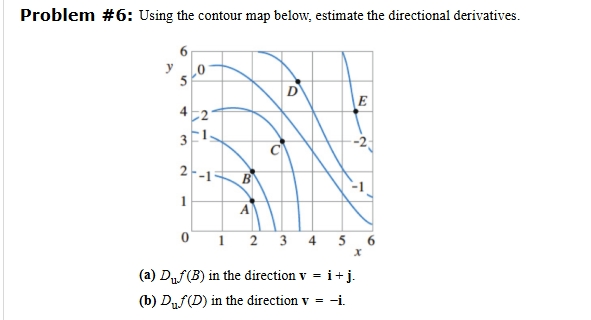 Problem #6: Using the contour map below, estimate the directional derivatives.
6
Er)
3 D
4p2 -
3f! R
C |
2a
8 a
! A
01 2 3 4 5 6
x
(@) D7 (8) in the direction v = i+],
(b) D, f(D) in the ditection v = -i.
This is AI generated Response.
Asked by: gvr
Created at: 2025-06-16 20:26:09
Asked by: gvr
Created at: 2025-06-16 20:26:09
Final Answer:
Rendered
Raw Text
Did you like this answer?
Let's break down the solution step by step.
### **Step 1: Understanding the Directional Derivative**
The **directional derivative** of \( f \) at point \( P \) in the direction of a unit vector \( \mathbf{v} \) is:
\[
D_{\mathbf{v}} f(P) = \nabla f(P) \cdot \mathbf{v}
\]
It represents the rate of change of the function \( f \) at \( P \) in the direction of \( \mathbf{v} \).
---
### **Step 2: Estimating the Gradient from the Contour Map**
- The gradient \( \nabla f \) points in the direction of steepest increase of \( f \).
- Its magnitude is greatest where contours are closest together.
- The gradient is **perpendicular** to the contour lines.
---
## **Part (a): \( D_{\mathbf{v}} f(\mathbf{B}) \) where \( \mathbf{v} = \mathbf{i} + \mathbf{j} \)**
#### **1. Find the location and values:**
- Point \( B \) is at (1, 2).
- Nearby contours: At \( (1, 1) \) (point \( A \)): \( f = 0 \)
- At \( (2, 3) \): \( f = -1 \)
#### **2. Find the Direction:**
- The vector \( \mathbf{v} = \mathbf{i} + \mathbf{j} \).
- **Unit vector:** \( \mathbf{u} = \frac{1}{\sqrt{2}}\mathbf{i} + \frac{1}{\sqrt{2}}\mathbf{j} \)
#### **3. Estimate rate of change:**
Move from \( B = (1,2) \) to \( (2,3) \):
- Change in \( f \): \( -1 - 0 = -1 \)
- Distance: \( \sqrt{(2-1)^2 + (3-2)^2} = \sqrt{2} \)
So, the **rate of change** is:
\[
\text{Rate} = \frac{-1}{\sqrt{2}}
\]
Thus,
\[
D_{\mathbf{v}} f(\mathbf{B}) \approx -\frac{1}{\sqrt{2}}
\]
---
## **Part (b): \( D_{\mathbf{v}} f(\mathbf{D}) \) where \( \mathbf{v} = -\mathbf{i} \)**
#### **1. Find the location and values:**
- Point \( D \) is at (3, 5).
- Move left (negative x-direction): from \( (4,5) \) to \( (3,5) \).
- Contours at \( x = 4 \): \( f = -2 \)
- Contours at \( x = 3 \): \( f = -1 \)
#### **2. Direction:**
- Direction is \( -\mathbf{i} \) (unit vector).
#### **3. Estimate rate of change:**
Move from \( (4,5) \) to \( (3,5) \):
- Change in \( f \): \( -1 - (-2) = 1 \)
- Distance: \( 1 \)
So,
\[
D_{\mathbf{v}} f(\mathbf{D}) = \frac{1}{1} = 1
\]
---
## **Final Answers**
### **(a) \( D_{\mathbf{v}} f(\mathbf{B}) \) in direction \( \mathbf{i} + \mathbf{j} \):**
\[
\boxed{ -\frac{1}{\sqrt{2}} }
\]
### **(b) \( D_{\mathbf{v}} f(\mathbf{D}) \) in direction \( -\mathbf{i} \):**
\[
\boxed{ 1 }
\]
---
**Explanation:**
- The directional derivative is estimated by the change in \( f \) over the distance between two points in the given direction (following the contours).
- The negative sign in (a) means \( f \) decreases in that direction.
- The positive sign in (b) means \( f \) increases as you move in the negative \( x \)-direction at \( D \).
📢 Instructions:
- Ask anything relatd to above question only.
- For new Question goto :