 VIPSolutions
Give step-by-step solution with explanation and final answer:Let f be a function that is even and continuous on the closed interval [-5,5] . The function f and its derivatives have the properties indicated in the table below. Properties of f and its derivatives: [= [0 pee
Question:
Give step-by-step solution with explanation and final answer: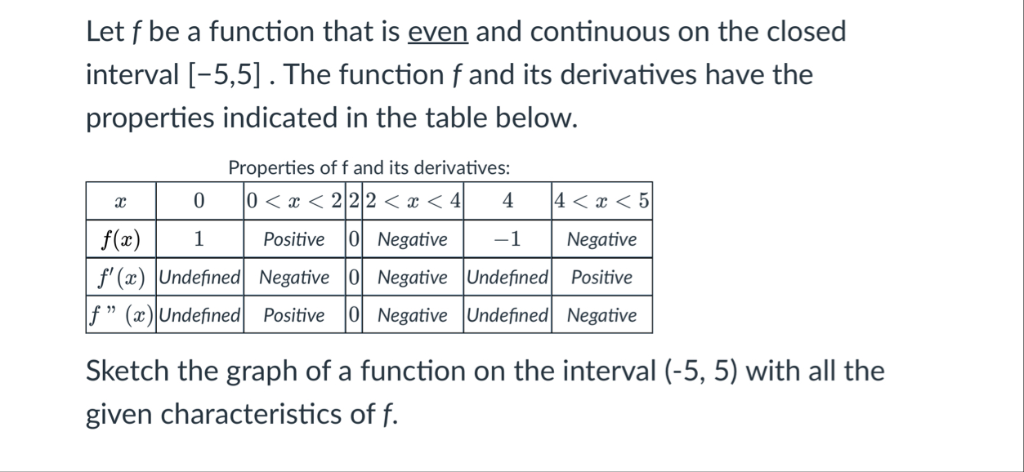 Let f be a function that is even and continuous on the closed
interval [-5,5] . The function f and its derivatives have the
properties indicated in the table below.
Properties of f and its derivatives:
[= [0 pee
This is AI generated Response.
Asked by: gvr
Created at: 2025-06-16 15:19:30
Asked by: gvr
Created at: 2025-06-16 15:19:30
Final Answer:
Rendered
Raw Text
Did you like this answer?
Let's break down the information step by step and sketch the graph based on the given properties.
### **Step 1: Understand the Symmetry**
- The function \( f \) is **even**, so \( f(-x) = f(x) \). This means the graph is symmetric about the y-axis.
---
### **Step 2: Analyze the Table (on \( [0, 5] \))**
#### **At \( x = 0 \):**
- \( f(0) = 1 \)
- \( f'(0) \) is **undefined**
- \( f''(0) \) is **undefined**
#### **On \( 0 < x < 2 \):**
- \( f(x) \) is **positive**
- \( f'(x) \) is **negative**: Decreasing
- \( f''(x) \) is **positive**: Concave up
#### **At \( x = 2 \):**
- \( f(2) = 0 \)
- \( f'(2) = 0 \)
- \( f''(2) = 0 \)
#### **On \( 2 < x < 4 \):**
- \( f(x) \) is **negative**
- \( f'(x) \) is **negative**: Decreasing
- \( f''(x) \) is **negative**: Concave down
#### **At \( x = 4 \):**
- \( f(4) = -1 \)
- \( f'(4) \) is **undefined**
- \( f''(4) \) is **undefined**
#### **On \( 4 < x < 5 \):**
- \( f(x) \) is **negative**
- \( f'(x) \) is **positive**: Increasing
- \( f''(x) \) is **negative**: Concave down
---
### **Step 3: Key Points and Behavior**
- **At \( x = 0 \), \( f(0) = 1 \); sharp point or cusp (since \( f'(0) \) undefined).**
- **At \( x = 2 \), \( f(2) = 0 \); possible inflection point (since all derivatives are zero).**
- **At \( x = 4 \), \( f(4) = -1 \); cusp or sharp point.**
- **On \( 0 < x < 2 \), \( f(x) \) is positive, decreasing, concave up.**
- **On \( 2 < x < 4 \), \( f(x) \) is negative, decreasing, concave down.**
- **On \( 4 < x < 5 \), \( f(x) \) is negative, increasing, concave down.**
---
### **Step 4: Sketch on \( [0, 5] \)**
1. Start at \( (0, 1) \) with a cusp.
2. Decrease (concave up) until \( (2, 0) \).
3. Continue decreasing (now concave down) until \( (4, -1) \) with a cusp.
4. From \( (4, -1) \), start increasing (still concave down) toward \( x = 5 \), but stay negative.
---
### **Step 5: Symmetry**
- Reflect the graph across the y-axis for \( x < 0 \) because \( f \) is even.
---
### **Step 6: Final Sketch**
Below is a rough sketch description:
```
y
^
| /\
| / \
| / \
| / \
| / \
| / \
|--/-------------\-------> x
| / \
|/ \
```
- The peak at \( (0,1) \) is a cusp.
- The graph decreases (concave up) to \( (2,0) \) (inflection point).
- Continues down (concave down) to \( (4,-1) \) (cusp).
- From \( (4,-1) \), increases but stays negative as \( x \to 5 \).
- Reflect this for \( x < 0 \) due to evenness.
---
### **Summary Table of Key Features**
| Point | Value | Behavior |
|-----------|------------|-------------------------|
| \( x=0 \) | \( f=1 \) | Cusp, start |
| \( x=2 \) | \( f=0 \) | Inflection, all derivs 0|
| \( x=4 \) | \( f=-1 \) | Cusp |
---
### **Final Answer:**
Draw a graph that is symmetric about the y-axis, starts at \( (0,1) \) with a cusp, decreases concave up to \( (2,0) \), continues down concave down to \( (4,-1) \) (cusp), then increases (concave down) but remains negative as \( x \to 5 \). Reflect for \( x < 0 \).
Would you like a hand-drawn/sketched image of the graph as well?
📢 Instructions:
- Ask anything relatd to above question only.
- For new Question goto :