 VIPSolutions
Give step-by-step solution with explanation and final answer:(1 point) pei \/ BY -1 Find a formula for the graph of the function y = f(x) given in the figure above. v=| |
Question:
Give step-by-step solution with explanation and final answer: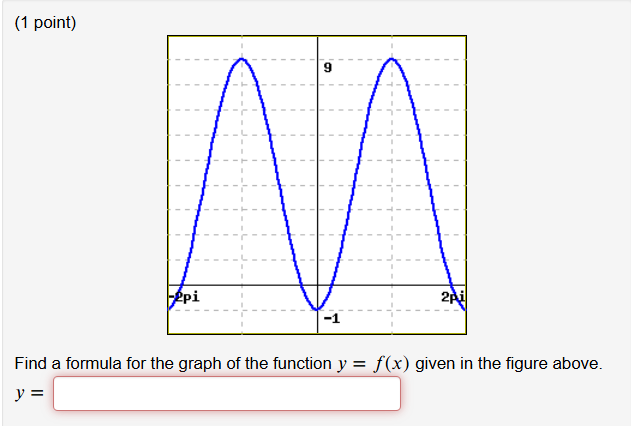 (1 point)
pei \/ BY
-1
Find a formula for the graph of the function y = f(x) given in the figure above.
v=| |
This is AI generated Response.
Asked by: gvr
Created at: 2025-06-16 06:11:09
Asked by: gvr
Created at: 2025-06-16 06:11:09
Final Answer:
Rendered
Raw Text
Did you like this answer?
Let's analyze the graph step-by-step:
### **Step 1: Identify the General Form**
This looks like a sine or cosine function. The general formula is:
\[
y = a \cos(bx + c) + d
\]
or
\[
y = a \sin(bx + c) + d
\]
Let's use cosine, as the graph starts at a maximum (which is typical for cosine).
---
### **Step 2: Amplitude (\(a\))**
The graph oscillates between \(1\) and \(-1\), so:
\[
\text{Amplitude},\; a = 1
\]
---
### **Step 3: Vertical Shift (\(d\))**
The midline is at \(y = 0\), so:
\[
d = 0
\]
---
### **Step 4: Period and Frequency (\(b\))**
The period of cosine is \(2\pi / b\).
From the graph:
- One full cycle occurs from \(x = 0\) to \(x = 2\pi\).
So,
\[
\text{Period} = 2\pi \implies \frac{2\pi}{b} = 2\pi \implies b = 1
\]
---
### **Step 5: Phase Shift (\(c\))**
At \(x = 0\), the graph is at its maximum, so there is **no phase shift**:
\[
c = 0
\]
---
### **Step 6: Write the Final Formula**
Putting it all together:
\[
y = \cos(x)
\]
---
## **Final Answer**
\[
\boxed{y = \cos(x)}
\]
📢 Instructions:
- Ask anything relatd to above question only.
- For new Question goto :