 VIPSolutions
Give step-by-step solution with explanation and final answer:3. Obtain the maximum and minimum of z = x, + 2x, subject to: x, +x,
Question:
Give step-by-step solution with explanation and final answer: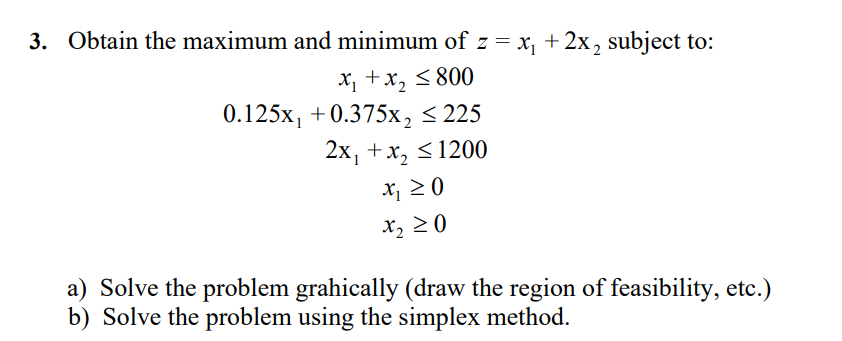 3. Obtain the maximum and minimum of z = x, + 2x, subject to:
x, +x,
This is AI generated Response.
Asked by: gvr
Created at: 2025-06-16 04:14:59
Asked by: gvr
Created at: 2025-06-16 04:14:59
Final Answer:
Rendered
Raw Text
Did you like this answer?
Let's solve the problem **step by step** both graphically and using the **simplex method**.
---
### **Given Problem**
Maximize and minimize \( z = x_1 + 2x_2 \)
Subject to:
\[
\begin{align*}
x_1 + x_2 & \leq 800 \\
0.125x_1 + 0.375x_2 & \leq 225 \\
2x_1 + x_2 & \leq 1200 \\
x_1 & \geq 0 \\
x_2 & \geq 0
\end{align*}
\]
---
## **a) Graphical Solution**
### **Step 1: Draw the Constraints**
Let's rewrite constraints:
1. \(x_1 + x_2 \leq 800\)
2. \(0.125x_1 + 0.375x_2 \leq 225\)
Divide both sides by 0.125:
\(x_1 + 3x_2 \leq 1800\)
3. \(2x_1 + x_2 \leq 1200\)
4. \(x_1 \geq 0\)
5. \(x_2 \geq 0\)
---
### **Step 2: Find Intersections (Corner Points)**
#### **Find intersection points of constraints:**
#### **(i) \(x_1 + x_2 = 800\) and \(x_1 + 3x_2 = 1800\):**
\[
x_1 + x_2 = 800 \implies x_1 = 800 - x_2
\]
Substitute into second:
\[
(800 - x_2) + 3x_2 = 1800 \\
800 + 2x_2 = 1800 \\
2x_2 = 1000 \implies x_2 = 500 \\
x_1 = 800 - 500 = 300
\]
So, \(\boxed{(300, 500)}\)
---
#### **(ii) \(x_1 + x_2 = 800\) and \(2x_1 + x_2 = 1200\):**
\[
x_1 + x_2 = 800 \implies x_1 = 800 - x_2 \\
2x_1 + x_2 = 1200 \\
2(800 - x_2) + x_2 = 1200 \\
1600 - 2x_2 + x_2 = 1200 \\
1600 - x_2 = 1200 \implies x_2 = 400 \\
x_1 = 800 - 400 = 400
\]
So, \(\boxed{(400, 400)}\)
---
#### **(iii) \(x_1 + 3x_2 = 1800\) and \(2x_1 + x_2 = 1200\):**
\[
x_1 + 3x_2 = 1800 \implies x_1 = 1800 - 3x_2 \\
2x_1 + x_2 = 1200 \\
2(1800 - 3x_2) + x_2 = 1200 \\
3600 - 6x_2 + x_2 = 1200 \\
3600 - 5x_2 = 1200 \implies 5x_2 = 2400 \implies x_2 = 480 \\
x_1 = 1800 - 3(480) = 1800 - 1440 = 360
\]
So, \(\boxed{(360, 480)}\)
---
#### **Intersections with axes:**
##### For \(x_1 + x_2 = 800\):
- \(x_1=0\): \(x_2=800\) \(\to (0,800)\)
- \(x_2=0\): \(x_1=800\) \(\to (800,0)\)
##### For \(x_1 + 3x_2 = 1800\):
- \(x_1=0\): \(3x_2=1800 \implies x_2=600\) \(\to (0,600)\)
- \(x_2=0\): \(x_1=1800\) (but \(x_1=1800\) is outside other constraints)
##### For \(2x_1 + x_2 = 1200\):
- \(x_1=0\): \(x_2=1200\) \(\to (0,1200)\)
- \(x_2=0\): \(2x_1=1200 \implies x_1=600\) \(\to (600,0)\)
---
#### **Now check which of these are within all constraints:**
Let’s check the feasible region bounded by:
- \(x_1 + x_2 \leq 800\)
- \(x_1 + 3x_2 \leq 1800\)
- \(2x_1 + x_2 \leq 1200\)
- \(x_1 \geq 0\)
- \(x_2 \geq 0\)
The feasible region is the intersection of all these inequalities. The valid corner points (from above and axes) are:
- (0,0)
- (0,600): \(x_1+3(600)=1800\), \(x_1=0\) OK; \(0+600=600\leq800\), \(2(0)+600=600\leq1200\)
- (300,500): checked above
- (360,480): checked above
- (400,400): checked above
- (600,0): \(2(600)=1200\), \(600+0=600\leq800\), \(600+3(0)=600\leq1800\)
- (800,0): \(800+0=800\leq800\), \(800+3(0)=800\leq1800\), \(2(800)=1600>1200\) **not feasible**
---
### **Step 3: Evaluate Objective Function at Each Vertex**
\[
z = x_1 + 2x_2
\]
- At **(0,0):** \(z=0+2\cdot0=0\)
- At **(0,600):** \(z=0+2\cdot600=1200\)
- At **(300,500):** \(z=300+2\cdot500=300+1000=1300\)
- At **(360,480):** \(z=360+2\cdot480=360+960=1320\)
- At **(400,400):** \(z=400+2\cdot400=400+800=1200\)
- At **(600,0):** \(z=600+2\cdot0=600\)
---
### **Step 4: Find Maximum and Minimum**
- **Maximum:** at (360,480), \(z=1320\)
- **Minimum:** at (0,0), \(z=0\)
---
### **Graphical Conclusion**
- **Maximum \(z=1320\) at \((360,480)\)**
- **Minimum \(z=0\) at \((0,0)\)**
---
## **b) Simplex Method Solution**
Convert inequalities to equalities by adding slack variables:
\[
\begin{align*}
x_1 + x_2 + s_1 &= 800 \\
x_1 + 3x_2 + s_2 &= 1800 \\
2x_1 + x_2 + s_3 &= 1200 \\
x_1, x_2, s_1, s_2, s_3 &\geq 0
\end{align*}
\]
Objective function:
Maximize \(z = x_1 + 2x_2\)
Set up the simplex tableau:
| BV | \(x_1\) | \(x_2\) | \(s_1\) | \(s_2\) | \(s_3\) | RHS |
|-----|:------:|:------:|:------:|:------:|:------:|:----:|
| \(s_1\) | 1 | 1 | 1 | 0 | 0 | 800 |
| \(s_2\) | 1 | 3 | 0 | 1 | 0 | 1800 |
| \(s_3\) | 2 | 1 | 0 | 0 | 1 | 1200 |
| \(z\) | -1 | -2 | 0 | 0 | 0 | 0 |
**Proceed with the simplex method** (this will be a bit long, but here’s the process):
#### **Step 1: Identify entering variable (most negative in z-row): \(x_2\) (-2)**
#### **Step 2: Ratio test**
- Row 1: \(800/1 = 800\)
- Row 2: \(1800/3 = 600\)
- Row 3: \(1200/1 = 1200\)
Smallest is 600 (Row 2), so \(x_2\) enters, \(s_2\) leaves.
#### **Step 3: Pivot on Row 2, Col \(x_2\) (make it 1, others 0 in \(x_2\) column)**
- Divide Row 2 by 3:
- \(x_1 + 3x_2 + s_2 = 1800\)
- \(x_1/3 + x_2 + s_2/3 = 600\)
New tableau:
| BV | \(x_1\) | \(x_2\) | \(s_1\) | \(s_2\) | \(s_3\) | RHS |
|-----|:------:|:------:|:------:|:------:|:------:|:----:|
| \(s_1\) | 1 | 1 | 1 | 0 | 0 | 800 |
| \(x_2\) | 1/3 | 1 | 0 | 1/3 | 0 | 600 |
| \(s_3\) | 2 | 1 | 0 | 0 | 1 | 1200 |
| \(z\) | -1 | -2 | 0 | 0 | 0 | 0 |
Now eliminate \(x_2\) from other rows:
- Row 1: Row 1 - Row 2
- Row 3: Row 3 - Row 2
- \(z\) row: \(z + 2\times\) Row 2
Let’s do the calculations:
**Row 1:**
\(s_1: 1 - (1/3) = 2/3\) for \(x_1\)
\(1 - 1 = 0\) for \(x_2\)
\(1 - 0 = 1\) for \(s_1\)
\(0 - (1/3) = -1/3\) for \(s_2\)
\(0 - 0 = 0\) for \(s_3\)
\(800 - 600 = 200\) RHS
**Row 3:**
\(2 - (1/3 \times 1) = 2 - 1/3 = 5/3\) for \(x_1\)
\(1 - 1 = 0\) for \(x_2\)
\(0 - 0 = 0\) for \(s_1\)
\(0 - (1/3) = -1/3\) for \(s_2\)
\(1 - 0 = 1\) for \(s_3\)
\(1200 - 600 = 600\) RHS
**z row:**
\(-1 + 2 \times (1/3) = -1 + 2/3 = -1/3\) for \(x_1\)
\(-2 + 2 \times 1 = 0\) for \(x_2\)
\(0 + 2 \times 0 = 0\) for \(s_1\)
\(0 + 2 \times (1/3) = 2/3\) for \(s_2\)
\(0 + 2 \times 0 = 0\) for \(s_3\)
\(0 + 2 \times 600 = 1200\) RHS
Tableau becomes:
| BV | \(x_1\) | \(x_2\) | \(s_1\) | \(s_2\) | \(s_3\) | RHS |
|-----|:------:|:------:|:------:|:------:|:------:|:----:|
| \(s_1\) | 2/3 | 0 | 1 | -1/3 | 0 | 200 |
| \(x_2\) | 1/3 | 1 | 0 | 1/3 | 0 | 600 |
| \(s_3\) | 5/3 | 0 | 0 | -1/3 | 1 | 600 |
| \(z\) | -1/3 | 0
📢 Instructions:
- Ask anything relatd to above question only.
- For new Question goto :