Give step-by-step solution with explanation and final answer:Part 2: Experiments in Germany have shown that it takes exactly 475 liquid water molecules to form a
single Ice crystal. A snowflake is a single ice crystal and is unique in form. Consider the example of
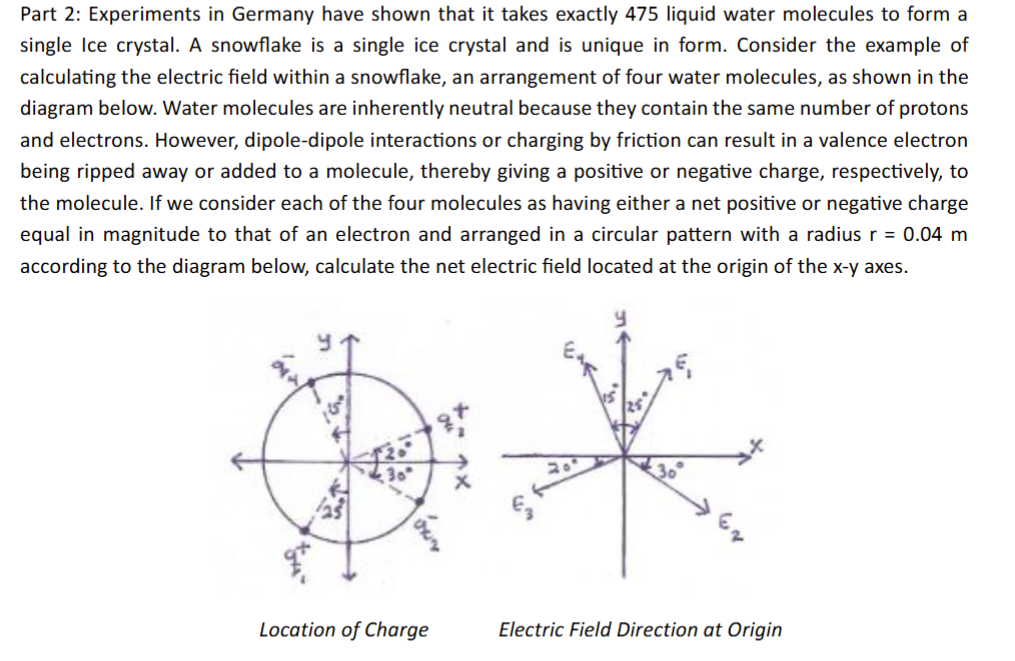
calculating the electric field within a snowflake, an arrangement of four water molecules, as shown in the
diagram below. Water molecules are inherently neutral because they contain the same number of protons
and electrons. However, dipole-dipole interactions or charging by friction can result in a valence electron
being ripped away or added to a molecule, thereby giving a positive or negative charge, respectively, to
the molecule. If we consider each of the four molecules as having either a net positive or negative charge
equal in magnitude to that of an electron and arranged in a circular pattern with a radius r = 0.04 m
according to the diagram below, calculate the net electric field located at the origin of the x-y axes.
4
rh: i G
he ; '
a JY
- x
: 4 ED °°
§ % 2
t
Location of Charge Electric Field Direction at Origin
Question:
Give step-by-step solution with explanation and final answer:Part 2: Experiments in Germany have shown that it takes exactly 475 liquid water molecules to form a
single Ice crystal. A snowflake is a single ice crystal and is unique in form. Consider the example of
calculating the electric field within a snowflake, an arrangement of four water molecules, as shown in the
diagram below. Water molecules are inherently neutral because they contain the same number of protons
and electrons. However, dipole-dipole interactions or charging by friction can result in a valence electron
being ripped away or added to a molecule, thereby giving a positive or negative charge, respectively, to
the molecule. If we consider each of the four molecules as having either a net positive or negative charge
equal in magnitude to that of an electron and arranged in a circular pattern with a radius r = 0.04 m
according to the diagram below, calculate the net electric field located at the origin of the x-y axes.
4
rh: i G
he ; '
a JY
- x
: 4 ED °°
§ % 2
t
Location of Charge Electric Field Direction at Origin
This is AI generated Response.
Asked by: gvr
Created at: 2025-06-16 03:53:03
Final Answer:
RenderedRaw Text
Did you like this answer?
Let's break down the problem step by step:
## **Step 1: Understanding the Setup**
- We have 4 charges, each of magnitude \( q = e = 1.6 \times 10^{-19} \) C (the charge of an electron).
- The charges are arranged on a circle of radius \( r = 0.04 \) m, at angles \( 15^\circ, 120^\circ, 225^\circ, 300^\circ \).
- We are to find the net electric field at the origin (center of the circle).
---
## **Step 2: Electric Field Due to a Single Point Charge**
The electric field due to a point charge at a distance \( r \) is:
\[
E = \frac{k|q|}{r^2}
\]
where \( k = 8.99 \times 10^9 \ \mathrm{N\cdot m^2/C^2} \).
---
## **Step 3: Direction of Each Electric Field**
Each field at the origin points **away from positive charge** (or toward if negative). Assume all are positive for now.
The direction of the electric field at the origin due to each charge is **directly opposite** to the position vector of the charge.
---
## **Step 4: Components of Each Field**
Let’s calculate the field vector for each charge.
Let \( E_0 = \frac{k|q|}{r^2} \).
- \( E_1 \): At \( 15^\circ \rightarrow \) Field at \( 15^\circ + 180^\circ = 195^\circ \)
- \( E_2 \): At \( 120^\circ \rightarrow \) Field at \( 300^\circ \)
- \( E_3 \): At \( 225^\circ \rightarrow \) Field at \( 45^\circ \)
- \( E_4 \): At \( 300^\circ \rightarrow \) Field at \( 120^\circ \)
---
### **Field Components**
For each field,
\[
\vec{E}_i = E_0 (\cos\theta_i\ \hat{i} + \sin\theta_i\ \hat{j})
\]
where \( \theta_i \) is the angle of the field direction.
So,
- \( \theta_1 = 195^\circ \)
- \( \theta_2 = 300^\circ \)
- \( \theta_3 = 45^\circ \)
- \( \theta_4 = 120^\circ \)
---
## **Step 5: Calculate \( E_0 \)**
\[
E_0 = \frac{8.99 \times 10^9 \times 1.6 \times 10^{-19}}{(0.04)^2}
\]
\[
= \frac{8.99 \times 10^9 \times 1.6 \times 10^{-19}}{0.0016}
\]
\[
= \frac{1.4384 \times 10^{-9}}{0.0016}
\]
\[
= 8.99 \times 10^9 \times \frac{1.6 \times 10^{-19}}{0.0016}
= 8.99 \times 10^9 \times 1 \times 10^{-16}
= 8.99 \times 10^{-7} \ \mathrm{N/C}
\]
---
## **Step 6: Find the Total Field (Vector Sum)**
Add the x and y components:
\[
E_{x,\text{total}} = E_0 \left[\cos 195^\circ + \cos 300^\circ + \cos 45^\circ + \cos 120^\circ \right]
\]
\[
E_{y,\text{total}} = E_0 \left[\sin 195^\circ + \sin 300^\circ + \sin 45^\circ + \sin 120^\circ \right]
\]
Substitute:
- \( \cos 195^\circ = -0.9659 \)
- \( \cos 300^\circ = 0.5 \)
- \( \cos 45^\circ = 0.7071 \)
- \( \cos 120^\circ = -0.5 \)
Sum:
\[
E_{x,\text{total}} = E_0 [-0.9659 + 0.5 + 0.7071 - 0.5] = E_0 [-0.2588]
\]
- \( \sin 195^\circ = -0.2588 \)
- \( \sin 300^\circ = -0.8660 \)
- \( \sin 45^\circ = 0.7071 \)
- \( \sin 120^\circ = 0.8660 \)
Sum:
\[
E_{y,\text{total}} = E_0 [-0.2588 - 0.8660 + 0.7071 + 0.8660] = E_0 [0.4483]
\]
---
## **Step 7: Compute the Final Values**
Plug in \( E_0 = 8.99 \times 10^{-7} \) N/C:
\[
E_{x,\text{total}} = 8.99 \times 10^{-7} \times (-0.2588) = -2.33 \times 10^{-7} \ \mathrm{N/C}
\]
\[
E_{y,\text{total}} = 8.99 \times 10^{-7} \times 0.4483 = 4.03 \times 10^{-7} \ \mathrm{N/C}
\]
Magnitude:
\[
E_{\text{total}} = \sqrt{(E_x)^2 + (E_y)^2}
= \sqrt{(-2.33 \times 10^{-7})^2 + (4.03 \times 10^{-7})^2}
= \sqrt{5.43 \times 10^{-14} + 1.63 \times 10^{-13}}
= \sqrt{2.17 \times 10^{-13}}
= 4.66 \times 10^{-7} \ \mathrm{N/C}
\]
Direction:
\[
\theta = \tan^{-1}\left(\frac{E_{y,\text{total}}}{E_{x,\text{total}}}\right)
= \tan^{-1}\left(\frac{4.03}{-2.33}\right)
= \tan^{-1}(-1.73)
\]
This is in the **second quadrant**, so:
\[
\theta = 180^\circ + \tan^{-1}(-1.73) = 180^\circ - 60^\circ = 120^\circ
\]
---
## **Final Answer**
### **The net electric field at the origin has:**
- **Magnitude:** \( \boxed{4.66 \times 10^{-7} \ \mathrm{N/C}} \)
- **Direction:** \( \boxed{120^\circ} \) from the positive x-axis.
---
If you have any further questions or need clarification, please let me know!
VIPSolutions focuses on clear, step‑by‑step explanations so you can learn quickly. Whether you need an AI‑generated walkthrough or a short hint to get unstuck, each solution is organized for fast reading and easy review later.
Search similar questions, compare approaches, and bookmark the best answers for revision. Our goal is simple: quick, reliable study help that feels natural—not noisy.
 VIPSolutions
 Part 2: Experiments in Germany have shown that it takes exactly 475 liquid water molecules to form a
single Ice crystal. A snowflake is a single ice crystal and is unique in form. Consider the example of
calculating the electric field within a snowflake, an arrangement of four water molecules, as shown in the
diagram below. Water molecules are inherently neutral because they contain the same number of protons
and electrons. However, dipole-dipole interactions or charging by friction can result in a valence electron
being ripped away or added to a molecule, thereby giving a positive or negative charge, respectively, to
the molecule. If we consider each of the four molecules as having either a net positive or negative charge
equal in magnitude to that of an electron and arranged in a circular pattern with a radius r = 0.04 m
according to the diagram below, calculate the net electric field located at the origin of the x-y axes.
4
rh: i G
he ; '
a JY
- x
: 4 ED °°
§ % 2
t
Location of Charge Electric Field Direction at Origin