 VIPSolutions
Give step-by-step solution with explanation and final answer:| | ri [ == 2 SR) 5 TT — d EEEeCa=es: PURELA USER APNEA : | : EEE nme . EE || 1 Fr EERIE es gq, >0 at(-40) 492= — at (—2,0) x Pat (1,0) qs
Question:
Give step-by-step solution with explanation and final answer: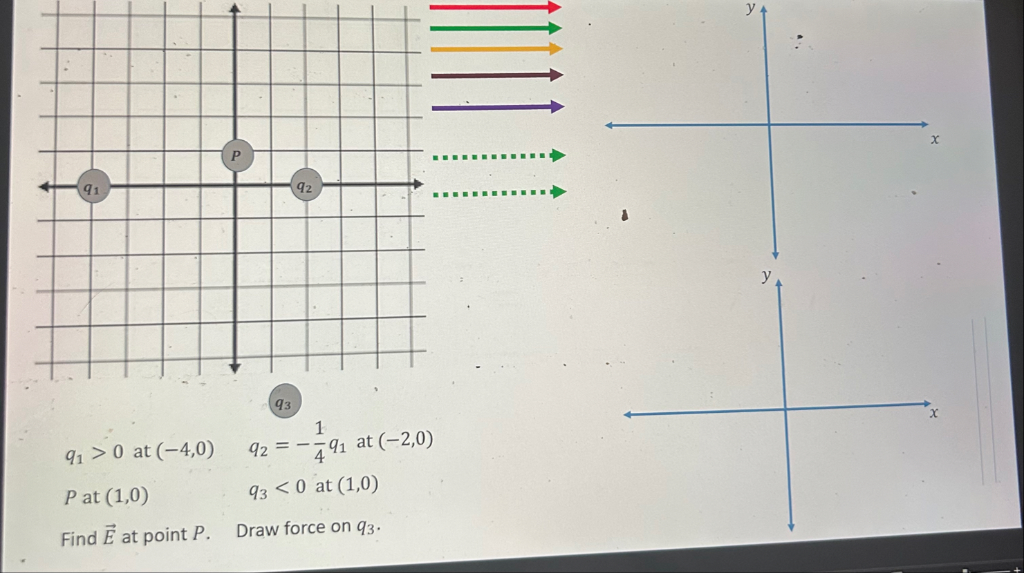 | | ri
[ == 2
SR) 5
TT —
d EEEeCa=es:
PURELA
USER APNEA :
| :
EEE nme .
EE ||
1 Fr EERIE es
gq, >0 at(-40) 492= — at (—2,0) x
Pat (1,0) qs
This is AI generated Response.
Asked by: gvr
Created at: 2025-06-16 03:36:52
Asked by: gvr
Created at: 2025-06-16 03:36:52
Final Answer:
Rendered
Raw Text
Did you like this answer?
Let's break down the problem step by step:
### **Step 1: Assign Positions and Charges**
- \( q_1 > 0 \) at \((-4, 0)\)
- \( q_2 = -\frac{1}{4}q_1 \) at \((-2, 0)\)
- \( P \) at \((1, 0)\)
- \( q_3 < 0 \) at \((1, 0)\) (same as point \(P\))
We need to find the electric field \(\vec{E}\) at point \(P\) due to \(q_1\) and \(q_2\), and then draw the force on \(q_3\).
---
### **Step 2: Electric Field Formula**
The electric field at \(P\) due to a point charge \(q\) at position \((x_0, 0)\) is:
\[
\vec{E} = k \frac{q}{r^2} \hat{r}
\]
where:
- \(k = 8.99 \times 10^9 \, \text{Nm}^2/\text{C}^2\)
- \(r\) is the distance from the charge to \(P\)
- \(\hat{r}\) is a unit vector from the charge to \(P\)
---
### **Step 3: Calculate Distances**
For both charges, since all points are on the \(x\)-axis (\(y=0\)):
- Distance from \(q_1\) to \(P\): \(r_1 = |1 - (-4)| = 5\)
- Distance from \(q_2\) to \(P\): \(r_2 = |1 - (-2)| = 3\)
---
### **Step 4: Find Direction of \(\vec{E}\)**
- Both charges are to the **left** of \(P\), so the field at \(P\) due to each charge is along the **positive \(x\)-axis** for positive charges, and **negative \(x\)-axis** for negative charges.
---
### **Step 5: Find Each Field**
#### **a. Due to \(q_1\):**
\[
\vec{E}_1 = k \frac{q_1}{(5)^2} \hat{i}
\]
Since \(q_1 > 0\), the field points away from \(q_1\), i.e., to the right (\(+\hat{i}\)).
#### **b. Due to \(q_2\):**
\[
q_2 = -\frac{1}{4} q_1
\]
\[
\vec{E}_2 = k \frac{q_2}{(3)^2} \hat{i}
\]
Since \(q_2\) is negative, the field points **toward** \(q_2\), so still to the right (\(+\hat{i}\)), as \(P\) is to the right of \(q_2\).
---
### **Step 6: Add the Fields**
Both fields are in the \(+\hat{i}\) direction:
\[
\vec{E}_{\text{total}} = \vec{E}_1 + \vec{E}_2
\]
\[
= k \frac{q_1}{25} \hat{i} + k \frac{-\frac{1}{4}q_1}{9} \hat{i}
\]
\[
= k q_1 \left(\frac{1}{25} - \frac{1}{36}\right) \hat{i}
\]
\[
= k q_1 \left(\frac{36 - 25}{900}\right) \hat{i}
\]
\[
= k q_1 \left(\frac{11}{900}\right) \hat{i}
\]
---
### **Step 7: Draw the Force on \(q_3\)**
- \(q_3 < 0\) is at \(P\).
- The force on \(q_3\) is \(\vec{F}_3 = q_3 \vec{E}_{\text{total}}\).
- Since \(\vec{E}_{\text{total}}\) is to the **right** (\(+x\)), and \(q_3\) is negative, the force will be to the **left** (\(-x\)).
---
### **Step 8: Final Answers**
#### **Electric Field at \(P\):**
\[
\boxed{
\vec{E}_P = k q_1 \frac{11}{900} \hat{i}
}
\]
(Direction: \(+\hat{i}\), or to the right)
#### **Force on \(q_3\):**
\[
\vec{F}_3 = q_3 \vec{E}_P
\]
(Direction: \(-x\), to the left, since \(q_3 < 0\))
---
### **Summary Table**
| Quantity | Value/Direction |
|----------------------------------|--------------------------------------|
| \(\vec{E}_P\) | \(k q_1 \dfrac{11}{900} \hat{i}\) |
| Direction of \(\vec{E}_P\) | \(+\hat{i}\) (to the right) |
| Direction of force on \(q_3\) | \(-\hat{i}\) (to the left) |
#### **On your diagram:**
- Draw a rightward arrow at \(P\) for \(\vec{E}_P\).
- Draw a leftward arrow at \(q_3\) for the force on \(q_3\).
If you have the value for \(q_1\), you can substitute it in for a numerical answer.
📢 Instructions:
- Ask anything relatd to above question only.
- For new Question goto :