VIPSolutions logo ✨ VIPSolutions

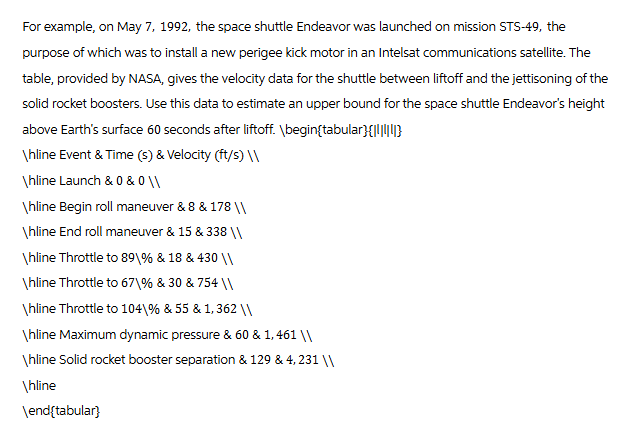
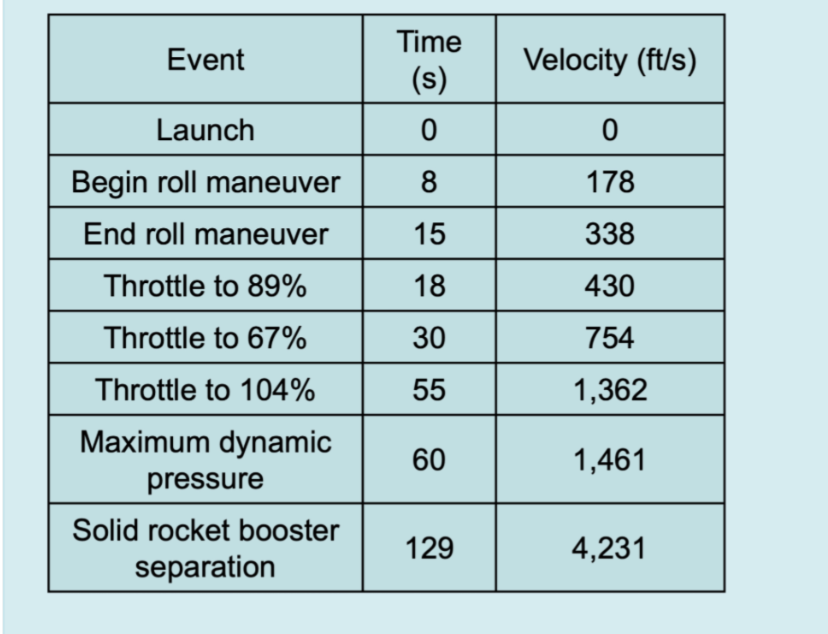
Give step-by-step solution with explanation and final answer:we [0 | 0 Throttle to 67% Throttle to 104% | 55 | 1,362 Maximum dynamic pressure Solid rocket booster 129 4.931 separation ’ For example, on May 7, 1992, the space shuttle Endeavor was launched on mission STS-49, the. purpose of which was to install a new perigee kick motor in an Intelsat communications satellite. The table, provided by NASA, gives the velocity data for the shuttle between liftoff and the jettisoning of the sold rocket boosters. Use this data to estimate an upper bound for the space shuttle Endeavor's height ‘above Earth's surface 60 seconds after liftoff. \begingtabular}(Iil[} \hline Event & Time (5) & Velocity (ft/s) \\ \hline Launch & 0 & 0\\ \hline Begin roll maneuver &8 & 178 \\ \hline End roll maneuver & 15 &338 \\ \hline Throttle to 89\% & 18 & 430 \\ \hline Throttle to 67\% & 30 & 754 \\ \hline Throttle to 104\96 &55 &1,362\\ \hline Maximum dynamic pressure & 60 & 1,461 \\ \hline Solid rocket booster separation & 129 &4,231\\ \hline: \endtabular}

Question:

Give step-by-step solution with explanation and final answer:Uploaded ImageUploaded Imagewe [0 | 0 Throttle to 67% Throttle to 104% | 55 | 1,362 Maximum dynamic pressure Solid rocket booster 129 4.931 separation ’ For example, on May 7, 1992, the space shuttle Endeavor was launched on mission STS-49, the. purpose of which was to install a new perigee kick motor in an Intelsat communications satellite. The table, provided by NASA, gives the velocity data for the shuttle between liftoff and the jettisoning of the sold rocket boosters. Use this data to estimate an upper bound for the space shuttle Endeavor's height ‘above Earth's surface 60 seconds after liftoff. \begingtabular}(Iil[} \hline Event & Time (5) & Velocity (ft/s) \\ \hline Launch & 0 & 0\\ \hline Begin roll maneuver &8 & 178 \\ \hline End roll maneuver & 15 &338 \\ \hline Throttle to 89\% & 18 & 430 \\ \hline Throttle to 67\% & 30 & 754 \\ \hline Throttle to 104\96 &55 &1,362\\ \hline Maximum dynamic pressure & 60 & 1,461 \\ \hline Solid rocket booster separation & 129 &4,231\\ \hline: \endtabular}
This is AI generated Response.
Asked by: gvr
Created at: 2025-06-15 20:55:33

Final Answer:

Rendered Raw Text
Did you like this answer?
Let's **estimate an upper bound for the height** of the space shuttle Endeavor **60 seconds after liftoff**. We are given the time and velocity data at several points. Since we're asked for an **upper bound**, we'll use the largest reasonable value for the velocity at each interval. We can estimate the height by integrating the velocity over time, i.e., finding the area under the velocity-time curve. Since we have only discrete data, we can **approximate the area under the curve using the velocities at each interval** (using the **right endpoint** for an upper bound). --- ### **Step 1: Write Down the Intervals and Velocities** | Interval (s) | Time Start | Time End | Velocity at End (ft/s) | Duration (s) | |--------------|------------|----------|------------------------|--------------| | 1 | 0 | 8 | 178 | 8 | | 2 | 8 | 15 | 338 | 7 | | 3 | 15 | 18 | 430 | 3 | | 4 | 18 | 30 | 754 | 12 | | 5 | 30 | 55 | 1,362 | 25 | | 6 | 55 | 60 | 1,461 | 5 | --- ### **Step 2: Calculate the Distance for Each Interval** We **approximate** distance traveled in each interval as: \[ \text{Distance} \approx \text{Velocity at End} \times \text{Duration} \] #### 1. Interval 0–8 s: \[ d_1 = 178 \ \text{ft/s} \times 8 \ \text{s} = 1,424 \ \text{ft} \] #### 2. Interval 8–15 s: \[ d_2 = 338 \ \text{ft/s} \times 7 \ \text{s} = 2,366 \ \text{ft} \] #### 3. Interval 15–18 s: \[ d_3 = 430 \ \text{ft/s} \times 3 \ \text{s} = 1,290 \ \text{ft} \] #### 4. Interval 18–30 s: \[ d_4 = 754 \ \text{ft/s} \times 12 \ \text{s} = 9,048 \ \text{ft} \] #### 5. Interval 30–55 s: \[ d_5 = 1,362 \ \text{ft/s} \times 25 \ \text{s} = 34,050 \ \text{ft} \] #### 6. Interval 55–60 s: \[ d_6 = 1,461 \ \text{ft/s} \times 5 \ \text{s} = 7,305 \ \text{ft} \] --- ### **Step 3: Sum All the Distances** \[ \text{Total Distance} = d_1 + d_2 + d_3 + d_4 + d_5 + d_6 \] \[ \text{Total Distance} = 1,424 + 2,366 + 1,290 + 9,048 + 34,050 + 7,305 \] \[ \text{Total Distance} = 55,483 \ \text{ft} \] --- ### **Step 4: Final Answer** **The upper bound for the space shuttle Endeavor’s height 60 seconds after liftoff is approximately:** \[ \boxed{55,483 \ \text{feet}} \] --- ### **Explanation** - We used the velocity at the *end* of each interval to get an upper bound, because the shuttle is accelerating (velocity is increasing). - This estimate **ignores air resistance and the fact that the shuttle is not going perfectly vertically**, but it's a reasonable upper estimate given the data. If you would like to see a lower bound or a more accurate estimate (average velocities), let me know!

📢 Instructions:

  • Ask anything relatd to above question only.
  • For new Question goto :

Study Help, Fast Answers

VIPSolutions focuses on clear, step‑by‑step explanations so you can learn quickly. Whether you need an AI‑generated walkthrough or a short hint to get unstuck, each solution is organized for fast reading and easy review later.

Search similar questions, compare approaches, and bookmark the best answers for revision. Our goal is simple: quick, reliable study help that feels natural—not noisy.