 VIPSolutions
Give step-by-step solution with explanation and final answer:S51. Consider the small longitudinal oscillations of the system shown below: | 9 |] 9 |] Q |] 294] In the picture above, each bob has mass m, each pendulum has length . each spring has spring constant x, and the equilibrium separation between bobs is . a. Findthe MK matrix for tis system in the basis in which the displacements of the blocks from equilibrium are all measured to the right and arranged info vector i the obvious. way, no z(t) 0 = |= XO =| 150) alt)
Question:
Give step-by-step solution with explanation and final answer: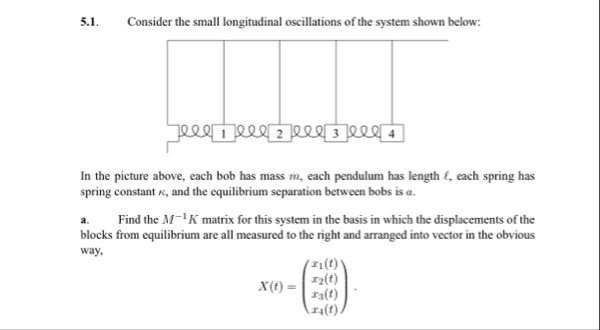 S51. Consider the small longitudinal oscillations of the system shown below:
| 9 |] 9 |] Q |] 294]
In the picture above, each bob has mass m, each pendulum has length . each spring has
spring constant x, and the equilibrium separation between bobs is .
a. Findthe MK matrix for tis system in the basis in which the displacements of the
blocks from equilibrium are all measured to the right and arranged info vector i the obvious.
way,
no
z(t)
0 = |=
XO =| 150)
alt)
This is AI generated Response.
Asked by: gvr
Created at: 2025-06-15 20:26:29
Asked by: gvr
Created at: 2025-06-15 20:26:29
Final Answer:
Rendered
Raw Text
Did you like this answer?
Let's solve the problem step by step.
---
## **Step 1: Understanding the System**
- **4 masses** (\( m \)), each connected to its neighbors by springs of spring constant \( k \).
- The displacements from equilibrium are \( x_1, x_2, x_3, x_4 \).
- We are interested in **longitudinal oscillations** (horizontal direction).
---
## **Step 2: Write the Equations of Motion**
For each mass, Newton's second law gives:
\[
m \ddot{x}_i = \text{sum of forces on } m_i
\]
**For mass 1:**
\[
m \ddot{x}_1 = -k(x_1 - 0) + k(x_2 - x_1)
= -k x_1 + k(x_2 - x_1)
= -2k x_1 + k x_2
\]
**For mass 2:**
\[
m \ddot{x}_2 = -k(x_2 - x_1) + k(x_3 - x_2)
= -k(x_2 - x_1) + k(x_3 - x_2)
= k x_1 - 2k x_2 + k x_3
\]
**For mass 3:**
\[
m \ddot{x}_3 = -k(x_3 - x_2) + k(x_4 - x_3)
= k x_2 - 2k x_3 + k x_4
\]
**For mass 4:**
\[
m \ddot{x}_4 = -k(x_4 - x_3) - k(x_4 - 0)
= k x_3 - 2k x_4
\]
---
## **Step 3: Write in Matrix Form**
Let \( \mathbf{X}(t) = \begin{pmatrix} x_1 \\ x_2 \\ x_3 \\ x_4 \end{pmatrix} \).
The equations can be written as:
\[
m \ddot{\mathbf{X}} = -K \mathbf{X}
\]
where \( K \) is the force matrix (stiffness matrix):
\[
K = k \begin{pmatrix}
2 & -1 & 0 & 0 \\
-1 & 2 & -1 & 0 \\
0 & -1 & 2 & -1 \\
0 & 0 & -1 & 2
\end{pmatrix}
\]
---
## **Step 4: Find \( M^{-1}K \) Matrix**
Here, \( M \) is a diagonal mass matrix: \( M = m I \), with \( I \) as the \( 4 \times 4 \) identity matrix.
\[
M^{-1}K = \frac{1}{m} K
\]
So,
\[
M^{-1} K = \frac{k}{m}
\begin{pmatrix}
2 & -1 & 0 & 0 \\
-1 & 2 & -1 & 0 \\
0 & -1 & 2 & -1 \\
0 & 0 & -1 & 2
\end{pmatrix}
\]
---
## **Step 5: Final Answer**
### **The \( M^{-1} K \) matrix is:**
\[
\boxed{
M^{-1} K = \frac{k}{m}
\begin{pmatrix}
2 & -1 & 0 & 0 \\
-1 & 2 & -1 & 0 \\
0 & -1 & 2 & -1 \\
0 & 0 & -1 & 2
\end{pmatrix}
}
\]
This matrix describes the coupled equations for small longitudinal oscillations of the system.
Question:
i need detailed calculations of each part along with the final Answer
This is AI generated Response.
Asked by: gvr
Created at: 2025-06-15 20:28:34
Asked by: gvr
Created at: 2025-06-15 20:28:34
Final Answer:
Rendered
Raw Text
Did you like this answer?
Let's carefully analyze and derive the \( M^{-1} K \) matrix step by step, including detailed explanations at each stage.
---
### **Step 1: Understanding the System**
- The system consists of 4 identical masses \( m \), each connected sequentially by springs with spring constant \( k \).
- The displacements from equilibrium are \( x_1, x_2, x_3, x_4 \), measured to the right.
- The equilibrium positions are such that the masses are equally spaced, and the springs are at their natural length when \( x_i = 0 \).
- For small oscillations, the restoring forces are proportional to the displacements, leading to linear equations.
---
### **Step 2: Writing the Equations of Motion**
Using Newton’s second law:
\[
m \ddot{x}_i = \text{Sum of forces on mass } i
\]
Let's analyze each mass separately.
---
### **Mass 1 (leftmost):**
- Connected to fixed end (say, wall at the left) via spring with constant \( k \), and to mass 2 via spring with constant \( k \).
- Restoring force from fixed end: \( -k x_1 \).
- Force from spring between mass 1 and 2: \( k(x_2 - x_1) \).
Summing forces:
\[
m \ddot{x}_1 = -k x_1 + k(x_2 - x_1) = -k x_1 + k x_2 - k x_1 = -2k x_1 + k x_2
\]
---
### **Mass 2:**
- Connected to mass 1 and mass 3 via springs.
- Forces: from mass 1: \( k(x_1 - x_2) \), from mass 3: \( k(x_3 - x_2) \).
Sum:
\[
m \ddot{x}_2 = k(x_1 - x_2) + k(x_3 - x_2) = k x_1 - 2k x_2 + k x_3
\]
---
### **Mass 3:**
- Connected to mass 2 and mass 4.
Sum:
\[
m \ddot{x}_3 = k(x_2 - x_3) + k(x_4 - x_3) = k x_2 - 2k x_3 + k x_4
\]
---
### **Mass 4 (rightmost):**
- Connected to mass 3 and a fixed boundary (assuming fixed boundary at the right, or mass 4 connected to a fixed point, which exerts a restoring force).
- Forces:
\[
k(x_3 - x_4) + (-k x_4) = k x_3 - 2k x_4
\]
---
### **Summary of equations:**
\[
\begin{cases}
m \ddot{x}_1 = -2k x_1 + k x_2 \\
m \ddot{x}_2 = k x_1 - 2k x_2 + k x_3 \\
m \ddot{x}_3 = k x_2 - 2k x_3 + k x_4 \\
m \ddot{x}_4 = k x_3 - 2k x_4
\end{cases}
\]
---
### **Step 3: Matrix Formulation**
Define the displacement vector:
\[
\mathbf{X} = \begin{bmatrix} x_1 \\ x_2 \\ x_3 \\ x_4 \end{bmatrix}
\]
The equations can be written as:
\[
m \ddot{\mathbf{X}} = -K \mathbf{X}
\]
where the **stiffness matrix \( K \)** is:
\[
K = k \times
\begin{bmatrix}
2 & -1 & 0 & 0 \\
-1 & 2 & -1 & 0 \\
0 & -1 & 2 & -1 \\
0 & 0 & -1 & 2
\end{bmatrix}
\]
---
### **Step 4: Mass matrix and \( M^{-1} K \)**
Since all masses are identical:
\[
M = m \times I_{4}
\]
and its inverse:
\[
M^{-1} = \frac{1}{m} I_{4}
\]
The matrix \( M^{-1} K \) becomes:
\[
M^{-1} K = \frac{1}{m} \times K
\]
which simplifies to:
\[
M^{-1} K = \frac{k}{m}
\begin{bmatrix}
2 & -1 & 0 & 0 \\
-1 & 2 & -1 & 0 \\
0 & -1 & 2 & -1 \\
0 & 0 & -1 & 2
\end{bmatrix}
\]
---
### **Final Answer:**
\[
\boxed{
\boxed{
M^{-1} K = \frac{k}{m}
\begin{bmatrix}
2 & -1 & 0 & 0 \\
-1 & 2 & -1 & 0 \\
0 & -1 & 2 & -1 \\
0 & 0 & -1 & 2
\end{bmatrix}
}
}
\]
This matrix governs the coupled small longitudinal oscillations of the four masses in the system.
Question:
i have one doubt how u take the values of stiffness matrix
This is AI generated Response.
Asked by: gvr
Created at: 2025-06-15 20:29:40
Asked by: gvr
Created at: 2025-06-15 20:29:40
Final Answer:
Rendered
Raw Text
Did you like this answer?
Great question! Let's clarify how the stiffness matrix \( K \) is constructed based on the physical setup and the forces involved.
---
### Understanding the Construction of the Stiffness Matrix \( K \):
**1. Physical intuition:**
- Each spring exerts a restoring force proportional to how much it is stretched or compressed from its equilibrium length.
- For small oscillations, these forces are linear in the displacements.
**2. How do we assign matrix elements?**
- Each element \( K_{ij} \) encapsulates how the displacement of the \( j \)-th mass affects the force on the \( i \)-th mass.
- The diagonal elements \( K_{ii} \) represent the total "restoring strength" acting on the \( i \)-th mass due to its neighboring springs.
- The off-diagonal elements \( K_{ij} \) (for \( i \neq j \)) are negative and represent the coupling between masses due to the springs connecting them.
---
### **Step-by-step derivation of \( K \):**
**Mass 1:**
- Connected to the wall (fixed boundary) via spring \( k \), and to mass 2 via spring \( k \).
- Restoring forces:
- From fixed boundary: \( -k x_1 \).
- From spring to mass 2: \( k (x_2 - x_1) \).
Total:
\[
F_1 = -k x_1 + k (x_2 - x_1) = -2k x_1 + k x_2
\]
**Mass 2:**
- Connected to mass 1 and mass 3:
\[
F_2 = -k (x_2 - x_1) + k (x_3 - x_2) = k x_1 - 2k x_2 + k x_3
\]
**Mass 3:**
- Connected to mass 2 and mass 4:
\[
F_3 = -k (x_3 - x_2) + k (x_4 - x_3) = k x_2 - 2k x_3 + k x_4
\]
**Mass 4:**
- Connected to mass 3 and fixed boundary at the right:
\[
F_4 = -k (x_4 - x_3) - k x_4 = k x_3 - 2k x_4
\]
---
### **3. Constructing matrix \( K \):**
Expressing forces as matrix-vector multiplication:
\[
\mathbf{F} = -K \mathbf{X}
\]
with:
\[
K = k \times
\begin{bmatrix}
2 & -1 & 0 & 0 \\
-1 & 2 & -1 & 0 \\
0 & -1 & 2 & -1 \\
0 & 0 & -1 & 2
\end{bmatrix}
\]
**Why these entries?**
- For \( F_1 \):
\[
F_1 = - (2k x_1 - k x_2)
\]
Matching \( K_{11} = 2k \), \( K_{12} = -k \).
- For \( F_2 \):
\[
F_2 = - (-k x_1 + 2k x_2 - k x_3) \implies \text{matrix entries as above}
\]
And similarly for others.
---
### **Summary:**
- The diagonal entries \( 2k \) are the sum of the spring constants connected to that mass.
- The off-diagonal entries \( -k \) are the negative of the spring constant for springs connecting neighboring masses.
---
### **Conclusion:**
The stiffness matrix \( K \) is constructed based on the linear restoring forces due to springs connecting masses and fixed points, with the entries determined by the number and nature of these connections.
---
**Let me know if you'd like a more detailed explanation of any specific part!**
📢 Instructions:
- Ask anything relatd to above question only.
- For new Question goto :