 VIPSolutions
Give step-by-step solution with explanation and final answer:39 [0 Derive this expression for the intensity pattern for a three- slit “grating”: 1 =, +4 cos ¢ + 4 cos’ §), where ¢ = (27d sin 6)/A and a < A.
Question:
Give step-by-step solution with explanation and final answer: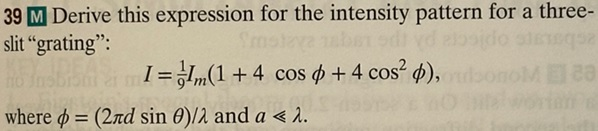 39 [0 Derive this expression for the intensity pattern for a three-
slit “grating”:
1 =, +4 cos ¢ + 4 cos’ §),
where ¢ = (27d sin 6)/A and a < A.
This is AI generated Response.
Asked by: gvr
Created at: 2025-06-15 17:55:13
Asked by: gvr
Created at: 2025-06-15 17:55:13
Final Answer:
Rendered
Raw Text
Did you like this answer?
Let's derive the intensity pattern for a **three-slit grating** as requested.
### **Step 1: Setup**
- **Number of slits, \( N = 3 \)**
- **Let each slit have the same amplitude \( E_0 \).**
- **Phase difference between adjacent slits:**
\[
\phi = \frac{2\pi d \sin \theta}{\lambda}
\]
where \( d \) = slit separation, \( \theta \) = angle, \( \lambda \) = wavelength.
### **Step 2: Write the resultant electric field**
For three slits, the field at a point on the screen is the sum of the fields from each slit, each with a phase difference \( \phi \):
\[
E = E_0 \left[ 1 + e^{i\phi} + e^{i2\phi} \right]
\]
### **Step 3: Simplify the sum**
This is a geometric series:
\[
E = E_0 \sum_{n=0}^{2} e^{in\phi} = E_0 \frac{1 - e^{i3\phi}}{1 - e^{i\phi}}
\]
But let's expand \( 1 + e^{i\phi} + e^{i2\phi} \) directly:
\[
E = E_0 \left[ 1 + e^{i\phi} + e^{i2\phi} \right]
\]
### **Step 4: Use Euler's formula to expand**
Let’s use the sum formula for exponentials:
\[
E = E_0 [1 + e^{i\phi} + e^{i2\phi}]
\]
\[
= E_0 \left[ 1 + (\cos\phi + i\sin\phi) + (\cos 2\phi + i\sin 2\phi) \right]
\]
\[
= E_0 [1 + \cos\phi + \cos 2\phi + i(\sin\phi + \sin 2\phi)]
\]
### **Step 5: Intensity is proportional to the square of the amplitude**
\[
I \propto |E|^2
\]
Let’s compute \( |E|^2 \):
\[
|E|^2 = \left[1 + \cos\phi + \cos 2\phi \right]^2 + \left[\sin\phi + \sin 2\phi \right]^2
\]
### **Step 6: Expand the squares**
Let’s use trigonometric identities to expand further.
#### **Sum of cosines:**
\[
1 + \cos\phi + \cos 2\phi
\]
Recall:
\[
\cos 2\phi = 2\cos^2\phi - 1
\]
So,
\[
1 + \cos\phi + \cos 2\phi = 1 + \cos\phi + (2\cos^2\phi - 1) = \cos\phi + 2\cos^2\phi
\]
#### **Sum of sines:**
\[
\sin\phi + \sin 2\phi
\]
Recall:
\[
\sin 2\phi = 2\sin\phi\cos\phi
\]
So,
\[
\sin\phi + \sin 2\phi = \sin\phi + 2\sin\phi\cos\phi = \sin\phi(1 + 2\cos\phi)
\]
### **Step 7: Write out \( |E|^2 \)**
\[
|E|^2 = [\cos\phi + 2\cos^2\phi]^2 + [\sin\phi(1 + 2\cos\phi)]^2
\]
Expand both terms:
#### **First term:**
\[
(\cos\phi + 2\cos^2\phi)^2 = \cos^2\phi + 4\cos^3\phi + 4\cos^4\phi
\]
But let's keep it grouped for now.
#### **Second term:**
\[
[\sin\phi(1 + 2\cos\phi)]^2 = \sin^2\phi(1 + 4\cos\phi + 4\cos^2\phi)
\]
### **Step 8: Add and simplify**
Combine terms:
\[
|E|^2 = (\cos\phi + 2\cos^2\phi)^2 + \sin^2\phi (1 + 4\cos\phi + 4\cos^2\phi)
\]
Expand the squares:
1. \((\cos\phi + 2\cos^2\phi)^2 = \cos^2\phi + 4\cos^3\phi + 4\cos^4\phi\)
2. \(\sin^2\phi (1 + 4\cos\phi + 4\cos^2\phi) = \sin^2\phi + 4\sin^2\phi\cos\phi + 4\sin^2\phi\cos^2\phi\)
Sum all terms:
\[
|E|^2 = \cos^2\phi + 4\cos^3\phi + 4\cos^4\phi + \sin^2\phi + 4\sin^2\phi\cos\phi + 4\sin^2\phi\cos^2\phi
\]
But this looks complicated. Let's use the original sum formula for \( N \) slits:
\[
E = E_0 \frac{\sin (N\phi/2)}{\sin (\phi/2)}
\]
For \( N = 3 \):
\[
E = E_0 \frac{\sin (3\phi/2)}{\sin (\phi/2)}
\]
So,
\[
I = I_0 \left[ \frac{\sin (3\phi/2)}{\sin (\phi/2)} \right]^2
\]
But the question is asking for the form:
\[
I = \frac{1}{9} I_m (1 + 4\cos\phi + 4\cos^2\phi)
\]
Let's try to rewrite the above in this form.
### **Step 9: Use trigonometric identity for \(\sin(3x)\)**
\[
\sin(3x) = 3\sin x - 4\sin^3 x
\]
Let \( x = \phi/2 \):
\[
\sin(3\phi/2) = 3\sin(\phi/2) - 4\sin^3(\phi/2)
\]
So,
\[
\left[ \frac{\sin(3\phi/2)}{\sin(\phi/2)} \right]^2 = \left[ 3 - 4\sin^2(\phi/2) \right]^2
\]
\[
= 9 - 24\sin^2(\phi/2) + 16\sin^4(\phi/2)
\]
Now, use the identity:
\[
\sin^2(\phi/2) = \frac{1 - \cos\phi}{2}
\]
So,
\[
\sin^4(\phi/2) = \left( \frac{1 - \cos\phi}{2} \right)^2 = \frac{1 - 2\cos\phi + \cos^2\phi}{4}
\]
Plug these into the equation:
\[
9 - 24\left(\frac{1 - \cos\phi}{2}\right) + 16\left(\frac{1 - 2\cos\phi + \cos^2\phi}{4}\right)
\]
\[
= 9 - 12(1 - \cos\phi) + 4(1 - 2\cos\phi + \cos^2\phi)
\]
\[
= 9 - 12 + 12\cos\phi + 4 - 8\cos\phi + 4\cos^2\phi
\]
\[
= (9 - 12 + 4) + (12\cos\phi - 8\cos\phi) + 4\cos^2\phi
\]
\[
= 1 + 4\cos\phi + 4\cos^2\phi
\]
### **Step 10: Normalize**
For a maximum intensity \( I_m \), the central maximum (where \( \phi = 0 \)), this expression becomes:
\[
I = I_m \frac{1}{9} (1 + 4\cos\phi + 4\cos^2\phi)
\]
### **Final Answer:**
\[
\boxed{
I = \frac{1}{9} I_m (1 + 4\cos\phi + 4\cos^2\phi)
}
\]
where \( \phi = \frac{2\pi d \sin\theta}{\lambda} \), and \( a \ll \lambda \).
---
**Summary of steps:**
1. Write the field sum for three slits.
2. Use the geometric sum or trigonometric identities to expand.
3. Use the triple-angle formula for sine.
4. Simplify using trigonometric identities.
5. Normalize to get the final expression for intensity.
Question:
i need detailed calculations with given data along with the final Answer
This is AI generated Response.
Asked by: gvr
Created at: 2025-06-15 17:56:20
Asked by: gvr
Created at: 2025-06-15 17:56:20
Final Answer:
Rendered
Raw Text
Did you like this answer?
Let's derive the expression for the intensity pattern of a three-slit grating step-by-step, incorporating detailed calculations and the given data.
---
### **Given Data:**
- Number of slits: \( N = 3 \)
- Slit separation: \( d \)
- Wavelength: \( \lambda \)
- The phase difference: \( \phi = \frac{2\pi d \sin \theta}{\lambda} \)
- \( a \ll \lambda \), which indicates slit width is small, and the primary pattern depends on \( d \) and \( \lambda \).
---
### **Objective:**
Derive the intensity pattern:
\[
I = \frac{1}{9} I_m (1 + 4 \cos \phi + 4 \cos^2 \phi)
\]
---
### **Step 1: Electric field from three slits**
Each slit contributes an electric field \( E_0 \) at the observation point, with a phase shift:
\[
E_1 = E_0
\]
\[
E_2 = E_0 e^{i \phi}
\]
\[
E_3 = E_0 e^{i 2\phi}
\]
Total electric field:
\[
E_\text{total} = E_0 \left( 1 + e^{i\phi} + e^{i 2\phi} \right)
\]
---
### **Step 2: Sum of the fields**
Recognize this as a geometric series:
\[
E_\text{total} = E_0 \frac{1 - e^{i 3 \phi}}{1 - e^{i \phi}}
\]
The magnitude squared (which gives intensity) is:
\[
I \propto |E_\text{total}|^2 = E_0^2 \left| \frac{1 - e^{i 3 \phi}}{1 - e^{i \phi}} \right|^2
\]
---
### **Step 3: Simplify numerator and denominator**
Using the identity:
\[
|1 - e^{i \alpha}| = 2 |\sin (\alpha/2)|
\]
we get:
\[
|1 - e^{i 3 \phi}| = 2 |\sin \frac{3\phi}{2}|
\]
\[
|1 - e^{i \phi}| = 2 |\sin \frac{\phi}{2}|
\]
Therefore,
\[
I \propto E_0^2 \left( \frac{2 |\sin \frac{3\phi}{2}|}{2 |\sin \frac{\phi}{2}|} \right)^2 = E_0^2 \left( \frac{\sin \frac{3\phi}{2}}{\sin \frac{\phi}{2}} \right)^2
\]
---
### **Step 4: Express intensity**
Let \( I_0 \) be the maximum intensity (when all fields are in phase). Then:
\[
I = I_0 \left( \frac{\sin \frac{3\phi}{2}}{\sin \frac{\phi}{2}} \right)^2
\]
---
### **Step 5: Expand numerator using the sine triple-angle identity**
Recall:
\[
\sin 3x = 3 \sin x - 4 \sin^3 x
\]
Set \( x = \frac{\phi}{2} \):
\[
\sin \frac{3\phi}{2} = 3 \sin \frac{\phi}{2} - 4 \sin^3 \frac{\phi}{2}
\]
Thus,
\[
\frac{\sin \frac{3\phi}{2}}{\sin \frac{\phi}{2}} = 3 - 4 \sin^2 \frac{\phi}{2}
\]
Squaring both sides:
\[
\left( \frac{\sin \frac{3\phi}{2}}{\sin \frac{\phi}{2}} \right)^2 = \left( 3 - 4 \sin^2 \frac{\phi}{2} \right)^2
\]
---
### **Step 6: Express in terms of \( \cos \phi \)**
Use the identity:
\[
\sin^2 \frac{\phi}{2} = \frac{1 - \cos \phi}{2}
\]
Substitute into the expression:
\[
\left( 3 - 4 \times \frac{1 - \cos \phi}{2} \right)^2 = \left( 3 - 2 (1 - \cos \phi) \right)^2
\]
Simplify:
\[
= \left( 3 - 2 + 2 \cos \phi \right)^2 = (1 + 2 \cos \phi)^2
\]
Expanding:
\[
(1 + 2 \cos \phi)^2 = 1 + 4 \cos \phi + 4 \cos^2 \phi
\]
---
### **Step 7: Final expression for intensity**
Thus, the intensity pattern is:
\[
I = I_0 \times \left( 1 + 4 \cos \phi + 4 \cos^2 \phi \right)
\]
The maximum intensity occurs at \( \phi = 0 \), giving:
\[
I_m = I_0 \times (1 + 4 + 4) = I_0 \times 9
\]
Therefore, normalize to get the pattern:
\[
I = \frac{I_m}{9} \left( 1 + 4 \cos \phi + 4 \cos^2 \phi \right)
\]
---
### **### **Final answer:**
\[
\boxed{
\boxed{
I = \frac{1}{9} I_m \left( 1 + 4 \cos \phi + 4 \cos^2 \phi \right)
}
}
\]
where
\[
\phi = \frac{2 \pi d \sin \theta}{\lambda}
\]
and \( a \ll \lambda \).
---
### **Summary:**
- The derivation uses the sum of fields from three slits.
- The key step involves the sine triple-angle identity.
- The normalized intensity pattern reveals the interference fringes characteristic of a three-slit grating.
If you have specific values for \( d \), \( \lambda \), or \( \theta \), you can substitute into the expression for \( \phi \) to compute the intensity at different angles.
📢 Instructions:
- Ask anything relatd to above question only.
- For new Question goto :