 VIPSolutions
Give step-by-step solution with explanation and final answer:95. Consider a semi-infinite system of two kinds of massive string with different densi- ties, shown below: 13 ra 1 _ ce. © region] region 11 x=-L =0 ‘The density of the string in region / is p and in region 77 is //. The tension in both strings is 7. Suppose that the end at z = —L is oscillated in the transverse direction with displacement sin wt. This produces an outgoing wave (moving to the right) in region 77 with no incoming wave. Suppose that w = 77/T. Find the displacement at the point = = 0 as a function of time.
Question:
Give step-by-step solution with explanation and final answer: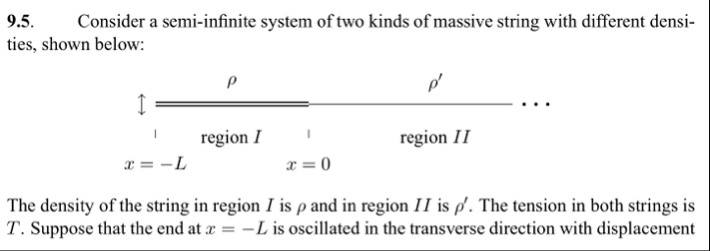
 95. Consider a semi-infinite system of two kinds of massive string with different densi-
ties, shown below:
13 ra
1 _ ce.
© region] region 11
x=-L =0
‘The density of the string in region / is p and in region 77 is //. The tension in both strings is
7. Suppose that the end at z = —L is oscillated in the transverse direction with displacement
sin wt. This produces an outgoing wave (moving to the right) in region 77 with no incoming
wave. Suppose that w = 77/T. Find the displacement at the point = = 0 as a function of
time.
This is AI generated Response.
Asked by: gvr
Created at: 2025-06-15 17:25:37
Asked by: gvr
Created at: 2025-06-15 17:25:37
Final Answer:
Rendered
Raw Text
Did you like this answer?
Let's solve the problem step by step.
---
## **Step 1: Wave Equations and General Solutions**
### **Region I (\( -L \leq x \leq 0 \), density \(\rho\)):**
The wave equation is:
\[
\frac{\partial^2 y_1}{\partial t^2} = \frac{T}{\rho} \frac{\partial^2 y_1}{\partial x^2}
\]
General solution (for standing waves, since boundary at \(x = -L\) is driven):
\[
y_1(x,t) = [A \sin(k(x+L))] \sin(\omega t)
\]
where \(k = \omega/v_1\), \(v_1 = \sqrt{T/\rho}\).
### **Region II (\( x > 0 \), density \(\rho'\)):**
The wave equation is:
\[
\frac{\partial^2 y_2}{\partial t^2} = \frac{T}{\rho'} \frac{\partial^2 y_2}{\partial x^2}
\]
Only outgoing waves (right-going):
\[
y_2(x,t) = B \sin(k'(x)) \sin(\omega t)
\]
where \(k' = \omega/v_2\), \(v_2 = \sqrt{T/\rho'}\).
But since only outgoing wave, we use:
\[
y_2(x,t) = C \sin(\omega t - k' x)
\]
---
## **Step 2: Boundary and Continuity Conditions**
- **At \(x = -L\):** The string is driven: \(y_1(-L, t) = \chi \sin(\omega t)\)
- **At \(x = 0\):** Displacement and slope (force) must be continuous.
Let's write the general solution in region I as:
\[
y_1(x, t) = A \sin[k(x+L)] \sin(\omega t)
\]
At \(x = -L\):
\[
y_1(-L, t) = A \sin(0) \sin(\omega t) = 0
\]
But this cannot match the driven displacement unless we add a cosine term:
\[
y_1(x, t) = [a \sin(k(x+L)) + b \cos(k(x+L))] \sin(\omega t)
\]
Apply boundary:
\[
y_1(-L, t) = b \cos(0) \sin(\omega t) = b \sin(\omega t)
\implies b = \chi
\]
So,
\[
y_1(x, t) = [a \sin(k(x+L)) + \chi \cos(k(x+L))] \sin(\omega t)
\]
---
## **Step 3: Matching at \(x = 0\)**
- **Displacement continuity:**
\[
y_1(0, t) = y_2(0, t)
\]
- **Slope (force) continuity:**
\[
T \left. \frac{\partial y_1}{\partial x} \right|_{x=0} = T \left. \frac{\partial y_2}{\partial x} \right|_{x=0}
\]
### **Compute values at \(x = 0\):**
- \(y_1(0, t) = [a \sin(kL) + \chi \cos(kL)] \sin(\omega t)\)
- \(\frac{\partial y_1}{\partial x} \Big|_{x=0} = a k \cos(kL) - \chi k \sin(kL)\)
Let the outgoing wave in region II be:
\[
y_2(x, t) = C \sin(\omega t - k' x)
\]
- At \(x = 0\): \(y_2(0, t) = C \sin(\omega t)\)
- \(\frac{\partial y_2}{\partial x} \big|_{x=0} = -C k' \cos(\omega t)\)
---
## **Step 4: Apply Matching Conditions at \(x = 0\):**
(Assume all terms have the same time dependence, so we can equate coefficients.)
1. **Displacement:**
\[
a \sin(kL) + \chi \cos(kL) = C
\]
2. **Slope:**
\[
a k \cos(kL) - \chi k \sin(kL) = -C k'
\]
---
## **Step 5: Solve for \(a\) and \(C\)**
From (1):
\[
C = a \sin(kL) + \chi \cos(kL)
\]
Plug into (2):
\[
a k \cos(kL) - \chi k \sin(kL) = -[a \sin(kL) + \chi \cos(kL)] k'
\]
\[
a k \cos(kL) - \chi k \sin(kL) + a k' \sin(kL) + \chi k' \cos(kL) = 0
\]
\[
a [k \cos(kL) + k' \sin(kL)] + \chi [-k \sin(kL) + k' \cos(kL)] = 0
\]
\[
a = \chi \frac{k \sin(kL) - k' \cos(kL)}{k \cos(kL) + k' \sin(kL)}
\]
---
## **Step 6: Plug in \(a\) to Find Displacement at \(x=0\)**
Recall:
\[
y_1(0, t) = [a \sin(kL) + \chi \cos(kL)] \sin(\omega t)
\]
So,
\[
y_1(0, t) = \left[ \chi \frac{k \sin(kL) - k' \cos(kL)}{k \cos(kL) + k' \sin(kL)} \sin(kL) + \chi \cos(kL) \right] \sin(\omega t)
\]
\[
= \chi \left[ \frac{ (k \sin(kL) - k' \cos(kL)) \sin(kL) + (k \cos(kL) + k' \sin(kL)) \cos(kL) } {k \cos(kL) + k' \sin(kL)} \right] \sin(\omega t)
\]
Expand numerator:
\[
k \sin^2(kL) - k' \sin(kL) \cos(kL) + k \cos^2(kL) + k' \sin(kL) \cos(kL)
\]
The \(k' \sin(kL) \cos(kL)\) terms cancel:
\[
k (\sin^2(kL) + \cos^2(kL)) = k
\]
So:
\[
y_1(0, t) = \chi \frac{k}{k \cos(kL) + k' \sin(kL)} \sin(\omega t)
\]
---
## **Step 7: Substitute \( k = \omega/v_1 = \omega \sqrt{\rho/T} \), \( k' = \omega \sqrt{\rho'/T} \), and \( \omega = \frac{\pi}{2L} \sqrt{T/\rho} \) (given)**
- \(k = \frac{\pi}{2L}\)
- \(k' = \omega \sqrt{\rho'/T} = \frac{\pi}{2L} \sqrt{\frac{\rho'}{\rho}}\)
Also, \(kL = \frac{\pi}{2}\), so \(\cos(kL) = 0\), \(\sin(kL) = 1\).
Plug in:
\[
y_1(0, t) = \chi \frac{\frac{\pi}{2L}}{k \cdot 0 + k' \cdot 1} \sin(\omega t)
= \chi \frac{\frac{\pi}{2L}}{ \frac{\pi}{2L} \sqrt{\frac{\rho'}{\rho}} } \sin(\omega t)
= \chi \frac{1}{ \sqrt{\frac{\rho'}{\rho}} } \sin(\omega t)
= \chi \sqrt{\frac{\rho}{\rho'}} \sin(\omega t)
\]
---
## **Final Answer**
\[
\boxed{
y(0, t) = \chi \sqrt{\frac{\rho}{\rho'}} \sin(\omega t)
}
\]
with \(\omega = \frac{\pi}{2L} \sqrt{\frac{T}{\rho}}\).
---
**Summary of Approach:**
- Write general solutions in both regions.
- Match boundary conditions at \(x = -L\) and \(x = 0\).
- Solve for the amplitude at \(x = 0\).
- Substitute the provided value of \(\omega\) to get the final result.
📢 Instructions:
- Ask anything relatd to above question only.
- For new Question goto :