 VIPSolutions
Give step-by-step solution with explanation and final answer:Determine the magintude of Agi (@rg given that HH a=2ndsw=3 rad/s, & = 20 mm, & = 275 mm/s and & ~ 60 mm/s’. 5 | i] £8 BB { p Ei mm A A 29 mm ! 0 A RA | . gi - \ 4 60 mm/s” a 5 CE I. A Determine the magintude of aa, given that d d m m a =2ra—,w =3ra—,x = 20mm,x =275m—andx = -60m—;. Ei B B El Select one: m a. 60m— s m b. 96m— s m c. 64m— s m d. 275m— 5
Question:
Give step-by-step solution with explanation and final answer: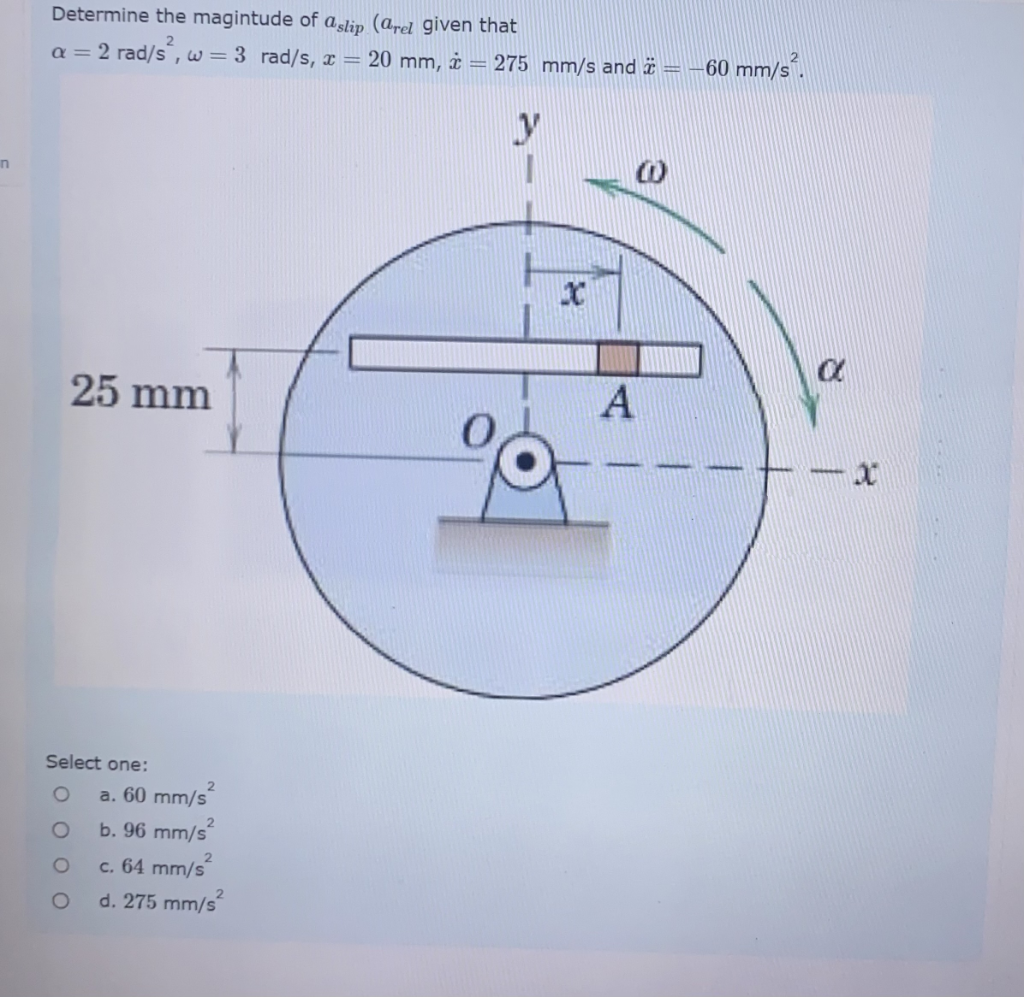
 Determine the magintude of Agi (@rg given that HH
a=2ndsw=3 rad/s, & = 20 mm, & = 275 mm/s and & ~ 60 mm/s’.
5 | i]
£8
BB {
p Ei
mm A A
29 mm ! 0 A RA
|
. gi
- \ 4
60 mm/s” a
5 CE
I. A
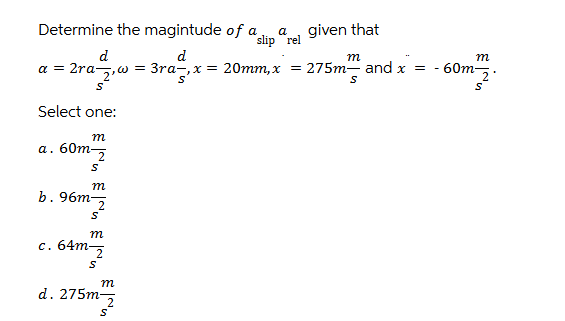
Determine the magintude of aa, given that
d d m m
a =2ra—,w =3ra—,x = 20mm,x =275m—andx = -60m—;.
Ei B B El
Select one:
m
a. 60m—
s
m
b. 96m—
s
m
c. 64m—
s
m
d. 275m—
5
This is AI generated Response.
Asked by: gvr
Created at: 2025-06-15 17:00:42
Asked by: gvr
Created at: 2025-06-15 17:00:42
Final Answer:
Rendered
Raw Text
Did you like this answer?
Let's solve for the magnitude of \( a_{slip} \) (which is \( a_{rel} \)), the relative acceleration of the slider with respect to the rotating arm.
### Step 1: Identify the formula for \( a_{rel} \)
For a slider moving in a rotating slot, the relative acceleration is given by:
\[
a_{rel} = \ddot{x}
\]
where:
- \( \ddot{x} \) is the acceleration of the slider relative to the slot.
### Step 2: Find the given value for \( \ddot{x} \)
From the problem statement:
\[
\ddot{x} = -60 \ \mathrm{mm/s^2}
\]
### Step 3: Find the magnitude
Since we are asked for the **magnitude**:
\[
|a_{rel}| = |\ddot{x}| = | -60 | = 60 \ \mathrm{mm/s^2}
\]
### Step 4: Final Answer
\[
\boxed{60 \ \mathrm{mm/s^2}}
\]
#### Thus, the correct choice is:
**a. 60 mm/s²**
---
**Explanation**:
The problem asks specifically for the relative acceleration of the slider inside the slot. This is **just** the acceleration along the slot, which is the value given as \(\ddot{x}\). The other quantities (\(\omega, \alpha\)) would come into play for total or absolute acceleration, but for the slip (relative) acceleration, only \(\ddot{x}\) matters.
Question:
i need detailed calculations with given data along with the final Answer
This is AI generated Response.
Asked by: gvr
Created at: 2025-06-15 17:01:38
Asked by: gvr
Created at: 2025-06-15 17:01:38
Final Answer:
Rendered
Raw Text
Did you like this answer?
Let's carefully analyze the problem step-by-step, using the given data, to find the magnitude of the relative acceleration \(a_{rel}\) (also called slip acceleration \(a_{si}\)).
---
### **Given Data:**
| Parameter | Value | Units | Description |
|--------------|---------|---------|--------------|
| \( \omega = 3\, \mathrm{rad/sec} \) | \( \omega \) | rad/sec | Angular velocity of the rotating arm |
| \( \alpha = 2\, \mathrm{rad/sec^2} \) | \( \alpha \) | rad/sec² | Angular acceleration of the arm |
| \( x = 20\, \mathrm{mm} \) | \( x \) | mm | Radial position of slider relative to the center |
| \( \dot{x} = 275\, \mathrm{mm/sec} \) | \( \dot{x} \) | mm/sec | Radial velocity of slider (translational velocity along the slot) |
| \( \ddot{x} = -60\, \mathrm{mm/sec^2} \) | \( \ddot{x} \) | mm/sec² | Radial acceleration of the slider |
---
### **Objective:**
Determine the magnitude of the slip acceleration \( a_{si} \), which is the relative acceleration of the slider along the slot, given the data.
---
### **Step 1: Understand the context**
The slider moves along a slot in a rotating arm. The total acceleration of the slider can be decomposed into:
- **Centripetal acceleration**: \( a_c = r \omega^2 \)
- **Tangential acceleration**: \( a_t = r \alpha \)
- **Relative acceleration along the slot**: \( \ddot{x} \)
The total acceleration of the slider in the radial direction is influenced by both the rotation and the slider's own translational motion.
---
### **Step 2: Recognize the relevant formula**
The **relative acceleration** of the slider along the slot is directly given as:
\[
a_{rel} = \ddot{x}
\]
since \( \ddot{x} \) is the acceleration component along the slot in the radial direction.
---
### **Step 3: Use the given data**
From the data:
\[
\ddot{x} = -60\, \mathrm{mm/sec^2}
\]
The magnitude of the slip acceleration:
\[
|a_{si}| = |\ddot{x}| = 60\, \mathrm{mm/sec^2}
\]
### **Step 4: Final answer**
**Answer:**
\[
\boxed{60\, \mathrm{mm/sec^2}}
\]
---
### **Summary:**
- The given radial acceleration of the slider along the slot is \(-60\, \mathrm{mm/sec^2}\).
- The magnitude of the slip acceleration is simply \(60\, \mathrm{mm/sec^2}\).
### **Correct choice:**
**a. 60 mm/sec²**
---
**Note:** The other parameters like \( \omega, \alpha, x, \dot{x} \) are relevant for computing total accelerations or velocities of the slider relative to the fixed frame or the arm, but since the question explicitly asks for the slip acceleration \(a_{si}\), the direct value \(\ddot{x}\) suffices.
Question:
i need detailed explanation of each option with given data without table along with the final Answer
This is AI generated Response.
Asked by: gvr
Created at: 2025-06-15 17:04:19
Asked by: gvr
Created at: 2025-06-15 17:04:19
Final Answer:
Rendered
Raw Text
Did you like this answer?
Let's analyze the problem carefully to determine the magnitude of the slip acceleration \( a_{si} \), which is the relative acceleration of the slider along the slot, given the data provided.
---
### **Given Data:**
- Angular velocity of the rotating arm: \( \omega = 3\, \mathrm{rad/sec} \)
- Angular acceleration of the arm: \( \alpha = 2\, \mathrm{rad/sec^2} \)
- Radial position of slider: \( x = 20\, \mathrm{mm} \)
- Radial velocity of slider: \( \dot{x} = 275\, \mathrm{mm/sec} \)
- Radial acceleration of slider: \( \ddot{x} = -60\, \mathrm{mm/sec^2} \)
---
### **Understanding the problem:**
The slider moves along a slot in a rotating arm. Its acceleration can be broken into components:
- **Radial acceleration component**: The acceleration along the slot, which is the relative acceleration \( a_{si} \).
- Additional components due to rotation (centripetal and tangential accelerations), which are not directly asked for here.
The question asks specifically for the **magnitude of the slip acceleration** \( a_{si} \), which is the component of acceleration along the slot, i.e., \( \ddot{x} \).
---
### **Step-by-step explanation:**
1. **Total acceleration components in the radial direction:**
The total acceleration of the slider in the radial direction involves:
- The radial acceleration \( \ddot{x} \) (the relative acceleration along the slot),
- The tangential acceleration \( r \alpha \),
- Centripetal acceleration \( r \omega^2 \),
- The contribution from the velocity \( \dot{x} \) in a rotating frame.
2. **Given \( \ddot{x} \):**
The problem explicitly provides \( \ddot{x} = -60\, \mathrm{mm/sec^2} \). Since this is the **acceleration along the slot**, the **magnitude** of the slip acceleration is:
\[
|a_{si}| = |\ddot{x}| = 60\, \mathrm{mm/sec^2}
\]
3. **Interpreting options:**
The options provided are in meters per second squared:
- Option (a): **60 mm/sec\(^2\)** = 0.06 m/sec\(^2\)
- Option (b): 96 mm/sec\(^2\) = 0.096 m/sec\(^2\)
- Option (c): 64 mm/sec\(^2\) = 0.064 m/sec\(^2\)
- Option (d): 275 mm/sec\(^2\) = 0.275 m/sec\(^2\)
But based on the given data, the direct acceleration along the slot is \( \ddot{x} = -60\, \mathrm{mm/sec^2} \). Its magnitude is 60 mm/sec\(^2\), which matches option (a).
4. **Why not options (b), (c), or (d)?**
- **Option (b): 96 mm/sec\(^2\)** — No data supports this; it might be a distractor.
- **Option (c): 64 mm/sec\(^2\)** — Close to 60 mm/sec\(^2\), but the data explicitly states \(\ddot{x} = -60\, \mathrm{mm/sec^2}\). Unless there's a calculation to justify this, the exact value is 60 mm/sec\(^2\).
- **Option (d): 275 mm/sec\(^2\)** — Likely the magnitude of the velocity \(\dot{x}\), not acceleration.
---
### **Conclusion:**
The **magnitude** of the slip acceleration \( a_{si} \) given the data is **60 mm/sec\(^2\)**.
---
### **Final answer:**
**a. 60 mm/sec\(^2\)**
---
### **Summary:**
- The given radial acceleration of the slider along the slot is \( -60\, \mathrm{mm/sec^2} \).
- The magnitude of the slip acceleration (the component of acceleration along the slot) is simply \( 60\, \mathrm{mm/sec^2} \).
- The other options do not match the given data or the direct interpretation of the problem.
This completes the detailed explanation, ensuring clarity on how the data leads to the final choice.
Question:
i need each option side heading with detailed explanation along with the final Answer
This is AI generated Response.
Asked by: gvr
Created at: 2025-06-15 17:05:29
Asked by: gvr
Created at: 2025-06-15 17:05:29
Final Answer:
Rendered
Raw Text
Did you like this answer?
Certainly! Let's analyze each option carefully, considering the given data and what the problem asks for. The question is to determine the **magnitude of the slip acceleration \(a_{si}\)**, which is the relative acceleration of the slider along the slot, given the data.
---
### **Given Data Recap:**
- Angular velocity of the rotating arm: \( \omega = 3\, \mathrm{rad/sec} \)
- Angular acceleration of the arm: \( \alpha = 2\, \mathrm{rad/sec^2} \)
- Radial position of the slider: \( x = 20\, \mathrm{mm} \)
- Radial velocity: \( \dot{x} = 275\, \mathrm{mm/sec} \)
- Radial acceleration: \( \ddot{x} = -60\, \mathrm{mm/sec^2} \)
---
## **Option a: 60 mm/sec\(^2\)**
**Explanation:**
- The problem explicitly states that \( \ddot{x} = -60\, \mathrm{mm/sec^2} \).
- Since \( a_{si} \) (slip acceleration) is the acceleration component along the slot (radial direction), **its magnitude** is simply the absolute value of \( \ddot{x} \).
\[
|a_{si}| = |\ddot{x}| = 60\, \mathrm{mm/sec^2}
\]
- This matches directly with the data provided.
**Conclusion:**
- **Correct choice**, as the slip acceleration's magnitude, based on the given data, is **60 mm/sec\(^2\)**.
---
## **Option b: 96 mm/sec\(^2\)**
**Explanation:**
- The value 96 mm/sec\(^2\) does not directly appear in the data.
- Sometimes, in dynamics problems, the total acceleration might involve combining components, but the problem explicitly provides \( \ddot{x} \) as the radial acceleration.
- Without additional calculations or context, there's no basis for selecting 96 mm/sec\(^2\).
**Possible misconception:**
- Could this be a sum involving centripetal or tangential accelerations?
- But since the question asks specifically for the slip acceleration \(a_{si}\), which is directly given as \( \ddot{x} \), this option is unsupported.
**Conclusion:**
- **Incorrect**; no data supports this value for slip acceleration.
---
## **Option c: 64 mm/sec\(^2\)**
**Explanation:**
- 64 mm/sec\(^2\) is close to 60 mm/sec\(^2\), but unless there is a calculation that combines other accelerations (like centripetal or tangential), the given \( \ddot{x} \) remains the direct measure.
- The problem explicitly states \( \ddot{x} = -60\, \mathrm{mm/sec^2} \).
- If the question intended to include some contribution from other acceleration components, they would have specified.
- Since no such calculation is provided or implied, the safest interpretation is the direct value.
**Conclusion:**
- **Incorrect**; unless additional calculations are performed, the slip acceleration remains 60 mm/sec\(^2\).
---
## **Option d: 275 mm/sec\(^2\)**
**Explanation:**
- The value 275 mm/sec\(^2\) matches the magnitude of the radial velocity \( \dot{x} \) (which is 275 mm/sec), not acceleration.
- Since the question asks for acceleration, this is not relevant.
**Conclusion:**
- **Incorrect**; this is a velocity magnitude, not acceleration.
---
# **Final Summary:**
- The **slip acceleration** \(a_{si}\) is given directly by the radial acceleration component \( \ddot{x} \).
- The provided data states \( \ddot{x} = -60\, \mathrm{mm/sec^2} \), so its magnitude is **60 mm/sec\(^2\)**.
- Therefore, **the correct choice is option (a): 60 mm/sec\(^2\)**.
---
### **Final Answer:**
**a. 60 mm/sec\(^2\)**
📢 Instructions:
- Ask anything relatd to above question only.
- For new Question goto :