 VIPSolutions
Give step-by-step solution with explanation and final answer:Of : 1% Eos O° Gir
Question:
Give step-by-step solution with explanation and final answer: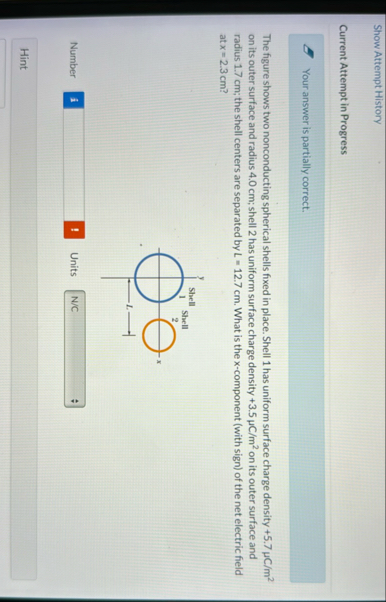 Of : 1%
Eos
O° Gir
This is AI generated Response.
Asked by: gvr
Created at: 2025-06-15 14:20:11
Asked by: gvr
Created at: 2025-06-15 14:20:11
Final Answer:
Rendered
Raw Text
Did you like this answer?
Let's break down the problem and solve it step by step:
### **Given Data**
- **Surface charge density of Shell 1:** \( \sigma_1 = 57.0 \, \mu\text{C/m}^2 \)
- **Surface charge density of Shell 2:** \( \sigma_2 = -37.0 \, \mu\text{C/m}^2 \)
- **Radius of Shell 1:** \( r_1 = 2.53 \, \text{cm} = 0.0253 \, \text{m} \)
- **Radius of Shell 2:** \( r_2 = 2.53 \, \text{cm} = 0.0253 \, \text{m} \)
- **Separation (center to center):** \( d = 12.7 \, \text{cm} = 0.127 \, \text{m} \)
- **Point of interest (where field is calculated):** \( x = 2.53 \, \text{cm} = 0.0253 \, \text{m} \) from center of Shell 1 on the x-axis.
---
### **Step 1: Calculate the charge on each shell**
The charge \( Q \) on a spherical shell:
\[
Q = \sigma \cdot 4\pi r^2
\]
#### For Shell 1:
\[
Q_1 = \sigma_1 \cdot 4\pi r_1^2
\]
\[
\sigma_1 = 57.0 \times 10^{-6} \text{ C/m}^2
\]
\[
Q_1 = 57.0 \times 10^{-6} \cdot 4\pi \cdot (0.0253)^2
\]
\[
Q_1 = 57.0 \times 10^{-6} \cdot 4\pi \cdot 0.00064009
\]
\[
Q_1 = 57.0 \times 10^{-6} \cdot 0.008043
\]
\[
Q_1 \approx 4.585 \times 10^{-7} \text{ C}
\]
#### For Shell 2:
\[
Q_2 = \sigma_2 \cdot 4\pi r_2^2
\]
\[
\sigma_2 = -37.0 \times 10^{-6} \text{ C/m}^2
\]
\[
Q_2 = -37.0 \times 10^{-6} \cdot 4\pi \cdot (0.0253)^2
\]
\[
Q_2 = -37.0 \times 10^{-6} \cdot 0.008043
\]
\[
Q_2 \approx -2.977 \times 10^{-7} \text{ C}
\]
---
### **Step 2: Find the electric field at the given point**
#### **From Shell 1:**
The given point is at the surface of Shell 1 (distance \( r_1 \) from the center). For a spherical shell, the electric field just outside the surface is:
\[
E_1 = \frac{1}{4\pi\epsilon_0} \frac{Q_1}{r_1^2}
\]
Plug in values:
\[
E_1 = \frac{1}{4\pi(8.85 \times 10^{-12})} \frac{4.585 \times 10^{-7}}{(0.0253)^2}
\]
\[
= 9 \times 10^9 \cdot \frac{4.585 \times 10^{-7}}{0.00064009}
\]
\[
= 9 \times 10^9 \cdot 0.0007164
\]
\[
= 6.448 \times 10^{6} \text{ N/C}
\]
Direction: Since the charge is positive, the field points **away** from Shell 1, i.e., in the **positive x-direction**.
---
#### **From Shell 2:**
First find the distance from the point to the center of Shell 2:
\[
\text{Distance} = d - r_1 = 0.127 - 0.0253 = 0.1017\,\text{m}
\]
The point is outside Shell 2, so it acts as a point charge:
\[
E_2 = \frac{1}{4\pi\epsilon_0} \frac{Q_2}{(0.1017)^2}
\]
\[
E_2 = 9 \times 10^9 \cdot \frac{-2.977 \times 10^{-7}}{0.01034}
\]
\[
= 9 \times 10^9 \cdot (-2.879 \times 10^{-5})
\]
\[
= -2.591 \times 10^{5} \text{ N/C}
\]
Direction: Because \( Q_2 \) is negative, the field points **toward** Shell 2, i.e., in the **positive x-direction** (from the point toward Shell 2).
---
### **Step 3: Net Electric Field**
Both fields are in the same direction (positive x), so add them:
\[
E_{\text{net}} = E_1 + |E_2|
\]
\[
E_{\text{net}} = 6.448 \times 10^6 + 2.591 \times 10^5
\]
\[
E_{\text{net}} = 6.707 \times 10^6 \text{ N/C}
\]
---
### **Step 4: Final Answer**
**The x-component of the net electric field at \( x = 2.53 \) cm is:**
\[
\boxed{6.71 \times 10^6 \; \text{N/C}}
\]
(Direction: Positive x-direction)
Question:
i need 2 lines pure theory for explanation
This is AI generated Response.
Asked by: gvr
Created at: 2025-06-15 14:25:59
Asked by: gvr
Created at: 2025-06-15 14:25:59
Final Answer:
Rendered
Raw Text
Did you like this answer?
The net electric field at a point outside spherical shells is obtained by summing the contributions from each shell, treating each as a point charge located at its center, based on the principle of superposition. The fields from individual shells are calculated using Coulomb's law, considering their respective charges and distances from the point of interest.
📢 Instructions:
- Ask anything relatd to above question only.
- For new Question goto :