 VIPSolutions
Give step-by-step solution with explanation and final answer:
Question:
Give step-by-step solution with explanation and final answer: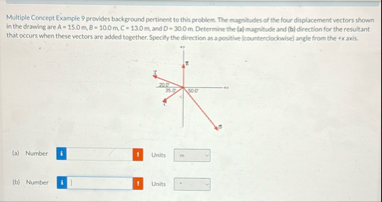
This is AI generated Response.
Asked by: gvr
Created at: 2025-06-15 08:56:54
Asked by: gvr
Created at: 2025-06-15 08:56:54
Final Answer:
Rendered
Raw Text
Did you like this answer?
Let’s break down the steps for finding the resultant vector:
**Given:**
- \( A = 15.0 \, \text{m} \)
- \( B = 10.0 \, \text{m} \)
- \( C = 13.0 \, \text{m} \)
- \( D = 30.0 \, \text{m} \)
Angles from the diagram (measured counterclockwise from the +x-axis):
- \( A \): along +y-axis → \( 90^\circ \)
- \( B \): \( 30^\circ \) below +x-axis → \( -30^\circ \)
- \( C \): \( 30^\circ \) above -x-axis → \( 180^\circ - 30^\circ = 150^\circ \)
- \( D \): \( 60^\circ \) below -x-axis → \( 180^\circ + 60^\circ = 240^\circ \)
We will resolve each vector into x and y components.
---
## **Step 1: Resolve Each Vector into Components**
**A:**
- \( A_x = 15.0 \cos 90^\circ = 0 \)
- \( A_y = 15.0 \sin 90^\circ = 15.0 \)
**B:**
- \( B_x = 10.0 \cos(-30^\circ) = 10.0 \times 0.866 = 8.66 \)
- \( B_y = 10.0 \sin(-30^\circ) = 10.0 \times (-0.5) = -5.0 \)
**C:**
- \( C_x = 13.0 \cos(150^\circ) = 13.0 \times (-0.866) = -11.26 \)
- \( C_y = 13.0 \sin(150^\circ) = 13.0 \times 0.5 = 6.5 \)
**D:**
- \( D_x = 30.0 \cos(240^\circ) = 30.0 \times (-0.5) = -15.0 \)
- \( D_y = 30.0 \sin(240^\circ) = 30.0 \times (-0.866) = -25.98 \)
---
## **Step 2: Add All x and y Components**
\[
R_x = A_x + B_x + C_x + D_x = 0 + 8.66 - 11.26 - 15.0 = -17.6
\]
\[
R_y = A_y + B_y + C_y + D_y = 15.0 - 5.0 + 6.5 - 25.98 = -9.48
\]
---
## **Step 3: Find the Magnitude of the Resultant Vector**
\[
R = \sqrt{R_x^2 + R_y^2} = \sqrt{(-17.6)^2 + (-9.48)^2} = \sqrt{309.76 + 89.86} = \sqrt{399.62} \approx 20.0
\]
---
## **Step 4: Find the Direction (Angle from the +x-axis, counterclockwise)**
\[
\theta = \tan^{-1} \left(\frac{R_y}{R_x}\right) = \tan^{-1} \left(\frac{-9.48}{-17.6}\right) = \tan^{-1}(0.539)
\]
\[
\theta \approx 28.3^\circ
\]
Both \( R_x \) and \( R_y \) are negative, so the vector is in the **third quadrant**.
To get the angle counterclockwise from the +x-axis:
\[
\theta_{ccw} = 180^\circ + 28.3^\circ = 208.3^\circ
\]
---
## **Final Answers:**
### (a) Magnitude:
\[
\boxed{20.0 \ \text{m}}
\]
### (b) Direction (counterclockwise from +x-axis):
\[
\boxed{208^\circ}
\]
---
**Summary Table:**
| Vector | \( x \) component | \( y \) component |
|--------|------------------|-------------------|
| A | 0 | 15.0 |
| B | +8.66 | -5.0 |
| C | -11.26 | +6.5 |
| D | -15.0 | -25.98 |
|**Total** | **-17.6** | **-9.48** |
---
**Let me know if you need the detailed breakdown of any step!**
📢 Instructions:
- Ask anything relatd to above question only.
- For new Question goto :