 VIPSolutions
Give step-by-step solution with explanation and final answer:A sinusoidal magnetic field is acting in a conducting medium with conductivity &. For this case, the vector potential A has the form A = A(z) expli(wt — az)] g. 1. 1f A satisfies the equation V2 A = 1&2, find the differential equation satisfied by A(z). Then, find the expression for A(z), assuming A(z) = Ap atz = 0, and lim,» A(z) = 0. 2. Determine E and H at any point and show that the ratio of the z and 2 components of the magnetic field satisfies 2-2 2 1/4 ow (1 +E ) . [e%
Question:
Give step-by-step solution with explanation and final answer: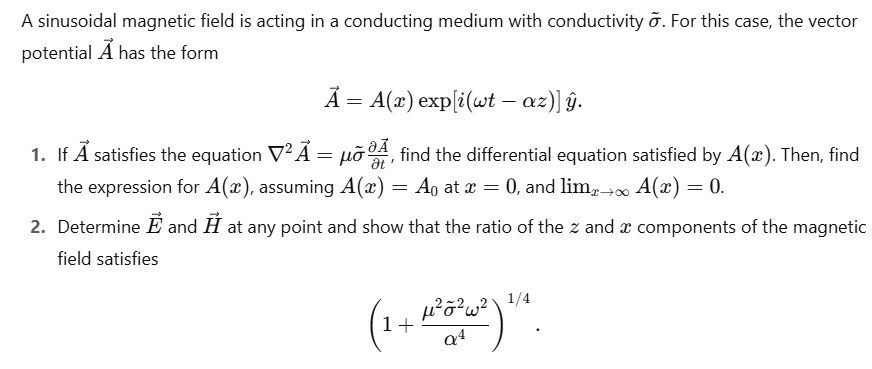 A sinusoidal magnetic field is acting in a conducting medium with conductivity &. For this case, the vector
potential A has the form
A = A(z) expli(wt — az)] g.
1. 1f A satisfies the equation V2 A = 1&2, find the differential equation satisfied by A(z). Then, find
the expression for A(z), assuming A(z) = Ap atz = 0, and lim,» A(z) = 0.
2. Determine E and H at any point and show that the ratio of the z and 2 components of the magnetic
field satisfies
2-2 2 1/4
ow
(1 +E ) .
[e%
This is AI generated Response.
Asked by: gvr
Created at: 2025-06-15 08:46:15
Asked by: gvr
Created at: 2025-06-15 08:46:15
Final Answer:
Rendered
Raw Text
Did you like this answer?
Let's solve the problem step by step:
---
### **1. Find the Differential Equation for \( A(x) \)**
Given:
\[
\vec{A} = A(x) \exp[i(\omega t - \alpha z)]\, \hat{y}
\]
and
\[
\nabla^2 \vec{A} = \mu \tilde{\sigma} \frac{\partial \vec{A}}{\partial t}
\]
#### **Step 1.1: Substitute \( \vec{A} \) into the equation**
Since \(\vec{A}\) only has a \(y\) component and depends on \(x, t, z\), let's write:
\[
\vec{A} = \hat{y} A(x) e^{i(\omega t - \alpha z)}
\]
The Laplacian reduces to:
\[
\nabla^2 \vec{A} = \hat{y} \left[\frac{\partial^2 A}{\partial x^2} - \alpha^2 A(x)\right] e^{i(\omega t - \alpha z)}
\]
The time derivative:
\[
\frac{\partial \vec{A}}{\partial t} = \hat{y} (i\omega) A(x) e^{i(\omega t - \alpha z)}
\]
So the equation becomes:
\[
\hat{y} \left[\frac{d^2 A}{dx^2} - \alpha^2 A(x)\right] e^{i(\omega t - \alpha z)} = \mu \tilde{\sigma} \hat{y} (i\omega) A(x) e^{i(\omega t - \alpha z)}
\]
#### **Step 1.2: Cancel common factors and simplify**
Divide both sides by \(\hat{y} e^{i(\omega t - \alpha z)}\):
\[
\frac{d^2 A}{dx^2} - \alpha^2 A(x) = \mu \tilde{\sigma} (i\omega) A(x)
\]
\[
\frac{d^2 A}{dx^2} = \left[ \alpha^2 + i\mu \tilde{\sigma} \omega \right] A(x)
\]
Let \( k^2 = \alpha^2 + i\mu \tilde{\sigma} \omega \):
\[
\frac{d^2 A}{dx^2} - k^2 A(x) = 0
\]
---
#### **Step 1.3: General solution for \(A(x)\) and apply boundary conditions**
General solution:
\[
A(x) = C_1 e^{k x} + C_2 e^{-k x}
\]
Boundary conditions:
- \(A(0) = A_0\)
- \(\lim_{x \to \infty} A(x) = 0\)
For the solution to be finite as \(x \to \infty\), set \(C_1 = 0\):
\[
A(x) = C_2 e^{-k x}
\]
\[
A(0) = A_0 = C_2 \implies C_2 = A_0
\]
\[
\boxed{A(x) = A_0 e^{-k x}}
\]
where \(k = \sqrt{\alpha^2 + i\mu \tilde{\sigma} \omega}\).
---
### **2. Find \( \vec{E} \) and \( \vec{H} \), and the ratio of the \(z\) and \(x\) components of \( \vec{H} \)**
#### **Step 2.1: Find \( \vec{E} \) and \( \vec{B} \) from \( \vec{A} \)**
- **Electric field:** \( \vec{E} = -\frac{\partial \vec{A}}{\partial t} \)
- **Magnetic field:** \( \vec{B} = \nabla \times \vec{A} \)
- **Magnetic field intensity:** \( \vec{H} = \vec{B}/\mu \)
Let’s compute:
#### **Step 2.2: Compute \( \vec{E} \)**
\[
\vec{E} = -\frac{\partial \vec{A}}{\partial t} = -i\omega A(x) e^{i(\omega t - \alpha z)} \hat{y}
\]
---
#### **Step 2.3: Compute \( \vec{B} = \nabla \times \vec{A} \)**
\[
\vec{A} = A(x) e^{i(\omega t - \alpha z)} \hat{y}
\]
Calculate the curl:
\[
(\nabla \times \vec{A})_x = \frac{\partial A_y}{\partial z} = -i\alpha A(x) e^{i(\omega t - \alpha z)}
\]
\[
(\nabla \times \vec{A})_z = -\frac{\partial A_y}{\partial x} = -\frac{dA(x)}{dx} e^{i(\omega t - \alpha z)}
\]
So,
\[
\vec{B} = -i\alpha A(x) e^{i(\omega t - \alpha z)} \hat{x} - \frac{dA(x)}{dx} e^{i(\omega t - \alpha z)} \hat{z}
\]
#### **Step 2.4: Compute \( \vec{H} \)**
\[
\vec{H} = \frac{\vec{B}}{\mu}
\]
So,
\[
H_x = -\frac{i\alpha}{\mu} A(x) e^{i(\omega t - \alpha z)}
\]
\[
H_z = -\frac{1}{\mu} \frac{dA(x)}{dx} e^{i(\omega t - \alpha z)}
\]
---
#### **Step 2.5: Ratio of \(H_z\) to \(H_x\)**
\[
\frac{H_z}{H_x} = \frac{-\frac{1}{\mu} \frac{dA(x)}{dx}}{-\frac{i\alpha}{\mu} A(x)} = \frac{1}{i\alpha} \frac{dA(x)}{dx} \cdot \frac{1}{A(x)}
\]
Given \(A(x) = A_0 e^{-kx}\):
\[
\frac{dA(x)}{dx} = -k A_0 e^{-kx} = -k A(x)
\]
\[
\therefore \frac{H_z}{H_x} = \frac{1}{i\alpha} \frac{-k A(x)}{A(x)} = -\frac{k}{i\alpha} = \frac{ik}{\alpha}
\]
---
#### **Step 2.6: Express \(k\) and find modulus**
Recall \(k = \sqrt{\alpha^2 + i\mu \tilde{\sigma} \omega}\).
Let’s write \(k\) in terms of \(\alpha\):
Let \(K = \frac{k}{\alpha} = \left(1 + \frac{i\mu \tilde{\sigma} \omega}{\alpha^2} \right)^{1/2}\)
So, the modulus of \(H_z/H_x\) is:
\[
\left|\frac{H_z}{H_x}\right| = \left| \frac{ik}{\alpha} \right| = |K|
\]
Now, for modulus:
\[
|K| = \left| \left(1 + \frac{i\mu \tilde{\sigma} \omega}{\alpha^2} \right)^{1/2} \right| = \left[ \left(1 + \frac{\mu^2 \tilde{\sigma}^2 \omega^2}{\alpha^4} \right)^{1/2} \right]^{1/2}
\]
\[
= \left( 1 + \frac{\mu^2 \tilde{\sigma}^2 \omega^2}{\alpha^4} \right)^{1/4}
\]
---
### **Final Answers**
#### **1. The differential equation and solution for \(A(x)\):**
\[
\frac{d^2 A}{dx^2} - (\alpha^2 + i\mu \tilde{\sigma} \omega) A(x) = 0
\]
with solution (given the boundary conditions):
\[
\boxed{A(x) = A_0 \exp\left[ -\sqrt{\alpha^2 + i\mu \tilde{\sigma} \omega}\ x \right]}
\]
#### **2. The electric and magnetic fields:**
\[
\vec{E} = -i\omega A(x) e^{i(\omega t - \alpha z)} \hat{y}
\]
\[
\vec{H} = -\frac{i\alpha}{\mu} A(x) e^{i(\omega t - \alpha z)} \hat{x} - \frac{1}{\mu} \frac{dA(x)}{dx} e^{i(\omega t - \alpha z)} \hat{z}
\]
#### **3. The ratio of \(H_z\) to \(H_x\):**
\[
\left| \frac{H_z}{H_x} \right| = \left( 1 + \frac{\mu^2 \tilde{\sigma}^2 \omega^2}{\alpha^4} \right)^{1/4}
\]
---
**This matches the required result.**
📢 Instructions:
- Ask anything relatd to above question only.
- For new Question goto :