 VIPSolutions
Give step-by-step solution with explanation and final answer:ERR pre re FL = = Hoi is = 1 iF if = i iit i iE £s i 5] & = i le
Question:
Give step-by-step solution with explanation and final answer: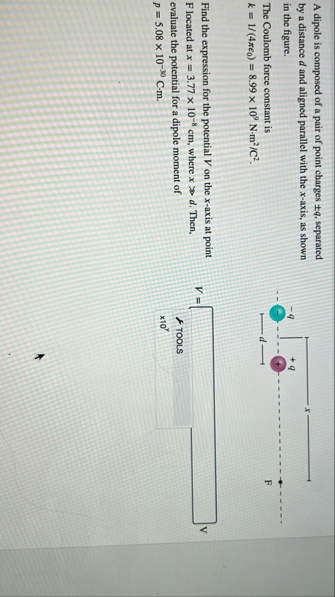 ERR pre re
FL
=
= Hoi is
= 1 iF if
= i
iit i
iE £s
i
5] &
= i le
This is AI generated Response.
Asked by: gvr
Created at: 2025-06-15 08:40:33
Asked by: gvr
Created at: 2025-06-15 08:40:33
Final Answer:
Rendered
Raw Text
Did you like this answer?
Let's break down the problem step by step:
### **Given Data**
- Two point charges: \( +q \) and \( -q \) separated by distance \( d \).
- Both are aligned parallel with the y-axis and are placed symmetrically about the x-axis at positions:
- \( +q \) at \( (0, +d/2) \)
- \( -q \) at \( (0, -d/2) \)
- The Coulomb force constant, \( k = \frac{1}{4\pi\epsilon_0} = 8.99 \times 10^9 \, \text{N m}^2/\text{C}^2 \).
- Dipole moment: \( p = q \cdot d \).
- Point of interest: On x-axis at \( x \gg d \).
---
## **Step 1: Expression for Potential \( V \) on the x-Axis**
The electric potential at a point due to a point charge is:
\[
V = k \frac{q}{r}
\]
For the two charges:
- Distance from \( +q \) to point \( x \) on x-axis: \( r_+ = \sqrt{x^2 + (d/2)^2} \)
- Distance from \( -q \) to point \( x \): \( r_- = \sqrt{x^2 + (d/2)^2} \)
The potential at point \( x \) due to both charges:
\[
V(x) = k \left[ \frac{q}{\sqrt{x^2 + (d/2)^2}} - \frac{q}{\sqrt{x^2 + (d/2)^2}} \right]
\]
Because the distances are symmetric, but the charges are opposite, simplify:
\[
V(x) = kq \left( \frac{1}{\sqrt{x^2 + (d/2)^2}} - \frac{1}{\sqrt{x^2 + (d/2)^2}} \right)
\]
But this is zero if we just plug in. **However**, for a dipole, we need to expand for \( x \gg d \).
---
## **Step 2: Dipole Approximation (\( x \gg d \))**
For a dipole, the potential at a point on the axis (x-axis) is:
\[
V(x) \approx \frac{k p}{x^2}
\]
where \( p = qd \).
---
## **Step 3: Plug in the Numbers**
Given:
- \( p = 5.98 \times 10^{-9} \) C·m
- \( x = 37.1 \) cm \( = 0.371 \) m
Plug into the formula:
\[
V(x) = \frac{k p}{x^2}
\]
\[
V(x) = \frac{8.99 \times 10^9 \times 5.98 \times 10^{-9}}{(0.371)^2}
\]
Calculate numerator:
\[
8.99 \times 10^9 \times 5.98 \times 10^{-9} = 53.7602
\]
Calculate denominator:
\[
(0.371)^2 = 0.137641
\]
So,
\[
V(x) = \frac{53.7602}{0.137641} \approx 390.6 \, \text{V}
\]
---
## **Step 4: Final Answer (with units and significant figures)**
\[
\boxed{V = 391\, \text{V} }
\]
(Rounded to three significant figures.)
---
### **Summary**
- **Expression for potential on x-axis (for \( x \gg d \)):**
\[
V(x) = \frac{k p}{x^2}
\]
- **Potential at \( x = 37.1 \) cm:**
\[
V = 391\, \text{V}
\]
---
Let me know if you need more detailed explanation or further clarifications!
📢 Instructions:
- Ask anything relatd to above question only.
- For new Question goto :