This is AI generated Response.
Asked by: Test User 100251
Created at: 2025-05-20 21:01:29
Final Answer:
RenderedRaw Text
Did you like this answer?
Let's solve each part step by step.
---
### **7.1.1 Define the term *hydrolysis* of a salt. (2)**
**Answer:**
*Hydrolysis of a salt* is the reaction of the ions of a dissolved salt with water to produce either acidic or basic solutions. It occurs when the salt is formed from a weak acid or a weak base (or both).
---
### **7.1.2 Will the pH of the solution be GREATER THAN, SMALLER THAN or EQUAL TO 7? Write a relevant equation to support your answer. (3)**
**Explanation:**
- Ammonium chloride (**NH₄Cl**) is a salt of a *weak base* (NH₃) and a *strong acid* (HCl).
- When dissolved in water, it dissociates into NH₄⁺ and Cl⁻.
- **NH₄⁺** (ammonium ion) acts as a weak acid and hydrolyzes in water:
\[
\mathrm{NH_4^+ (aq) + H_2O(l) \rightarrow NH_3(aq) + H_3O^+(aq)}
\]
- This produces hydronium ions (H₃O⁺), making the solution acidic.
**Answer:**
The pH will be **smaller than 7** because the solution is acidic.
---
### **7.2.1 Calculate the number of moles of H₂SO₄ present in this solution. (2)**
Given:
- Mass of H₂SO₄ = 7.35 g
- Volume of solution = 500 cm³ = 0.5 L
- Molar mass of H₂SO₄ = 2(1) + 32 + 4(16) = 2 + 32 + 64 = **98 g/mol**
\[
\text{Number of moles} = \frac{\text{Mass}}{\text{Molar mass}}
\]
\[
\text{Number of moles of H}_2\text{SO}_4 = \frac{7.35}{98} = 0.075 \text{ moles}
\]
---
### **7.2.2 Calculate the mass of NaOH added to the H₂SO₄ solution. Assume that the volume of the solution does not change. (9)**
#### **Step 1: Calculate [H₃O⁺] after reaction**
Given pH = 1.3
\[
\text{pH} = -\log[\text{H}_3\text{O}^+]
\]
\[
[\text{H}_3\text{O}^+] = 10^{-\text{pH}} = 10^{-1.3} \approx 0.0501\ \text{mol/L}
\]
Total volume = 0.5 L
\[
\text{Moles of H}_3\text{O}^+ = 0.0501 \times 0.5 = 0.02505\ \text{mol}
\]
#### **Step 2: Initial moles of H₂SO₄**
Already calculated: 0.075 mol
#### **Step 3: Reaction between H₂SO₄ and NaOH**
\[
\text{H}_2\text{SO}_4 + 2\text{NaOH} \rightarrow \text{Na}_2\text{SO}_4 + 2 \text{H}_2\text{O}
\]
Each mole of H₂SO₄ reacts with 2 moles of NaOH.
#### **Step 4: Moles of H₂SO₄ left after reaction**
After addition of NaOH, some H₂SO₄ remains (because the final solution is still acidic).
Let \( x \) = moles of H₂SO₄ left after reaction = moles of H₃O⁺ = 0.02505 mol
So, moles of H₂SO₄ that reacted = initial - remaining = 0.075 - 0.02505 = **0.04995 mol**
#### **Step 5: Moles of NaOH that reacted**
From the balanced equation, 1 mol H₂SO₄ reacts with 2 mol NaOH:
\[
\text{Moles of NaOH} = 2 \times \text{Moles of H}_2\text{SO}_4 \text{ that reacted}
\]
\[
= 2 \times 0.04995 = 0.0999 \text{ mol}
\]
#### **Step 6: Mass of NaOH added**
Molar mass of NaOH = 23 + 16 + 1 = 40 g/mol
\[
\text{Mass of NaOH} = 0.0999 \times 40 = 3.996 \text{ g} \approx 4.00 \text{ g}
\]
---
## **Final Answers**
### **7.1.1**
Hydrolysis of a salt is the reaction of the ions of a dissolved salt with water to produce acidic or basic solutions.
### **7.1.2**
The pH will be **smaller than 7**. Relevant equation:
\[
\mathrm{NH_4^+ (aq) + H_2O(l) \rightarrow NH_3(aq) + H_3O^+(aq)}
\]
### **7.2.1**
Number of moles of H₂SO₄ in solution = **0.075 mol**
### **7.2.2**
Mass of NaOH added = **4.00 g**
VIPSolutions focuses on clear, step‑by‑step explanations so you can learn quickly. Whether you need an AI‑generated walkthrough or a short hint to get unstuck, each solution is organized for fast reading and easy review later.
Search similar questions, compare approaches, and bookmark the best answers for revision. Our goal is simple: quick, reliable study help that feels natural—not noisy.
 VIPSolutions
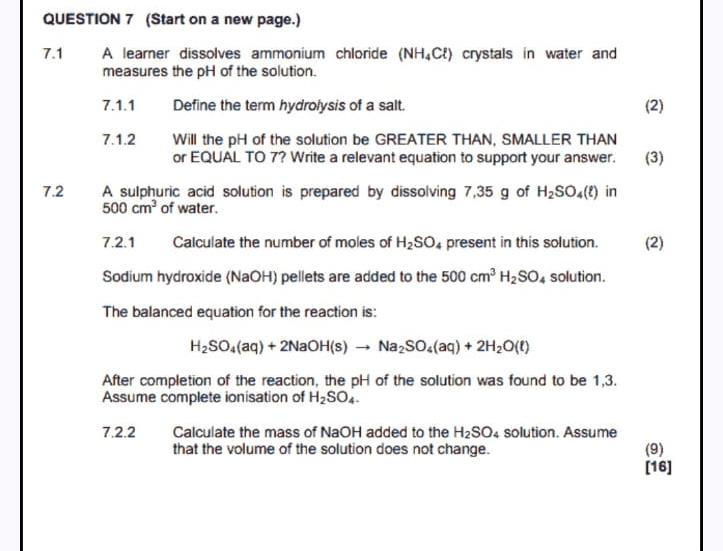 QUESTION 7 (Start on a new page.)
74 A leamer dissolves ammonium chloride (NH(CY) crystals in water and
measures the pH of the solution.
741 Define the term hydrolysis of a salt @
742 Wil the pH of the solution be GREATER THAN, SMALLER THAN
or EQUAL TO 77 Write a relevant equation to support your answer. (3)
72 A sulphuric acid solution is prepared by dissolving 7.35 g of H;SOu(t) in
500 cm” of water.
721 Calculate the number of moles of HSO, present in this solution. (2)
Sodium hydroxide (NaOH) pellets are added to the 500 cm” Hz SO, solution.
The balanced equation for the reaction is:
H2504(aq) + 2NaOH(s) — NazSO4(aq) + 2H;0(t)
After completion of the reaction, the pH of the solution was found to be 1,3.
Assume complete ionisation of H,SO.
722 Calculate the mass of NaOH added to the HzSOx solution. Assume
that the volume of the solution does not change. ©
[16]