 VIPSolutions
Give step-by-step solution with explanation and final answer:Chel a ~~ = / Ia \ 2 A one) a TEs 0 0 p/ I. qa By (2g, IS J Sf RIE
Question:
Give step-by-step solution with explanation and final answer: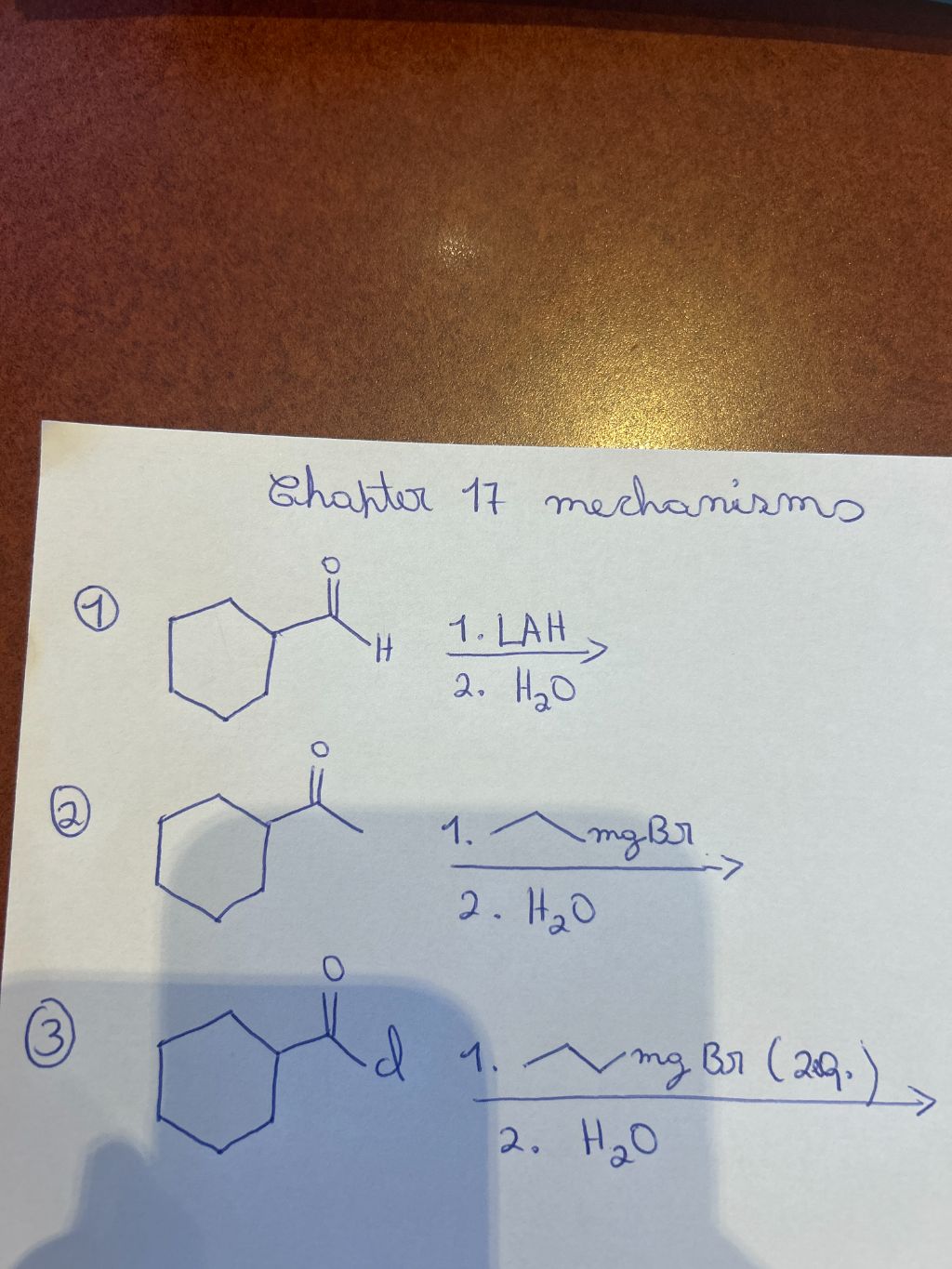 Chel a ~~
= / Ia \
2
A one) a TEs
0
0
p/ I. qa By (2g,
IS J
Sf RIE
This is AI generated Response.
Asked by: Sahzadi
Created at: 2026-03-08 04:01:27
Asked by: Sahzadi
Created at: 2026-03-08 04:01:27
Final Answer:
Rendered
Raw Text
Did you like this answer?
Let's solve each problem step-by-step:
---
## 1. Reduction of Cyclohexanecarboxaldehyde with LAH
**Starting material:**
Cyclohexanecarboxaldehyde (a cyclohexane ring with a CHO group)
**Reagents:**
1. LAH (Lithium aluminum hydride)
2. H₂O
**Step-by-step:**
1. **Reduction**: LAH is a strong reducing agent that reduces aldehydes to primary alcohols.
2. **Work-up**: Addition of water protonates the alkoxide intermediate to give the final alcohol.
**Product:**
Cyclohexanemethanol (a cyclohexane ring with a CH₂OH group)
---
## 2. Reaction of Cyclohexanecarboxaldehyde with Propylmagnesium Bromide (Grignard)
**Starting material:**
Cyclohexanecarboxaldehyde
**Reagents:**
1. Propylmagnesium bromide (Grignard, C₃H₇MgBr)
2. H₂O (work-up)
**Step-by-step:**
1. **Nucleophilic addition:** The propyl group from the Grignard adds to the carbonyl carbon, forming an alkoxide intermediate.
2. **Work-up:** Aqueous work-up protonates the alkoxide to give a secondary alcohol.
**Product:**
1-propyl-1-hydroxycyclohexane
(A cyclohexane ring with a CH(OH)-C₃H₇ group attached)
---
## 3. Reaction of Cyclohexanone with 2 Equiv. of Propylmagnesium Bromide
**Starting material:**
Cyclohexanone
**Reagents:**
1. 2 eq. Propylmagnesium bromide
2. H₂O
**Step-by-step:**
1. **First addition:** Propyl group from Grignard adds to the carbonyl carbon, forming a tertiary alkoxide.
2. **Second addition:** The second equivalent of Grignard can add to the carbonyl if it is present as an ester or acid chloride, but with a ketone, only one equivalent generally reacts (unless in excess or with esters). Here, "2 eq." ensures complete reaction.
3. **Work-up:** Alkoxide gets protonated to give a tertiary alcohol.
**Product:**
1,1-dipropyl-1-hydroxycyclohexane
(A cyclohexane ring with a C(OH)(C₃H₇)₂ group attached, both propyl groups attached to the same carbon as the OH)
---
## **Summary Table**
| Problem | Reagents | Product Structure |
|---------|---------------------------|----------------------------------------------------------|
| 1 | 1. LAH, 2. H₂O |  |
| 2 | 1. PrMgBr, 2. H₂O |  |
| 3 | 1. 2 eq PrMgBr, 2. H₂O |  |
*(Images are for illustrative purposes; the actual sketch should show the correct groups on the cyclohexane ring as described above.)*
---
**Let me know if you'd like to see the mechanism for any of these steps!**
📢 Instructions:
- Ask anything relatd to above question only.
- For new Question goto :