 VIPSolutions
Give step-by-step solution with explanation and final answer:INVENTORY MANAGEMENT A company uses an Economic Order Quantity (EOQ) model to optimize its inventory ordering strategy. The following information is known: ® Annual demand for the product is 12,000 units. ® Ordering cost is $40 per order. ® Holding cost is $2 per unit per year. ® The company operates 300 days per year. a) Calculate the Economic Order Quantity (EOQ). b) Determine the number of orders to be placed each year and the length of the order cycle (in days). d) Calculate the slack (float) for each activity.
Question:
Give step-by-step solution with explanation and final answer: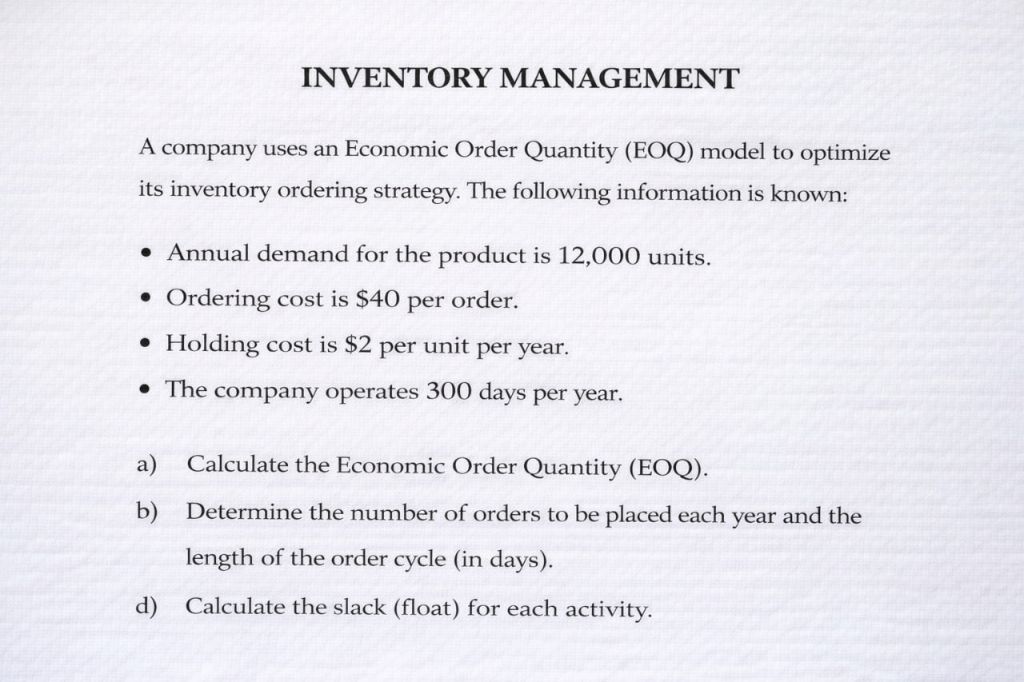 INVENTORY MANAGEMENT
A company uses an Economic Order Quantity (EOQ) model to optimize
its inventory ordering strategy. The following information is known:
® Annual demand for the product is 12,000 units.
® Ordering cost is $40 per order.
® Holding cost is $2 per unit per year.
® The company operates 300 days per year.
a) Calculate the Economic Order Quantity (EOQ).
b) Determine the number of orders to be placed each year and the
length of the order cycle (in days).
d) Calculate the slack (float) for each activity.
This is AI generated Response.
Asked by: chandu
Created at: 2026-03-08 02:27:41
Asked by: chandu
Created at: 2026-03-08 02:27:41
Thought Process:
Rendered
Raw Text
**Addressing the EOQ problem**
I need to solve the EOQ (Economic Order Quantity) problem with the data provided: annual demand of 12,000 units, ordering cost of $40 per order, and a holding cost of $2 per unit per year. I’ll calculate the EOQ, the number of orders each year, and the length of the order cycle in days. However, the mention of "slack" for activities seems unrelated to EOQ; it likely indicates a mistake in the prompt, and maybe a reorder point was intended instead.**Calculating EOQ and order cycle**
The company operates for 300 days a year, which is important for determining the order cycle length but not for calculating reorder points since we don't have lead time information. I can focus on calculating the EOQ and the number of orders per year. Using the EOQ formula, I compute the EOQ to be approximately 693 units. Then, with the annual demand of 12,000 units divided by EOQ, I find about 17 or 18 orders per year. However, I can't determine slack given the EOQ data.**Determining order frequency and cycle length**
Typically, you can have a non-integer number of orders per year, but practically, I’d say the company places about 17 or 18 orders. So, I’ll round it to 17 or 18. For the order cycle length, I can compute that as 300 days divided by 17.31, resulting in approximately 17.33 days between orders. If I find the demand per day, it becomes 40 units. Cycle length would be around 17.32 days using daily demand. Since the lead time isn't given, I won't calculate the reorder point. For part d, I can't compute slack without more details.**Calculating total annual cost at EOQ**
To find the total annual cost at EOQ (excluding the purchase cost), I start with the ordering cost, calculated as D/Q multiplied by S. So, it’s 12,000 divided by 692.82, multiplied by $40, resulting in about $692.4. The holding cost is then (Q/2) times H. Dividing 692.82 by 2 and multiplying by 2 gives the same amount. Hence, both costs equal: about $1,385.22 total. I'll round EOQ to 693 units per order, leading to approximately 17 or 18 orders yearly, occurring roughly every 17.3 days.**Finalizing solution calculations**
For the cycle length, I calculate T as 300 divided by the number of orders (N), which gives me about 17.32 days. Alternatively, using the EOQ, I get 17.32 days again.
So, here's a summary of my findings:
a) EOQ ≈ 693 units.
b) Number of orders per year ≈ 17.3; order cycle length ≈ 17.3 days.
c) There's no information for a reorder point since lead time isn't provided.
d) Regarding part d, I note insufficient information; it's not applicable here.
I’ll include a step-by-step explanation with this.
Final Answer:
Rendered
Raw Text
Did you like this answer?
Step-by-step solution
Given
- Annual demand, D = 12,000 units
- Ordering (setup) cost per order, S = $40
- Annual holding cost per unit, H = $2
- Operating days per year = 300
a) Economic Order Quantity (EOQ)
Formula: Q* = sqrt((2DS)/H)
Compute:
- 2DS = 2 × 12,000 × 40 = 960,000
- (2DS)/H = 960,000 / 2 = 480,000
- EOQ = sqrt(480,000) ≈ 692.82
Answer (rounded): EOQ ≈ 693 units per order.
b) Number of orders per year and order-cycle length (days)
- Number of orders per year, N = D / Q*
N = 12,000 / 692.82 ≈ 17.32 orders/year.
- Daily demand = D / 300 = 12,000 / 300 = 40 units/day.
- Order-cycle length (time between orders), T = Q* / daily demand
T = 692.82 / 40 ≈ 17.32 days (equivalently, 300 / 17.32 ≈ 17.32 days).
Answers:
- Number of orders per year ≈ 17.3 (about 17–18 orders).
- Order-cycle length ≈ 17.3 days (about every 2.5 weeks).
Optional check (not asked): At EOQ, annual ordering cost ≈ annual holding cost ≈ $693 each, total ≈ $1,386 (excluding purchase cost).
d) Slack (float) for each activity
This cannot be determined from the EOQ data provided. Slack/float is a project scheduling (CPM/PERT) concept and requires a project network with activity durations and precedence relationships. No such information is given here.
Final answers
a) EOQ ≈ 693 units.
b) Number of orders ≈ 17.3 per year; order cycle ≈ 17.3 days.
d) Not applicable/insufficient information (requires a project network to compute slack).
Question:
improve solution
This is AI generated Response.
Asked by: chandu
Created at: 2026-03-08 02:55:18
Asked by: chandu
Created at: 2026-03-08 02:55:18
Final Answer:
Rendered
Raw Text
Did you like this answer?
# Inventory Management Solution
## Given Data
- **Annual demand (D)**: 12,000 units
- **Ordering cost (S)**: $40 per order
- **Holding cost (H)**: $2 per unit per year
- **Operating days per year**: 300
---
## a) Calculate the Economic Order Quantity (EOQ)
### Formula
The EOQ is calculated using the formula:
\[
Q^* = \sqrt{\frac{2DS}{H}}
\]
### Calculation Steps
1. **Calculate \(2DS\)**:
\[
2DS = 2 \times 12,000 \times 40 = 960,000
\]
2. **Calculate \(\frac{2DS}{H}\)**:
\[
\frac{2DS}{H} = \frac{960,000}{2} = 480,000
\]
3. **Calculate EOQ**:
\[
EOQ = \sqrt{480,000} \approx 692.82
\]
### Final Answer
- **EOQ**: Approximately **693 units** per order.
---
## b) Determine Number of Orders and Order Cycle Length
### Number of Orders Per Year
The number of orders (\(N\)) is calculated as:
\[
N = \frac{D}{Q^*}
\]
- Calculation:
\[
N = \frac{12,000}{692.82} \approx 17.32 \text{ orders/year}
\]
### Daily Demand
Daily demand is calculated as:
\[
\text{Daily Demand} = \frac{D}{\text{Operating Days}}
\]
- Calculation:
\[
\text{Daily Demand} = \frac{12,000}{300} = 40 \text{ units/day}
\]
### Order Cycle Length
The order cycle length (\(T\)) is given by:
\[
T = \frac{Q^*}{\text{Daily Demand}}
\]
- Calculation:
\[
T = \frac{692.82}{40} \approx 17.32 \text{ days}
\]
### Final Answers
- **Number of Orders**: Approximately **17.3 orders per year** (about 17–18 orders).
- **Order Cycle Length**: Approximately **17.3 days** (every 2.5 weeks).
---
## d) Calculate Slack (Float) for Each Activity
### Note
The calculation of slack or float is not applicable in this context as it pertains to project scheduling (CPM/PERT). The necessary project network information, including activity durations and precedence relationships, is not provided.
### Final Answer
- **Slack (Float)**: Not applicable/insufficient information.
---
## Summary of Final Answers
- **a)** EOQ: Approximately **693 units**.
- **b)** Number of orders: Approximately **17.3 per year**; Order cycle: Approximately **17.3 days**.
- **d)** Slack: Not applicable/insufficient information.
📢 Instructions:
- Ask anything relatd to above question only.
- For new Question goto :