VIPSolutions logo ✨ VIPSolutions

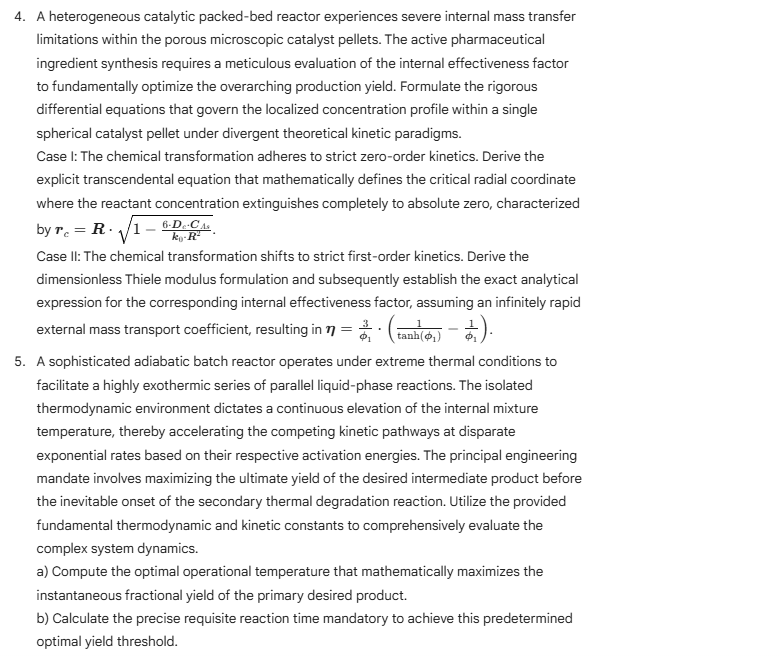
Give step-by-step solution with explanation and final answer:4. A heterogeneous catalytic packed-bed reactor experiences severe internal mass transfer limitations within the porous microscopic catalyst pellets. The active pharmaceutical ingredient synthesis requires a meticulous evaluation of the internal effectiveness factor to fundamentally optimize the overarching production yield. Formulate the rigorous differential equations that govern the localized concentration profile within a single spherical catalyst pellet under divergent theoretical kinetic paradigms. Case I: The chemical transformation adheres to strict zero-order kinetics. Derive the explicit transcendental equation that mathematically defines the critical radial coordinate where the reactant concentration extinguishes completely to absolute zero, characterized byr.= RoI SDE Case II: The chemical transformation shifts to strict first-order kinetics. Derive the dimensionless Thiele modulus formulation and subsequently establish the exact analytical expression for the corresponding internal effectiveness factor, assuming an infinitely rapid external mass transport coefficient, resutting nn = = - (tay — &)- 5. A sophisticated adiabatic batch reactor operates under extreme thermal conditions to facilitate a highly exothermic series of parallel liquid-phase reactions. The isolated thermodynamic environment dictates a continuous elevation of the internal mixture temperature, thereby accelerating the competing kinetic pathways at disparate exponential rates based on their respective activation energies. The principal engineering mandate involves maximizing the ultimate yield of the desired intermediate product before the inevitable onset of the secondary thermal degradation reaction. Utilize the provided fundamental thermodynamic and kinetic constants to comprehensively evaluate the complex system dynamics. a) Compute the optimal operational temperature that mathematically maximizes the instantaneous fractional yield of the primary desired product. b) Calculate the precise requisite reaction time mandatory to achieve this predetermined optimal yield threshold.

Question:

Give step-by-step solution with explanation and final answer:Uploaded Image4. A heterogeneous catalytic packed-bed reactor experiences severe internal mass transfer limitations within the porous microscopic catalyst pellets. The active pharmaceutical ingredient synthesis requires a meticulous evaluation of the internal effectiveness factor to fundamentally optimize the overarching production yield. Formulate the rigorous differential equations that govern the localized concentration profile within a single spherical catalyst pellet under divergent theoretical kinetic paradigms. Case I: The chemical transformation adheres to strict zero-order kinetics. Derive the explicit transcendental equation that mathematically defines the critical radial coordinate where the reactant concentration extinguishes completely to absolute zero, characterized byr.= RoI SDE Case II: The chemical transformation shifts to strict first-order kinetics. Derive the dimensionless Thiele modulus formulation and subsequently establish the exact analytical expression for the corresponding internal effectiveness factor, assuming an infinitely rapid external mass transport coefficient, resutting nn = = - (tay — &)- 5. A sophisticated adiabatic batch reactor operates under extreme thermal conditions to facilitate a highly exothermic series of parallel liquid-phase reactions. The isolated thermodynamic environment dictates a continuous elevation of the internal mixture temperature, thereby accelerating the competing kinetic pathways at disparate exponential rates based on their respective activation energies. The principal engineering mandate involves maximizing the ultimate yield of the desired intermediate product before the inevitable onset of the secondary thermal degradation reaction. Utilize the provided fundamental thermodynamic and kinetic constants to comprehensively evaluate the complex system dynamics. a) Compute the optimal operational temperature that mathematically maximizes the instantaneous fractional yield of the primary desired product. b) Calculate the precise requisite reaction time mandatory to achieve this predetermined optimal yield threshold.
This is AI generated Response.
Asked by: francis
Created at: 2026-03-05 08:51:57

Final Answer:

Rendered Raw Text
Did you like this answer?
Let's break down and solve **Problems 4 and 5 step-by-step**. --- # **Problem 4 – Heterogeneous Packed-Bed Reactor (Effectiveness Factor)** ## **Case I: Zero-Order Reaction in Spherical Pellet** **Governing equation (steady-state, zero-order reaction):** \[ D_e \left( \frac{1}{r^2} \frac{d}{dr} \left( r^2 \frac{dC_A}{dr} \right) \right) = k_ \] where: - \( D_e \) = effective diffusivity, - \( k_ \) = zero-order rate constant, - \( C_A \) = reactant concentration, - \( r \) = radial coordinate. **Boundary conditions:** - At \( r = \): \( \frac{dC_A}{dr} = \) (symmetry), - At \( r = R \): \( C_A = C_{A,s} \) (surface concentration). ### **Step 1: Integrate the ODE** Integrate once: \[ \frac{d}{dr} \left( r^2 \frac{dC_A}{dr} \right) = \frac{k_}{D_e} r^2 \] Integrate: \[ r^2 \frac{dC_A}{dr} = \frac{k_}{3D_e} r^3 + C_1 \] At \( r = \), symmetry gives \( C_1 = \): \[ \frac{dC_A}{dr} = \frac{k_}{3D_e} r \] Integrate again: \[ C_A(r) = \frac{k_}{6D_e} r^2 + C_2 \] At \( r = R \), \( C_A(R) = C_{A,s} \): \[ C_{A,s} = \frac{k_}{6D_e} R^2 + C_2 \implies C_2 = C_{A,s} - \frac{k_}{6D_e} R^2 \] So, \[ C_A(r) = C_{A,s} + \frac{k_}{6D_e}(r^2 - R^2) \] ### **Step 2: Find \( r_c \) where \( C_A(r_c) = \)** Set \( C_A(r_c) = \): \[ = C_{A,s} + \frac{k_}{6D_e}(r_c^2 - R^2) \] \[ \frac{k_}{6D_e}(r_c^2 - R^2) = -C_{A,s} \] \[ r_c^2 = R^2 - \frac{6D_e C_{A,s}}{k_} \] \[ r_c = R \sqrt{1 - \frac{6D_e C_{A,s}}{k_ R^2}} \] **This matches the formula given.** --- ## **Case II: First-Order Reaction in Spherical Pellet** **Governing equation (steady-state, first-order):** \[ D_e \left( \frac{1}{r^2} \frac{d}{dr} \left( r^2 \frac{dC_A}{dr} \right) \right) = k_1 C_A \] **Dimensionless Thiele modulus:** \[ \phi_1 = R \sqrt{\frac{k_1}{D_e}} \] **Effectiveness factor (\( \eta \)), for rapid external mass transfer:** \[ \eta = \frac{\text{overall reaction rate}}{\text{rate if no diffusion limitation}} \] For first-order, the solution is: \[ \eta = \frac{3}{\phi_1^2} \left( \phi_1 \coth \phi_1 - 1 \right) \] Or, \[ \eta = \frac{3}{\phi_1} \left( \frac{1}{\tanh \phi_1} - \frac{1}{\phi_1} \right) \] **This matches the formula given.** --- # **Problem 5 – Adiabatic Batch Reactor (Competing Reactions)** Given: - **Adiabatic** (no heat loss), - **Parallel reactions**: - Desired: \( A \to B \) (rate \( k_1 \)), activation energy \( E_1 \) - Undesired: \( A \to D \) (rate \( k_2 \)), activation energy \( E_2 \) - **Maximize yield of \( B \) before onset of \( D \)** ## **a) Compute the optimal temperature for maximum instantaneous yield of \( B \):** **Yield of B per A consumed:** \[ \text{Yield} = \frac{\text{rate of }A \to B}{\text{total rate of }A \text{ consumption}} = \frac{k_1}{k_1 + k_2} \] Both \( k_1 \) and \( k_2 \) are Arrhenius: \[ k_1 = A_1 e^{-E_1/RT}, \quad k_2 = A_2 e^{-E_2/RT} \] Yield: \[ Y(T) = \frac{A_1 e^{-E_1/RT}}{A_1 e^{-E_1/RT} + A_2 e^{-E_2/RT}} \] **To maximize \( Y \) with respect to \( T \):** Set \( \frac{dY}{dT} = \): Let \( x = 1/RT \), so \( Y(x) = \frac{A_1 e^{-E_1 x}}{A_1 e^{-E_1 x} + A_2 e^{-E_2 x}} \) But a more direct approach: Usually, yield is maximized at a temperature where the selectivity is maximized: \[ \frac{d}{dT} \left( \frac{k_1}{k_1 + k_2} \right) = \] This gives the following transcendental equation for \( T_{opt} \): \[ \frac{E_2 - E_1}{RT_{opt}^2} = \ln \left( \frac{A_2 E_2}{A_1 E_1} \right) \cdot \frac{1}{T_{opt}} \] But more commonly, the optimal temperature satisfies: \[ \frac{E_2 - E_1}{RT_{opt}^2} = \ln\left( \frac{A_2}{A_1} \right) + \frac{E_2 - E_1}{RT_{opt}} \] This equation must typically be solved numerically for \( T_{opt} \). ## **b) Calculate the residence time at \( T_{opt} \) to achieve maximum yield** For a batch reactor: - Rate equations: \( -\frac{dC_A}{dt} = (k_1 + k_2)C_A \) - Integrate: \( C_A = C_{A,} e^{-(k_1 + k_2)t} \) - Product B: \( \frac{dC_B}{dt} = k_1 C_A \) Integrate for yield: \[ C_B = C_{A,} \frac{k_1}{k_1 + k_2} \left( 1 - e^{-(k_1 + k_2)t} \right) \] So, to reach a desired conversion or yield, solve for \( t \): \[ \text{If you want to maximize } C_B, \text{ set } \frac{dC_B}{dt} = \] But for maximum **instantaneous** yield, it's at the beginning. For maximum **absolute** yield, you solve: \[ \frac{dC_B}{dt} = k_1 C_A - k_2 C_B = \] But with only parallel reactions (no B to D), maximize \( C_B \) with respect to time: \[ \frac{dC_B}{dt} = k_1 C_A \] \( C_B \) increases monotonically, but as \( C_A \) depletes, the rate slows. Optimal time is typically where: \[ \text{Yield} = \frac{C_B}{C_{A,}} = \frac{k_1}{k_1 + k_2} \left( 1 - e^{-(k_1 + k_2)t} \right) \] Set \( t \to \infty \) for absolute maximum, but practically, stop before significant \( D \) forms (if D can form from B, which is not the case here). --- ## **Summary of Final Answers** ### **4. Packed-Bed Reactor:** - **Zero-order:** \( r_c = R \sqrt{1 - \frac{6D_e C_{A,s}}{k_ R^2}} \) - **First-order:** \( \eta = \frac{3}{\phi_1} \left( \frac{1}{\tanh \phi_1} - \frac{1}{\phi_1} \right) \), \( \phi_1 = R \sqrt{\frac{k_1}{D_e}} \) ### **5. Batch Reactor:** a) **Optimal temperature:** \[ T_{opt} \text{ solves: } \frac{E_2 - E_1}{RT_{opt}^2} = \ln \left( \frac{A_2}{A_1} \right) + \frac{E_2 - E_1}{RT_{opt}} \] (Solve numerically.) b) **Residence time for desired yield:** \[ \text{Yield} = \frac{k_1}{k_1 + k_2} \left( 1 - e^{-(k_1 + k_2)t} \right) \] Solve for \( t \) to achieve the desired yield at \( T_{opt} \). --- **If you need numerical examples or further derivations, let me know!**

📢 Instructions:

  • Ask anything relatd to above question only.
  • For new Question goto :

Study Help, Fast Answers

VIPSolutions focuses on clear, step‑by‑step explanations so you can learn quickly. Whether you need an AI‑generated walkthrough or a short hint to get unstuck, each solution is organized for fast reading and easy review later.

Search similar questions, compare approaches, and bookmark the best answers for revision. Our goal is simple: quick, reliable study help that feels natural—not noisy.