 VIPSolutions
Give step-by-step solution with explanation and final answer: (give me answer without using bullet-points),NEED THE FINAL EXPRESSION.Problem 1. Under conditions of anisotropic permeability and significant capillary pressure gradients within a heterogeneous porous medium, a complete symbolic reconstruction of the macroscopic fractional flow equation for three phase immiscible fluid transport is mandatory, assuming incompressible phase behavior, and negligible inertial effects; the governing conservation laws dictate precise algebraic establishment. 1. Derivation of the phase mobility tensors. 2. A deduction of the general pressure equation incorporating gravity and capillary terms. 3. Establishment of the saturation evolution equations for each phase. 4. An analysis of the impact of relative permeability hysteresis on the flow behavior. Problem 2. Considering imiscible gas injection into a stratified petroleum reservoir exhibiting significant vertical heterogeneity, the overall displacement efficiency requires deep analytical evaluation utiizing an extended Buckley Leverett framework in the propagation of saturation shocks dictates precise symbolic deduction, assuming piston lke displacement in each layer and gravity segregation effects the goveming partial differential equations must be constructed. 1. Derivation of the fractional flow curve for the gas oil system Injector ihe Producer 1.1 An expression for the shock front saturation Ie » Lu. 2 12 A dducion ofthe average saturation bind the Me ~ e Lert 2. Establishment of the breakthrough time for the most ~~ a front ods LL permeable layer = - J 2.1 The effect of the mobility ratio on the breakthrough time + shook s. [pLaver2 2.2 A derivation of the subsequent ol recovery after | ITE Nan 1 brtakthvough ke 3. An evaluation of the vertical sweep efficiency considering % % crossflow between layers — 3.1 The influence of gravitational forces on the vertical equilibrium 3.2 An expression for the pseudo relative permeability functions for the layered system 4. A deduction of the ultimate recovery factor or the entire reservoir 41 The Impact of capil rapping on he residual of saturation 42 An analysis of the effect of injection rate on the recovery factor Problem 3 For a deviated wellbore trajectory drilled through an anisotropic formation subject to a non hydrostatic in situ stress field, a comprehensive ‘geomechanical stability model mandates meticulous construction ulilzing linear poroelasticity theory, the transformation of far field stresses fo the borehole coordinate system dictates precise algebraic establishment assuming permeable borehole walls and a steady state pore pressure distribution, the stress concentration equations must be derived. 1. Derivation ofthe stress transformation matrix from the n situ z . to the borehole coordinate system i 1.1 An expression for the effective stresses at the borehole wal on nd 1.2 A deduction of the principal stresses at the borehole wall er 2. Establishment of the shear failure criterion using the Mohr : Coulomb model oy Gh \ . 2.1 The required minimum mud weight to prevent breakout a, > B be analytically determined Tw | O2 22 A derivation of the critical orientation for shear failure: Py EA around the borefole circumference 17 “Tz 3. An evaluation of the tensile failure condition leading to driling lb induced fractures a! at 3.1 The maximum allowable mud weight to avoid fracture Q HE y initiation ps Tw 4. A deduction of the safe mud weight window for a given wellbore xB trajectory 4.1 The impact of pore pressure coupling on the stabilty window
Question:
Give step-by-step solution with explanation and final answer:
(give me answer without using bullet-points),NEED THE FINAL EXPRESSION.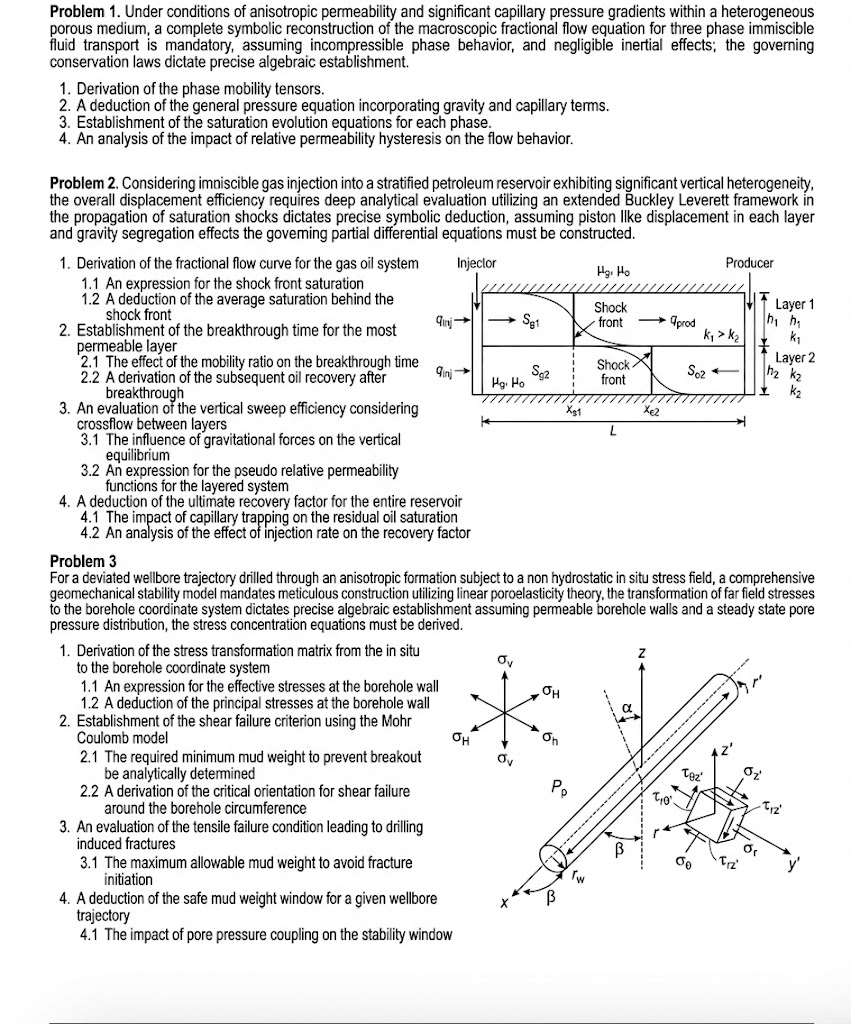 Problem 1. Under conditions of anisotropic permeability and significant capillary pressure gradients within a heterogeneous
porous medium, a complete symbolic reconstruction of the macroscopic fractional flow equation for three phase immiscible
fluid transport is mandatory, assuming incompressible phase behavior, and negligible inertial effects; the governing
conservation laws dictate precise algebraic establishment.
1. Derivation of the phase mobility tensors.
2. A deduction of the general pressure equation incorporating gravity and capillary terms.
3. Establishment of the saturation evolution equations for each phase.
4. An analysis of the impact of relative permeability hysteresis on the flow behavior.
Problem 2. Considering imiscible gas injection into a stratified petroleum reservoir exhibiting significant vertical heterogeneity,
the overall displacement efficiency requires deep analytical evaluation utiizing an extended Buckley Leverett framework in
the propagation of saturation shocks dictates precise symbolic deduction, assuming piston lke displacement in each layer
and gravity segregation effects the goveming partial differential equations must be constructed.
1. Derivation of the fractional flow curve for the gas oil system Injector ihe Producer
1.1 An expression for the shock front saturation Ie » Lu. 2
12 A dducion ofthe average saturation bind the Me ~ e Lert
2. Establishment of the breakthrough time for the most ~~ a front ods LL
permeable layer = - J
2.1 The effect of the mobility ratio on the breakthrough time + shook s. [pLaver2
2.2 A derivation of the subsequent ol recovery after | ITE Nan 1
brtakthvough ke
3. An evaluation of the vertical sweep efficiency considering % %
crossflow between layers —
3.1 The influence of gravitational forces on the vertical
equilibrium
3.2 An expression for the pseudo relative permeability
functions for the layered system
4. A deduction of the ultimate recovery factor or the entire reservoir
41 The Impact of capil rapping on he residual of saturation
42 An analysis of the effect of injection rate on the recovery factor
Problem 3
For a deviated wellbore trajectory drilled through an anisotropic formation subject to a non hydrostatic in situ stress field, a comprehensive
‘geomechanical stability model mandates meticulous construction ulilzing linear poroelasticity theory, the transformation of far field stresses
fo the borehole coordinate system dictates precise algebraic establishment assuming permeable borehole walls and a steady state pore
pressure distribution, the stress concentration equations must be derived.
1. Derivation ofthe stress transformation matrix from the n situ z .
to the borehole coordinate system i
1.1 An expression for the effective stresses at the borehole wal on nd
1.2 A deduction of the principal stresses at the borehole wall er
2. Establishment of the shear failure criterion using the Mohr :
Coulomb model oy Gh \ .
2.1 The required minimum mud weight to prevent breakout a, > B
be analytically determined Tw | O2
22 A derivation of the critical orientation for shear failure: Py EA
around the borefole circumference 17 “Tz
3. An evaluation of the tensile failure condition leading to driling lb
induced fractures a! at
3.1 The maximum allowable mud weight to avoid fracture Q HE y
initiation ps Tw
4. A deduction of the safe mud weight window for a given wellbore xB
trajectory
4.1 The impact of pore pressure coupling on the stabilty window
Asked by: Francis
Created at: 2026-03-05 07:54:04
Final Answer:
Question:
give me complete answer without any gaps or empty values.
Asked by: Francis
Created at: 2026-03-05 08:04:14
Final Answer:
📢 Instructions:
- Ask anything relatd to above question only.
- For new Question goto :