VIPSolutions logo ✨ VIPSolutions

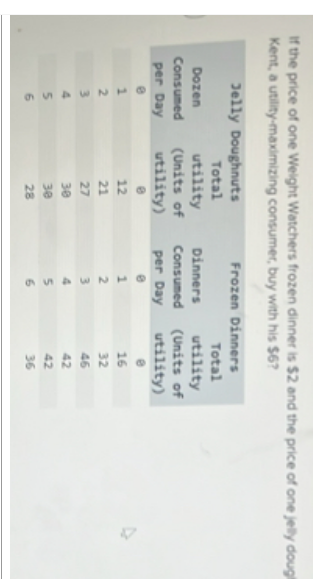
Give step-by-step solution with explanation and final answer: If the price of one Weight Watchers frozen dinner is $ 2 and the price of one jelly doughnut is $ 1 , which of the following would Kent, a utility - maximizing consumer, buy with his $ 6 ? \ table [ [ Jelly Doughnuts,Frozen Dinners ] , [ Dozen Consumed per Day,Total utility ( Units of utility ) , Dinners Consumed per Day,Total utility ( Units of utility [ 0 , 0 , 0 , 0 ] , [ 1 , 1 2 , 1 , 1 6 ] , [ 2 , 2 1 , 2 , 3 2 ] , [ 3 , 2 7 , 3 , 4 6 ] , [ 4 , 3 0 , 4 , 4 2 ] , [ 5 , 3 0 , 5 , 4 2 ] , [ 6 , 2 8 , 6 , 3 6 ] ]ll li qh i anaunme 13% i roses CHE * i H 3 wv 3 H

Question:

Give step-by-step solution with explanation and final answer: If the price of one Weight Watchers frozen dinner is $ 2 and the price of one jelly doughnut is $ 1 , which of the following would Kent, a utility - maximizing consumer, buy with his $ 6 ? \ table [ [ Jelly Doughnuts,Frozen Dinners ] , [ Dozen Consumed per Day,Total utility ( Units of utility ) , Dinners Consumed per Day,Total utility ( Units of utility [ 0 , 0 , 0 , 0 ] , [ 1 , 1 2 , 1 , 1 6 ] , [ 2 , 2 1 , 2 , 3 2 ] , [ 3 , 2 7 , 3 , 4 6 ] , [ 4 , 3 0 , 4 , 4 2 ] , [ 5 , 3 0 , 5 , 4 2 ] , [ 6 , 2 8 , 6 , 3 6 ] ]Uploaded Imagell li qh i anaunme 13% i roses CHE * i H 3 wv 3 H

This is AI generated Response.
Asked by: Vikram Kumar
Created at: 2026-03-05 04:44:14

Final Answer:

Rendered Raw Text
Did you like this answer?
Let's solve the problem **step by step** to find Kent's utility-maximizing combination of purchases with $6. --- ## 1. **Restate the Problem and Data** - **Budget:** $6 - **Price of 1 Weight Watchers Dinner:** $2 - **Price of 1 Jelly Doughnut:** $1 ### Utility Table | Jelly Doughnuts Consumed | Total Utility (JD) | Frozen Dinners Consumed | Total Utility (FD) | |-------------------------|-------------------|------------------------|--------------------| | | | | | | 1 | 12 | 1 | 16 | | 2 | 21 | 2 | 32 | | 3 | 27 | 3 | 46 | | 4 | 30 | 4 | 42 | | 5 | 30 | 5 | 42 | | 6 | 28 | 6 | 36 | --- ## 2. **Find All Affordable Combinations** Let: - \( x \) = Jelly doughnuts - \( y \) = Frozen dinners **Budget constraint:** \( x \times \$1 + y \times \$2 \leq \$6 \) Let’s list all possible pairs \((x, y)\): | x (JD) | y (FD) | Cost = x + 2y | Affordable? | |--------|--------|---------------|-------------| | | | | Yes | | | 1 | 2 | Yes | | | 2 | 4 | Yes | | | 3 | 6 | Yes | | | 4 | 8 | No | | 1 | | 1 | Yes | | 1 | 1 | 3 | Yes | | 1 | 2 | 5 | Yes | | 1 | 3 | 7 | No | | 2 | | 2 | Yes | | 2 | 1 | 4 | Yes | | 2 | 2 | 6 | Yes | | 2 | 3 | 8 | No | | 3 | | 3 | Yes | | 3 | 1 | 5 | Yes | | 3 | 2 | 7 | No | | 4 | | 4 | Yes | | 4 | 1 | 6 | Yes | | 4 | 2 | 8 | No | | 5 | | 5 | Yes | | 5 | 1 | 7 | No | | 6 | | 6 | Yes | --- ## 3. **Calculate Total Utility for Each Affordable Pair** Look up utilities from the table for each valid (JD, FD) pair: | JD | FD | Total Utility = TU(JD) + TU(FD) | |----|----|---------------------------------| | | | + = | | | 1 | + 16 = 16 | | | 2 | + 32 = 32 | | | 3 | + 46 = 46 | | 1 | | 12 + = 12 | | 1 | 1 | 12 + 16 = 28 | | 1 | 2 | 12 + 32 = 44 | | 2 | | 21 + = 21 | | 2 | 1 | 21 + 16 = 37 | | 2 | 2 | 21 + 32 = 53 | | 3 | | 27 + = 27 | | 3 | 1 | 27 + 16 = 43 | | 4 | | 30 + = 30 | | 4 | 1 | 30 + 16 = 46 | | 5 | | 30 + = 30 | | 6 | | 28 + = 28 | --- ## 4. **Find the Maximum Total Utility** From the table above, the **maximum total utility is 53** at the combination: - **2 Jelly Doughnuts** - **2 Frozen Dinners** **Cost:** \(2 \times \$1 + 2 \times \$2 = \$2 + \$4 = \$6\) (meets budget) --- ## 5. **Final Answer** ### **Kent should buy:** - **2 Jelly Doughnuts** - **2 Frozen Dinners** ### **This yields the highest total utility of 53 units.** --- **Summary Table for Reference:** | Jelly Doughnuts | Frozen Dinners | Total Utility | |-----------------|---------------|--------------| | 2 | 2 | 53 | --- **Final Answer:** Kent should buy **2 jelly doughnuts and 2 frozen dinners** with his $6, for a total utility of **53**.

Question:

2. Find All Affordable Combinations 3. Calculate Total Utility for Each Affordable Pair 4. Find the Maximum Total Utility each parts 50 words summary or explanation

This is AI generated Response.
Asked by: Vikram Kumar
Created at: 2026-03-05 05:11:21

Final Answer:

Rendered Raw Text
Did you like this answer?
# Summary of Steps to Determine Kent's Purchases ## 2. Find All Affordable Combinations To determine which combinations of jelly doughnuts and frozen dinners Kent can afford, we analyze the budget constraint. With a total of $6 to spend, we compute various combinations of jelly doughnuts (costing $1 each) and frozen dinners (costing $2 each). We list valid combinations where the total cost does not exceed $6. ## 3. Calculate Total Utility for Each Affordable Pair After listing all affordable combinations, we calculate the total utility for each pair. Using the provided utility table for jelly doughnuts and frozen dinners, we sum the total utilities for each combination. This helps us identify which purchase combinations yield the highest utility within the budget. ## 4. Find the Maximum Total Utility We review the total utility scores from the previous step to identify the maximum. The goal is to find the combination of jelly doughnuts and frozen dinners that maximizes utility while adhering to the budget constraint. The highest utility achieved is 53 units from purchasing 2 jelly doughnuts and 2 frozen dinners.

📢 Instructions:

  • Ask anything relatd to above question only.
  • For new Question goto :

Study Help, Fast Answers

VIPSolutions focuses on clear, step‑by‑step explanations so you can learn quickly. Whether you need an AI‑generated walkthrough or a short hint to get unstuck, each solution is organized for fast reading and easy review later.

Search similar questions, compare approaches, and bookmark the best answers for revision. Our goal is simple: quick, reliable study help that feels natural—not noisy.