 VIPSolutions
Give step-by-step solution with explanation and final answer:2) Fill in the blanks. a. OMe 1)16q.05,MeOH,-78°C AA lA 2) Me,S b. @ 1)03, MeOH, 78°C NaOEt CuLiMe, 2) Me,S Hz0" NaBH, Bn PBs OH
Question:
Give step-by-step solution with explanation and final answer: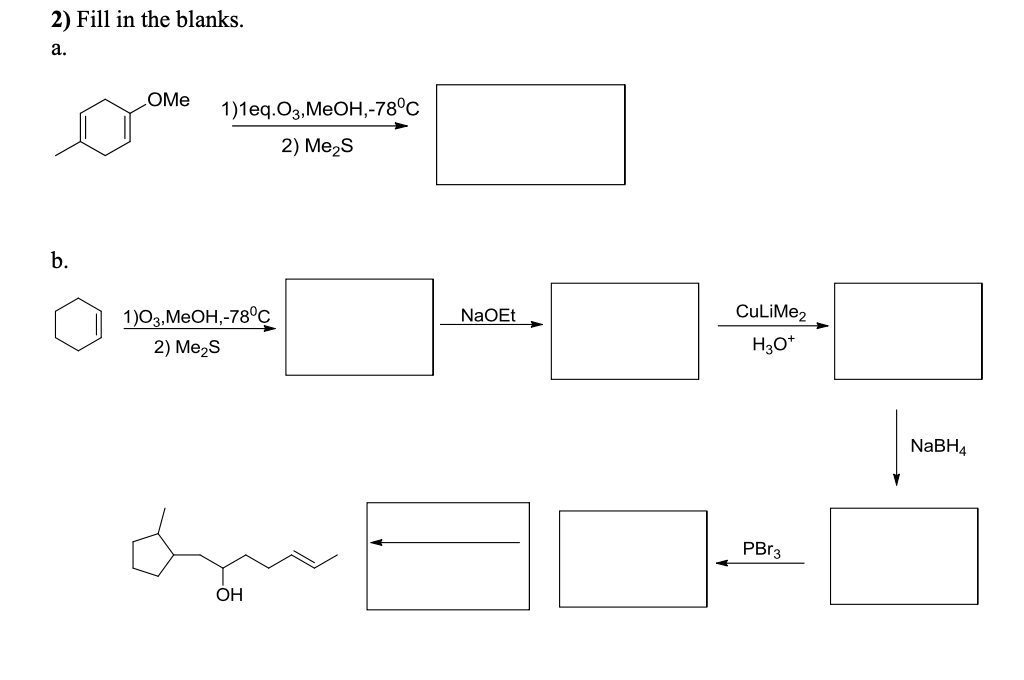 2) Fill in the blanks.
a.
OMe 1)16q.05,MeOH,-78°C
AA lA
2) Me,S
b.
@ 1)03, MeOH, 78°C NaOEt CuLiMe,
2) Me,S Hz0"
NaBH,
Bn PBs
OH
This is AI generated Response.
Asked by: Rahul
Created at: 2026-03-03 04:26:30
Asked by: Rahul
Created at: 2026-03-03 04:26:30
Final Answer:
Rendered
Raw Text
Did you like this answer?
Let's solve each part step-by-step.
---
## Part (a)
### **Given Reaction:**
- **Starting Material:** p-methoxytoluene (p-methyl anisole)
- **Reagents:**
1. 1 eq. O₃, MeOH, -78°C
2. Me₂S
### **Step-by-Step Solution:**
1. **Ozonolysis** cleaves the double bond (alkene), but here we have an aromatic ring with a methyl substituent (no double bond outside the ring).
However, under these ozonolysis conditions, the methyl group (benzylic position) next to the aromatic ring can be selectively oxidized to an aldehyde when treated with 1 eq. O₃ and MeOH.
2. **Reductive Workup (Me₂S):** Keeps the product as an aldehyde (not further oxidized to acid).
### **Product:**
- The methyl group (–CH₃) is oxidized to a formyl group (–CHO).
- Product: **p-methoxybenzaldehyde** (4-methoxybenzaldehyde)
#### **Structure:**
- Benzene ring with a methoxy (OCH₃) at para to an aldehyde (CHO).
---
## Part (b)
### **Step 1: Ozonolysis of Benzene**
#### **Reagents:**
1. O₃, MeOH, -78°C
2. Me₂S
- **Ozonolysis of benzene** gives **glyoxal** (OHC–CH=CH–CHO), but in MeOH, it forms the dialdehyde: **muconaldehyde** (1,6-hexanedial).
### **Step 2: NaOEt**
- Reaction of the dialdehyde with NaOEt (base) will yield the **enolate** or can induce an **aldol condensation**, but since it's a dialdehyde, it may cyclize or react further.
### **Step 3: CuLiMe₂, H₃O⁺**
- **Gilman reagent (CuLiMe₂)** does a nucleophilic addition to aldehydes, replacing the carbonyl with a methyl group.
### **Step 4: NaBH₄**
- Reduces any unreacted carbonyl groups (aldehydes or ketones) to alcohols.
### **Step 5: PBr₃**
- Converts alcohols to alkyl bromides.
### **Step 6: Final Product (shown as a structure)**
- The final structure is 6-methyl-1-bromohexane (after reduction and bromination).
---
## **Filled Blanks**
### **a.**
**Product:**
**4-methoxybenzaldehyde**
(Structure: benzene ring with para OCH₃ and CHO)
---
### **b. Step-by-Step:**
1. **Ozonolysis of benzene:**
**Product:** **1,6-hexanedial** (OHC-(CH₂)₄-CHO)
2. **NaOEt:**
No clear cyclization (stays as dialdehyde or forms small amount of cyclic compounds, but mainly remains as dialdehyde)
3. **CuLiMe₂, H₃O⁺:**
**Product:** **6-methyl-1-hexanal**
(one aldehyde becomes a methyl group, the other remains)
4. **NaBH₄:**
**Product:** **6-methyl-1-hexanol**
(aldehyde reduced to alcohol)
5. **PBr₃:**
**Product:** **6-methyl-1-bromohexane**
6. **Drawn structure:**
**6-methyl-1-hexanol** (before PBr₃), then **6-methyl-1-bromohexane** (after PBr₃)
---
## **Summary Table**
| Step | Intermediate/Product |
|------|-------------------------------------------|
| a | 4-methoxybenzaldehyde |
| b-1 | 1,6-hexanedial |
| b-2 | 1,6-hexanedial (or enolate) |
| b-3 | 6-methyl-1-hexanal |
| b-4 | 6-methyl-1-hexanol |
| b-5 | 6-methyl-1-bromohexane |
| b-6 | 6-methyl-1-hexanol (structure shown) |
---
### **Final Answers**
#### **a.**
- **4-methoxybenzaldehyde**
#### **b.**
1. **1,6-hexanedial**
2. **1,6-hexanedial (or enolate)**
3. **6-methyl-1-hexanal**
4. **6-methyl-1-hexanol**
5. **6-methyl-1-bromohexane**
6. **6-methyl-1-hexanol** (as shown in the structure)
---
Let me know if you want the structures explicitly drawn out!
📢 Instructions:
- Ask anything relatd to above question only.
- For new Question goto :