 VIPSolutions
Give step-by-step solution with explanation and final answer: ( give detail step by step answer without using bullet-points)A liquid-phase first-order reaction: A— B is carried out in a Plug Flow Reactor (PFR). Given: « Rate law: —ry=kCy + k=0.25 min" + Inlet concentration: C40 =2mol/L + Volumetric flow rate: vo = 5 L/min + Reactor volume: V=20L Required: 1. Calculate the conversion of A. 2. Determine the exit concentration of A. 3. Calculate the space time (1). 4. What reactor volume is required to achieve 80% conversion?
Question:
Give step-by-step solution with explanation and final answer:
( give detail step by step answer without using bullet-points)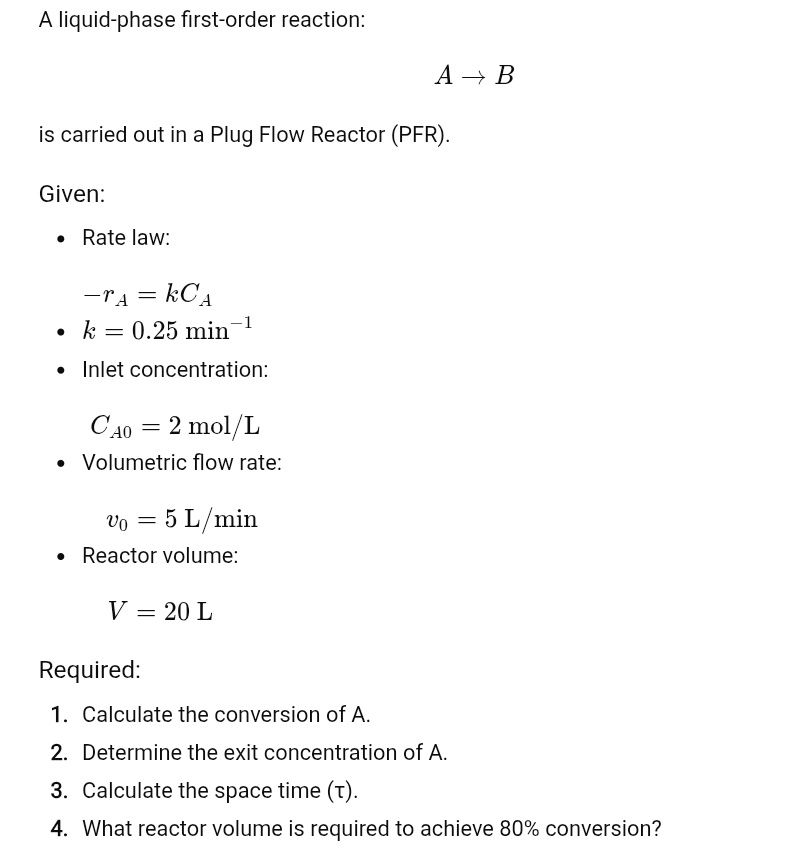 A liquid-phase first-order reaction:
A— B
is carried out in a Plug Flow Reactor (PFR).
Given:
« Rate law:
—ry=kCy
+ k=0.25 min"
+ Inlet concentration:
C40 =2mol/L
+ Volumetric flow rate:
vo = 5 L/min
+ Reactor volume:
V=20L
Required:
1. Calculate the conversion of A.
2. Determine the exit concentration of A.
3. Calculate the space time (1).
4. What reactor volume is required to achieve 80% conversion?
This is AI generated Response.
Asked by: Francis
Created at: 2026-03-02 12:57:40
Asked by: Francis
Created at: 2026-03-02 12:57:40
Final Answer:
Rendered
Raw Text
Did you like this answer?
# Step-by-Step Solution
Let's solve each part of the question systematically for the first-order reaction in a Plug Flow Reactor (PFR).
## **Given Data**
- Reaction: \( A \rightarrow B \)
- Rate law: \( -r_A = kC_A \)
- Rate constant: \( k = .25\, \text{min}^{-1} \)
- Inlet concentration: \( C_{A} = 2\, \text{mol/L} \)
- Volumetric flow rate: \( v_ = 5\, \text{L/min} \)
- Reactor volume: \( V = 20\, \text{L} \)
---
## **1. Calculate the Conversion of A (\(X\))**
For a first-order reaction in a PFR, the design equation is:
\[
\int_{C_{A}}^{C_A} \frac{dC_A}{-r_A} = \frac{V}{v_}
\]
Substitute the rate law \( -r_A = kC_A \):
\[
\int_{C_{A}}^{C_A} \frac{dC_A}{kC_A} = \frac{V}{v_}
\]
\[
\frac{1}{k}\int_{C_{A}}^{C_A} \frac{dC_A}{C_A} = \frac{V}{v_}
\]
\[
\frac{1}{k} \ln\left(\frac{C_A}{C_{A}}\right) = \frac{V}{v_}
\]
\[
\ln\left(\frac{C_A}{C_{A}}\right) = k \frac{V}{v_}
\]
\[
\frac{C_A}{C_{A}} = \exp\left(-k \frac{V}{v_}\right)
\]
\[
X = 1 - \frac{C_A}{C_{A}}
\]
Plug in the values:
\[
k = .25\, \text{min}^{-1}, \quad V = 20\, \text{L}, \quad v_ = 5\, \text{L/min}
\]
\[
k \frac{V}{v_} = .25 \times \frac{20}{5} = .25 \times 4 = 1
\]
\[
\frac{C_A}{C_{A}} = e^{-1} = .3679
\]
\[
X = 1 - .3679 = .6321
\]
**Final Answer (1):**
The conversion of A is **.632** (or **63.2%**).
---
## **2. Determine the Exit Concentration of A (\(C_A\))**
\[
C_A = C_{A} \cdot (1 - X)
\]
But from above,
\[
C_A = C_{A} \cdot e^{-kV/v_}
\]
\[
C_A = 2 \cdot .3679 = .7358\, \text{mol/L}
\]
**Final Answer (2):**
The exit concentration of A is **.736 mol/L**.
---
## **3. Calculate the Space Time (\(\tau\))**
Space time is defined as:
\[
\tau = \frac{V}{v_}
\]
Given:
\[
V = 20\, \text{L}, \quad v_ = 5\, \text{L/min}
\]
\[
\tau = \frac{20}{5} = 4\, \text{min}
\]
**Final Answer (3):**
The space time (\(\tau\)) is **4 min**.
---
## **4. Reactor Volume Required for 80% Conversion (\(X = .80\))**
Let \( X = .80 \), so \( \frac{C_A}{C_{A}} = 1 - X = .20 \).
For a first-order PFR:
\[
\frac{C_A}{C_{A}} = e^{-kV/v_}
\]
\[
.20 = e^{-kV/v_}
\]
Take the natural log on both sides:
\[
\ln(.20) = -kV/v_
\]
\[
-1.6094 = -kV/v_
\]
\[
kV/v_ = 1.6094
\]
\[
V = \frac{1.6094 \cdot v_}{k}
\]
\[
V = \frac{1.6094 \cdot 5}{.25} = \frac{8.047}{.25} = 32.19\, \text{L}
\]
**Final Answer (4):**
The reactor volume required for 80% conversion is **32.2 L**.
---
## **Summary Table**
| Part | Quantity | Value |
|------|---------------------------------|-----------------|
| 1 | Conversion of A (\(X\)) | .632 (63.2%) |
| 2 | Exit concentration (\(C_A\)) | .736 mol/L |
| 3 | Space time (\(\tau\)) | 4 min |
| 4 | Volume for 80% conversion (\(V\))| 32.2 L |
📢 Instructions:
- Ask anything relatd to above question only.
- For new Question goto :