VIPSolutions logo ✨ VIPSolutions

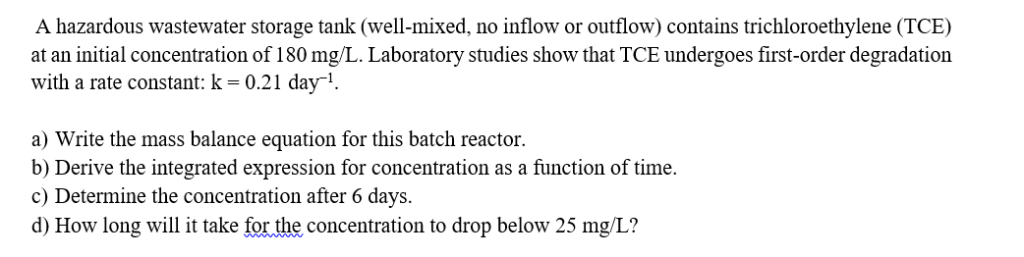
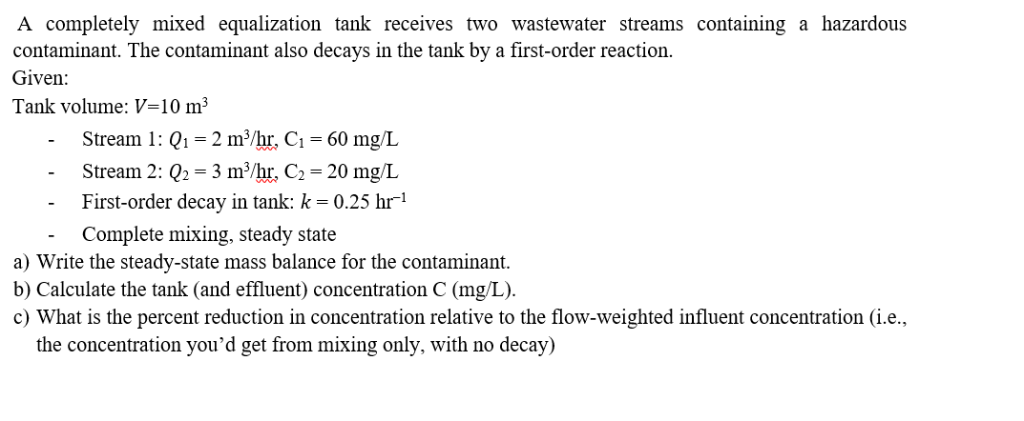
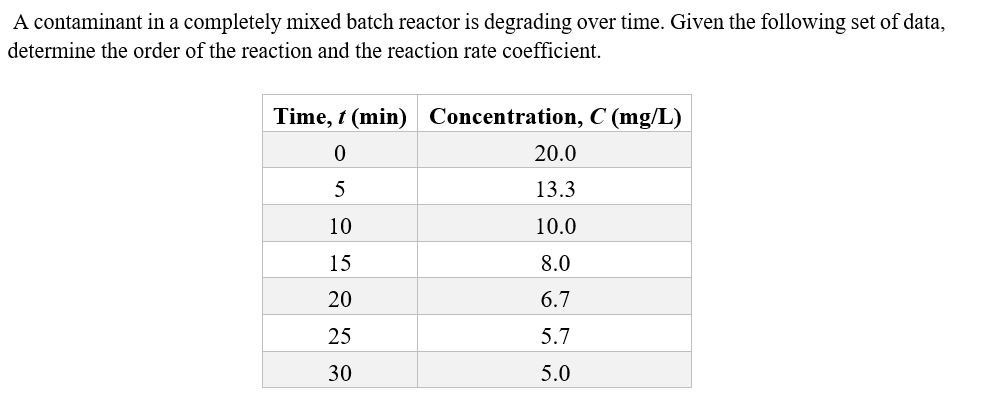
Give step-by-step solution with explanation and final answer:A contaminant in a completely mixed batch reactor is degrading over time. Given the following set of data, determine the order of the reaction and the reaction rate coefficient. Time, 7 (min) Concentration, C (mg/L) 0 20.0 5 13.3 10 10.0 15 8.0 20 6.7 25 5.7 30 5.0 A hazardous wastewater storage tank (well-mixed, no inflow or outflow) contains trichloroethylene (TCE) at an initial concentration of 180 mg/L. Laboratory studies show that TCE undergoes first-order degradation with a rate constant: k = 0.21 day’. a) Write the mass balance equation for this batch reactor. b) Derive the integrated expression for concentration as a function of time. ¢) Determine the concentration after 6 days. d) How long will it take for the concentration to drop below 25 mg/L? A completely mixed equalization tank receives two wastewater streams containing a hazardous contaminant. The contaminant also decays in the tank by a first-order reaction. Given: Tank volume: V=10 m* - Stream 1: Q; =2 mht, C1 = 60 mg/L - Stream 2: Q> = 3 m¥hr, C; =20 mg/L - First-order decay in tank: k = 0.25 hr! - Complete mixing, steady state a) Write the steady-state mass balance for the contaminant. b) Calculate the tank (and effluent) concentration C (mg/L). ©) What is the percent reduction in concentration relative to the flow-weighted influent concentration (i.e., the concentration you'd get from mixing only, with no decay)

Question:

Give step-by-step solution with explanation and final answer:Uploaded ImageUploaded ImageUploaded ImageA contaminant in a completely mixed batch reactor is degrading over time. Given the following set of data, determine the order of the reaction and the reaction rate coefficient. Time, 7 (min) Concentration, C (mg/L) 0 20.0 5 13.3 10 10.0 15 8.0 20 6.7 25 5.7 30 5.0 A hazardous wastewater storage tank (well-mixed, no inflow or outflow) contains trichloroethylene (TCE) at an initial concentration of 180 mg/L. Laboratory studies show that TCE undergoes first-order degradation with a rate constant: k = 0.21 day’. a) Write the mass balance equation for this batch reactor. b) Derive the integrated expression for concentration as a function of time. ¢) Determine the concentration after 6 days. d) How long will it take for the concentration to drop below 25 mg/L? A completely mixed equalization tank receives two wastewater streams containing a hazardous contaminant. The contaminant also decays in the tank by a first-order reaction. Given: Tank volume: V=10 m* - Stream 1: Q; =2 mht, C1 = 60 mg/L - Stream 2: Q> = 3 m¥hr, C; =20 mg/L - First-order decay in tank: k = 0.25 hr! - Complete mixing, steady state a) Write the steady-state mass balance for the contaminant. b) Calculate the tank (and effluent) concentration C (mg/L). ©) What is the percent reduction in concentration relative to the flow-weighted influent concentration (i.e., the concentration you'd get from mixing only, with no decay)
This is AI generated Response.
Asked by: venky
Created at: 2026-03-02 08:39:43

Final Answer:

Rendered Raw Text
Did you like this answer?
Let's solve each question **step-by-step**. --- # **Question 1: Determining Reaction Order and Rate Constant** ## **Step 1: Test for Zero, First, and Second Order** ### **Zero Order:** For a zero-order reaction: \[ C = C_ - kt \] Plot **C vs t**. If linear, zero order. ### **First Order:** For a first-order reaction: \[ \ln C = \ln C_ - kt \] Plot **ln(C) vs t**. If linear, first order. ### **Second Order:** For a second-order reaction: \[ \frac{1}{C} = \frac{1}{C_} + kt \] Plot **1/C vs t**. If linear, second order. ## **Step 2: Prepare Data Table** | t (min) | C (mg/L) | ln(C) | 1/C | |---------|----------|----------|-------| | | 20. | 2.996 | .050 | | 5 | 13.3 | 2.587 | .075 | | 10 | 10. | 2.303 | .100 | | 15 | 8. | 2.079 | .125 | | 20 | 6.7 | 1.902 | .149 | | 25 | 5.7 | 1.740 | .175 | | 30 | 5. | 1.609 | .200 | ## **Step 3: Check Linearity** Calculate differences (quick check): - **ln(C) drops nearly linearly with t** (difference per 5 min: about -.20 to -.17). - **1/C increases nearly linearly with t** (difference per 5 min: about +.025). But **ln(C) vs t** is slightly more linear. ## **Step 4: Determine Order** **First-order fits best.** ## **Step 5: Find Rate Constant \( k \)** Use first-order equation with two points: \[ k = \frac{\ln(C_) - \ln(C)}{t} \] Using \( t = , C_ = 20 \), \( t = 30, C = 5 \): \[ k = \frac{\ln(20) - \ln(5)}{30} = \frac{2.996 - 1.609}{30} = \frac{1.387}{30} = .0462\ \text{min}^{-1} \] --- ### **Final Answers (Q1):** - **Order:** First-order - **Rate constant:** \( k = .046\ \text{min}^{-1} \) --- # **Question 2: TCE Decay in Batch Reactor** Given: - \( C_ = 180\ \text{mg/L} \) - \( k = .21\ \text{day}^{-1} \) ## **a) Mass Balance Equation** No inflow/outflow: \[ \frac{dC}{dt} = -kC \] --- ## **b) Integrated Expression** First-order decay: \[ \frac{dC}{dt} = -kC \implies \ln C = \ln C_ - kt \] Or: \[ C = C_ e^{-kt} \] --- ## **c) Concentration After 6 Days** \[ C = 180\, e^{-.21 \times 6} \] \[ C = 180\, e^{-1.26} \approx 180 \times .284 = 51.1\ \text{mg/L} \] --- ## **d) Time to Reach 25 mg/L** \[ 25 = 180\, e^{-.21 t} \] \[ \frac{25}{180} = e^{-.21 t} \] \[ \ln \left(\frac{25}{180}\right) = -.21 t \] \[ \ln(.139) = -.21 t \] \[ -1.971 = -.21 t \] \[ t = \frac{1.971}{.21} = 9.39\ \text{days} \] --- ### **Final Answers (Q2):** a) \(\frac{dC}{dt} = -kC\) b) \(C = C_ e^{-kt}\) c) \(C = 51.1\ \text{mg/L}\) after 6 days d) \(t = 9.4\) days to drop below 25 mg/L --- # **Question 3: Mixed Tank with Two Streams and Decay** Given: - \( V = 10\ \text{m}^3 \) - \( Q_1 = 2\ \text{m}^3/\text{hr},\ C_1 = 60\ \text{mg/L} \) - \( Q_2 = 3\ \text{m}^3/\text{hr},\ C_2 = 20\ \text{mg/L} \) - \( k = .25\ \text{hr}^{-1} \) - Steady state --- ## **a) Steady-State Mass Balance** General steady-state: \[ \text{Input} = \text{Output} + \text{Decay} \] \[ Q_1 C_1 + Q_2 C_2 = (Q_1 + Q_2) C + k V C \] --- ## **b) Solve for \( C \) (Tank/Effluent Concentration)** \[ Q_1 C_1 + Q_2 C_2 = (Q_1 + Q_2 + kV) C \] \[ C = \frac{Q_1 C_1 + Q_2 C_2}{Q_1 + Q_2 + kV} \] Plug in numbers: - \( Q_1 C_1 = 2 \times 60 = 120 \) - \( Q_2 C_2 = 3 \times 20 = 60 \) - \( Q_1 + Q_2 = 5 \) - \( kV = .25 \times 10 = 2.5 \) \[ C = \frac{120 + 60}{5 + 2.5} = \frac{180}{7.5} = 24.\ \text{mg/L} \] --- ## **c) Percent Reduction vs Flow-Weighted Influent** Flow-weighted influent (no decay): \[ C_{mix} = \frac{Q_1 C_1 + Q_2 C_2}{Q_1 + Q_2} = \frac{180}{5} = 36\ \text{mg/L} \] Percent reduction: \[ \%\ \text{reduction} = \frac{36 - 24}{36} \times 100\% = \frac{12}{36} \times 100\% = 33.3\% \] --- ### **Final Answers (Q3):** a) **Mass balance:** \( Q_1 C_1 + Q_2 C_2 = (Q_1 + Q_2 + kV) C \) b) **Tank concentration:** \( C = 24.\ \text{mg/L} \) c) **Percent reduction:** \( 33.3\% \) --- **Let me know if you need any calculations explained in more detail or want to see any plots!**

📢 Instructions:

  • Ask anything relatd to above question only.
  • For new Question goto :

Study Help, Fast Answers

VIPSolutions focuses on clear, step‑by‑step explanations so you can learn quickly. Whether you need an AI‑generated walkthrough or a short hint to get unstuck, each solution is organized for fast reading and easy review later.

Search similar questions, compare approaches, and bookmark the best answers for revision. Our goal is simple: quick, reliable study help that feels natural—not noisy.