 VIPSolutions
Give step-by-step solution with explanation and final answer:| Be Vs hori Spoidaitd | > 0 EO mwa:
Question:
Give step-by-step solution with explanation and final answer: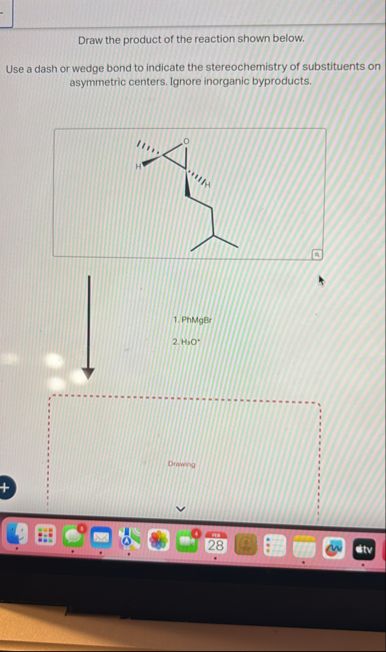 |
Be Vs hori Spoidaitd |
>
0 EO mwa:
This is AI generated Response.
Asked by: Rahul
Created at: 2026-03-01 06:22:14
Asked by: Rahul
Created at: 2026-03-01 06:22:14
Final Answer:
Rendered
Raw Text
Did you like this answer?
Let's break down the reaction step by step.
### **Step 1: Analyze the Starting Material**
- The starting material contains a **cyclic ketone** (indicated by the double-bonded O).
- There are two stereocenters already shown, and the question asks for careful attention to stereochemistry.
### **Step 2: Identify the Reagent**
- The reagents are:
1. **PhMgBr** (Phenylmagnesium bromide, a Grignard reagent)
2. **H₂O** (workup step)
A Grignard reagent adds to the carbonyl carbon of a ketone, forming a **tertiary alcohol**.
### **Step 3: Mechanism**
- The **PhMgBr** acts as a nucleophile and attacks the carbonyl carbon.
- The double bond to oxygen breaks, and the oxygen gets a negative charge.
- After acid workup (H₂O), the oxygen is protonated, forming an alcohol.
### **Step 4: Stereochemistry**
- Addition to the carbonyl carbon creates a new stereocenter.
- Since the attack can happen from either face, both wedge and dash are possible, but usually, we show one product.
### **Step 5: Draw the Product**
- The original carbonyl carbon now has:
- An OH group (from the former C=O)
- A phenyl group (from PhMgBr)
- The rest of the ring (and original substituents)
- **Retain the original stereochemistry of other centers.**
- The newly formed alcohol and phenyl group at the former carbonyl carbon should be shown **one as wedge, one as dash** to reflect the new stereocenter.
---
## **Final Structure**
I'll describe the product clearly:
- The 6-membered ring stays intact.
- The carbon that was double-bonded to O now has:
- An OH group (up or down, let's pick up/wedge)
- A phenyl group (down/dash)
- The rest of the ring and substituents retain their positions.
### **Product Structure**
```
OH (wedge/up)
|
/ \
--C-----C--
/ \
| |
C C
\ /
C---------C
|
Ph (dash/down)
```
- The two original substituents on the ring (**ethyl and methyl**) remain in their places as shown in your starting material.
- The **OH** is on a wedge and **Ph** on a dash at the former carbonyl carbon, or vice versa (depending on the approach of the Grignard reagent).
---
## **Summary Table**
| Step | Reactant/Intermediate | Product/Result |
|-------------------|-------------------------------|-------------------------|
| Starting material | Cyclohexanone derivative | |
| Add PhMgBr | Grignard addition | Tertiary alkoxide |
| Add H₂O | Protonation | **Tertiary alcohol** |
| Stereochemistry | At former C=O carbon: | New stereocenter (OH/Ph)|
---
### **Key Points**
- The product is a **tertiary alcohol**.
- The **phenyl** group and **OH** are added to the carbonyl carbon.
- Use wedge/dash notation to indicate the new stereochemistry.
If you want a detailed drawn structure, let me know!
📢 Instructions:
- Ask anything relatd to above question only.
- For new Question goto :