 VIPSolutions
Give step-by-step solution with explanation and final answer:Problem 6, “a sa Im v, @, j208 0a Find Iz in the circuit of the figure above, given that Vs=25V. Problem 5 BQ 70 j6Q Find the input impedance, Z, of the circuit in the figure above. Problem 4. sO R EE Find is(t) in the circuit, given that vst) = 15cos(5x10%-30°)V, R = 1k, L = 120 mH, and C = 5nF. Problem 3. Transform the following sinusoidal Determine the instantaneous time currents into their phasor functions corresponding to the counterparts: following phasors: (a) in(t) = 10sin(8t+75°) A. (d) Is = 6e3A. at f = 60 Hz (b) a(t) = -17cos(9t-25°) A. (e) Is = -2e™6A. at f = 1 kHz (c) i3(t) = [Bcos(61-45°) - Bsin(6t)] A. (f) Ie = j3A.at f = 1 MHz
Question:
Give step-by-step solution with explanation and final answer: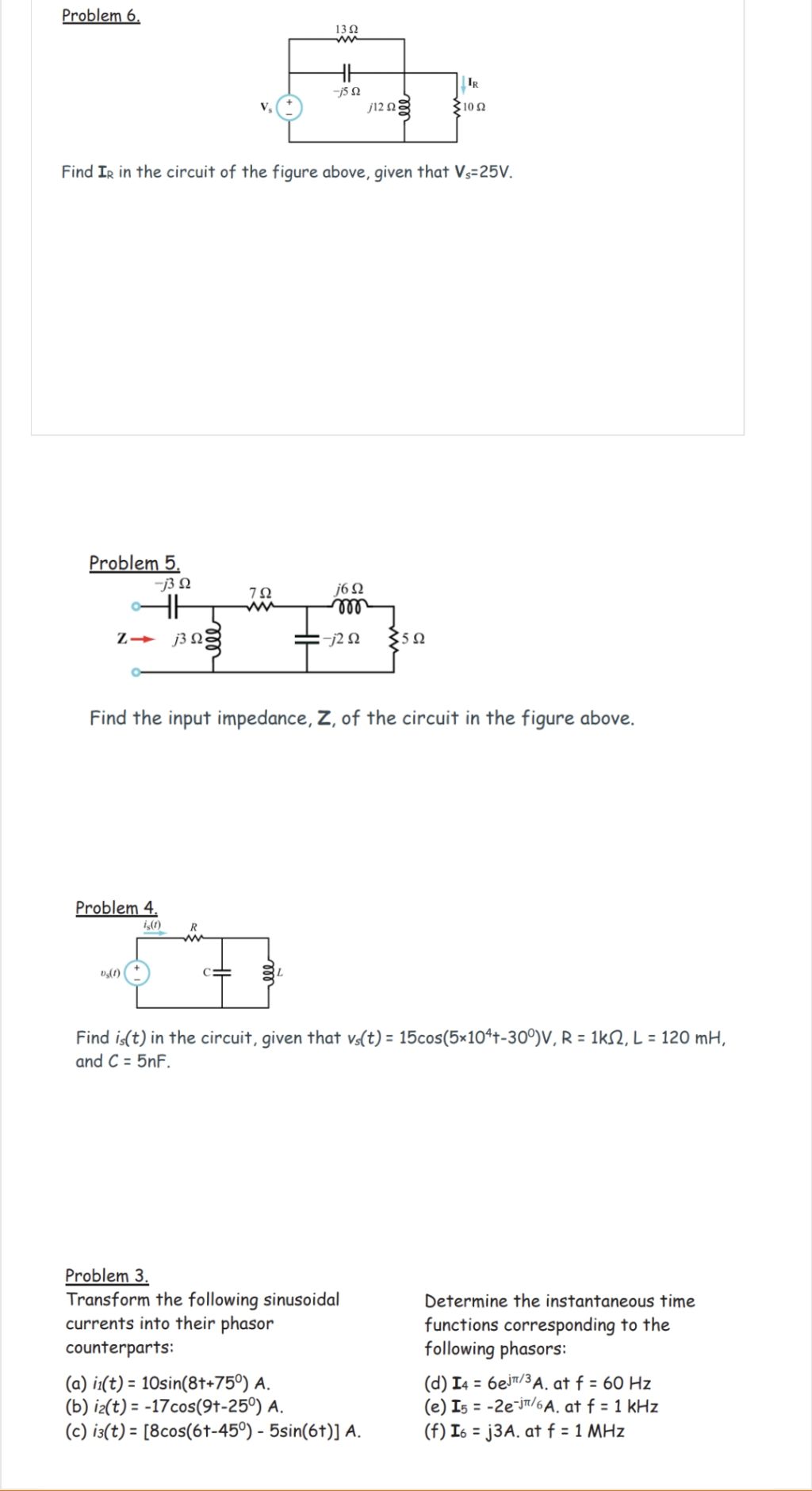 Problem 6, “a
sa Im
v, @, j208 0a
Find Iz in the circuit of the figure above, given that Vs=25V.
Problem 5
BQ 70 j6Q
Find the input impedance, Z, of the circuit in the figure above.
Problem 4.
sO R
EE
Find is(t) in the circuit, given that vst) = 15cos(5x10%-30°)V, R = 1k, L = 120 mH,
and C = 5nF.
Problem 3.
Transform the following sinusoidal Determine the instantaneous time
currents into their phasor functions corresponding to the
counterparts: following phasors:
(a) in(t) = 10sin(8t+75°) A. (d) Is = 6e3A. at f = 60 Hz
(b) a(t) = -17cos(9t-25°) A. (e) Is = -2e™6A. at f = 1 kHz
(c) i3(t) = [Bcos(61-45°) - Bsin(6t)] A. (f) Ie = j3A.at f = 1 MHz
This is AI generated Response.
Asked by: Rahul
Created at: 2026-02-28 04:42:16
Asked by: Rahul
Created at: 2026-02-28 04:42:16
Final Answer:
Rendered
Raw Text
Did you like this answer?
Let's solve **Problem 6** step by step:
---
## **Problem Statement**
Find \( I_R \) in the circuit, given \( V_s = 25\,V \).
**Circuit Elements:**
- Series branch 1: \( 13\,\Omega \) and \( -j5\,\Omega \) (capacitor)
- Series branch 2: \( j12\,\Omega \) (inductor) and \( 10\,\Omega \) (resistor)
- Both branches are in parallel across \( V_s \).
---
## **Step 1: Find Equivalent Impedance of Each Branch**
### **Left Branch (Z1):**
\[
Z_1 = 13 - j5 \quad \Omega
\]
### **Right Branch (Z2):**
\[
Z_2 = (j12 + 10) \quad \Omega = 10 + j12 \quad \Omega
\]
---
## **Step 2: Find Total Impedance \( Z_{total} \) (Parallel Combination)**
\[
\frac{1}{Z_{total}} = \frac{1}{Z_1} + \frac{1}{Z_2}
\]
\[
Z_{total} = \frac{Z_1 Z_2}{Z_1 + Z_2}
\]
First, calculate \( Z_1 + Z_2 \):
\[
Z_1 + Z_2 = (13 - j5) + (10 + j12) = (23 + j7)\,\Omega
\]
Now, calculate \( Z_1 Z_2 \):
\[
Z_1 Z_2 = (13 - j5)(10 + j12)
\]
\[
= 13 \times 10 + 13 \times j12 - j5 \times 10 - j5 \times j12
\]
\[
= 130 + j156 - j50 + 60
\]
\[
= (130 + 60) + (j156 - j50)
\]
\[
= 190 + j106
\]
So,
\[
Z_{total} = \frac{190 + j106}{23 + j7}
\]
---
### **Divide Complex Numbers**
Multiply numerator and denominator by the conjugate of denominator:
Conjugate of \( 23 + j7 \) is \( 23 - j7 \):
\[
Z_{total} = \frac{(190 + j106)(23 - j7)}{(23 + j7)(23 - j7)}
\]
\[
= \frac{190 \times 23 + 190 \times (-j7) + j106 \times 23 + j106 \times (-j7)}{23^2 - (j7)^2}
\]
\[
= \frac{437 - j133 + j2438 - j^2 742}{529 - (-49)}
\]
Recall: \( j^2 = -1 \), so \( -j^2 742 = +742 \):
\[
= \frac{437 + 742 + (-j133 + j2438)}{578}
\]
\[
= \frac{5112 + j1108}{578}
\]
\[
Z_{total} \approx 8.845 + j1.917\ \Omega
\]
---
## **Step 3: Find Current through \( 10\,\Omega \) Resistor (\( I_R \))**
The current \( I_R \) is the current through the right branch (\( Z_2 \)):
\[
I_R = \frac{V_s}{Z_2}
\]
\[
Z_2 = 10 + j12
\]
\[
|Z_2| = \sqrt{10^2 + 12^2} = \sqrt{100 + 144} = \sqrt{244} \approx 15.62\,\Omega
\]
\[
\theta = \arctan\left(\frac{12}{10}\right) \approx 50.19^\circ
\]
\[
I_R = \frac{25}{15.62} \angle -50.19^\circ = 1.601 \angle -50.19^\circ \text{ A}
\]
---
### **Express in Rectangular Form**
\[
I_R = 1.601 \times (\cos(-50.19^\circ) + j \sin(-50.19^\circ))
\]
\[
\cos(-50.19^\circ) \approx .6402, \quad \sin(-50.19^\circ) \approx -.7682
\]
\[
I_R \approx 1.601 \times .6402 + j (1.601 \times -.7682)
\]
\[
I_R \approx 1.025 - j1.229\ \text{A}
\]
---
## **Final Answers**
\[
\boxed{
I_R = 1.60 \angle -50.2^\circ\ \text{A} \quad \text{or} \quad I_R = 1.03 - j1.23\ \text{A}
}
\]
---
**Summary of Steps:**
1. Identify and label all impedances.
2. Combine impedances for parallel circuit.
3. Compute total impedance.
4. Calculate branch current \( I_R \) using Ohm's Law.
5. Give final answer in both polar and rectangular form.
If you need the answers to the other problems, let me!
📢 Instructions:
- Ask anything relatd to above question only.
- For new Question goto :